Project Background: Creating a Cardboard Floor Display that Balances Brand Identity with Merchandising Needs
In the second quarter of 2025, ONE PLUS DISPLAY (Shenzhen) received a custom request from a cosmetics brand. The client planned to use cardboard floor displays in their retail stores to showcase skincare products, aiming to enhance product presentation through a design with strong brand recognition and an efficient layout, while also accommodating multi-level product placement.
Initially, the client specified dimensions of 60×60 cm for the display unit. Through further consultation, both parties engaged in in-depth discussions regarding the available display space, overall proportions, structural design, and the specific retail environment in which the units would be used.
The client set high standards for both the visual appearance of the displays and the project delivery timeline. The core challenge for this project was to satisfy the brand’s visual requirements while simultaneously ensuring optimal merchandising space, structural stability, and suitability for the intended retail environment.
Requirement Consultation: Defining Display Space and Functional Needs
During the initial project discussions, the ONE PLUS DISPLAY team focused on understanding the client’s product display requirements, in-store usage scenarios, and design specifications. The planning process centered on the following key areas:
1. Brand Image Presentation: Designing the visuals for the display rack based on the client’s brand identity requirements to ensure that the product presentation aligns with the overall brand image.
2. Multi-Tiered Layout: Planning an efficient shelf structure tailored to the specific display needs of skincare products, maximizing the use of available space.
3. Structural and Dimensional Optimization: Balancing functional display requirements with considerations for the rack’s overall proportions, stability, and practical usage needs.
4. Timeline Coordination: Addressing the client’s urgent project deadline by ensuring seamless transitions across all stages—from design approval and prototyping to production and packaging.
Through initial consultations, the project team established the core objectives for this custom project: to create a display rack that offers a compelling visual presentation, features a structure perfectly suited to the products being displayed, and ensures a smooth process for mass production and final delivery.
Customized Solutions: Optimizing Dimensions and Structural Design
To meet the client’s requirements, ONE PLUS DISPLAY provided an end-to-end customized service for this project—encompassing structural and aesthetic design, prototyping, production, and logistics coordination.
1. Adjusting Display Stand Dimensions and Optimizing Overall Layout
During the prototyping phase, the project team refined the initial design by considering the overall proportions of the display stand alongside specific product presentation requirements.
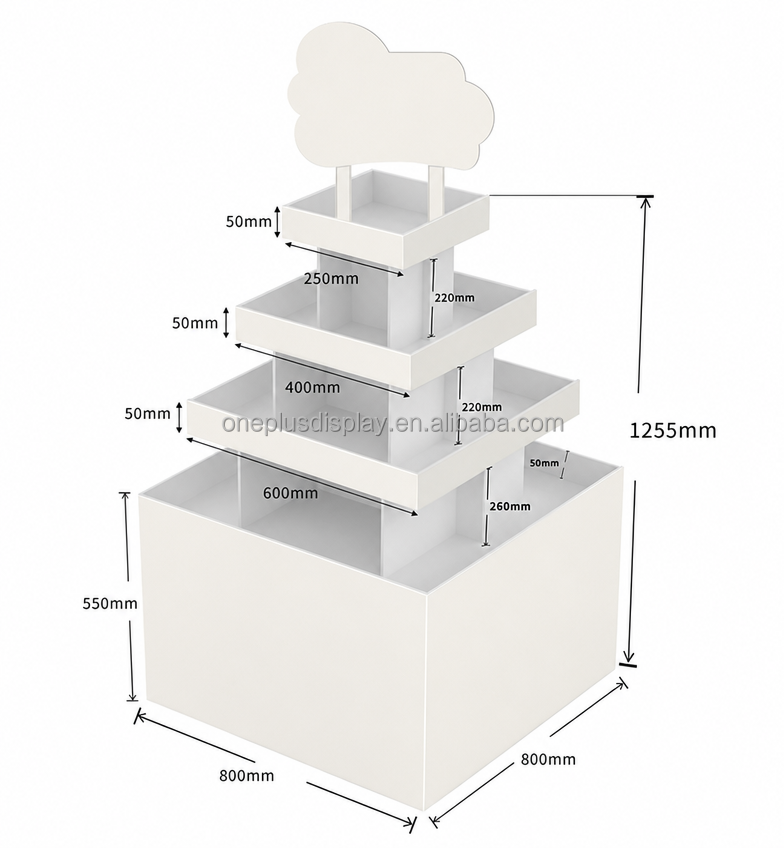
The dimensions of the display stand were adjusted from the originally considered 100 × 100 × 170 cm to a final, optimized size of 80 × 80 × 170 cm. This revised design accommodates multi-level product display while ensuring the overall dimensions align more effectively with the project’s practical planning requirements.
The final specifications for the display stand are as follows:
Product Type: Paper-based floor display unit (FSDU)
Finished Dimensions: 80 × 80 × 170 cm
Display Configuration: Four-tier shelving
Graphic Design: Double-sided header, designed for brand visual presentation
Base Structure: Includes a moisture-resistant base support
Primary Materials: Corrugated cardboard, paper tubes, and KT board (foam board)
Through prototyping and dimensional adjustments, the project team finalized the structural design, laying the groundwork for subsequent mass production.
2. Addition of a Moisture-Resistant Base and Corner Protectors
Given that the display rack is intended for long-term use in retail environments equipped with air conditioning, the client requested features to ensure moisture resistance at the base and comprehensive protection for the unit as a whole.
To address these requirements, the project team enhanced the original structure by incorporating a moisture-resistant base and adding corner protectors, providing extra safeguarding for the bottom of the display rack and other vulnerable areas.
This structural optimization highlights the importance of custom display rack design: beyond aesthetics and merchandising functionality, it is essential to consider the actual operating environment and implement targeted design solutions for parts susceptible to damage or wear.
3. Balancing Visual Presentation with Mass Production
Once the structural design is finalized, the team simultaneously advances brand visual design, material recommendations, and production process planning.
From graphic printing and substrate processing to the installation of components and final assembly, every stage is executed in alignment with the approved design, ensuring consistency across the product’s appearance, structure, and manufacturing requirements.
Production and Quality Control: Ensuring Seamless Coordination Across All Stages
Once the proposal is confirmed, the project enters the formal production phase. This order consists of 800 units, with a production process that includes printing, die-cutting, material processing, component installation, assembly, and packaging.
To ensure that the mass-produced items remain consistent with the approved samples, ONE PLUS DISPLAY focuses on the following key areas throughout production and prior to shipment:
Sample Verification: The approved sample and design proposal serve as the definitive benchmarks for mass production.
Structural Inspection: Each structural component is evaluated for processing quality and assembly status.
Load-Bearing Testing: The display structure undergoes load-bearing tests to ensure it meets the requirements for its intended display use.
Pre-Shipment Inspection: Finished products are thoroughly inspected to minimize any potential issues regarding appearance, structure, or assembly.
Packaging: Each unit is flat-packed to facilitate efficient transportation and on-site assembly.
Throughout the mass production process, the project team maintains seamless coordination between production stages and conducts rigorous quality checks, ensuring that all 800 units are manufactured in strict accordance with the final approved proposal.
Project Delivery: 800 Display Units Delivered as Scheduled
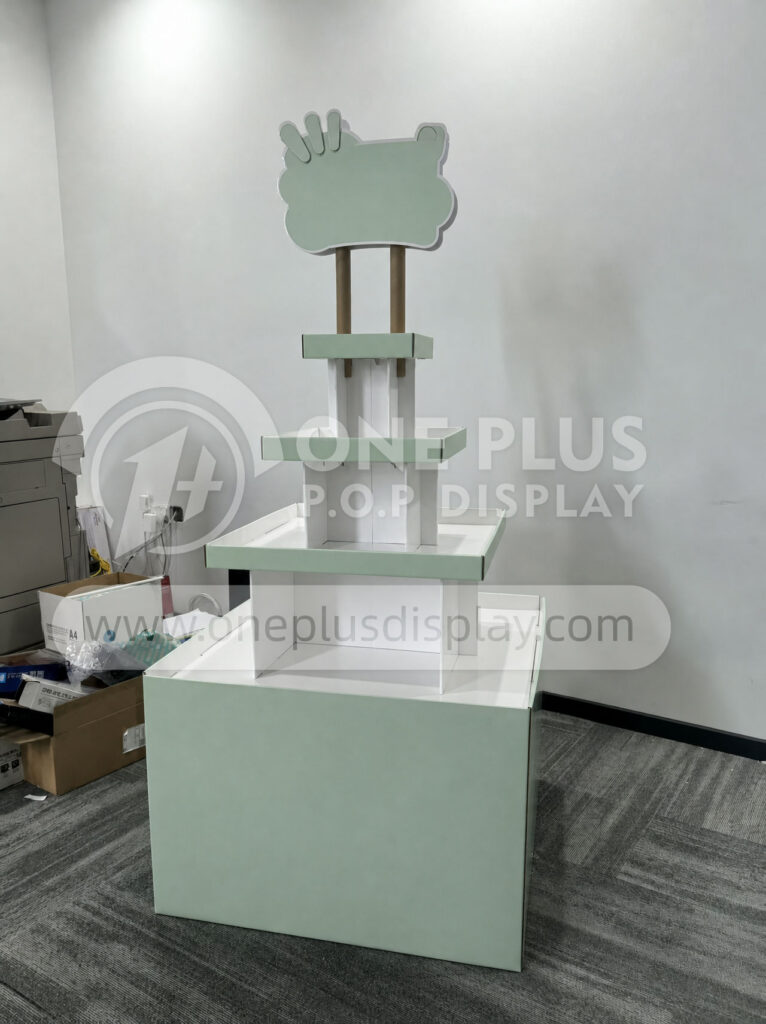
Following design confirmation, prototype refinement, mass production, and pre-shipment inspection, the project—comprising 800 paper-based floor display units—was successfully manufactured and delivered. The units have passed client inspection and are now in use at retail locations.
Given the specific characteristics of the products, the team utilized a flat-pack approach for individual units, coordinated with logistics arrangements to ensure successful delivery.
The project encompassed several stages—from initial requirements gathering to final shipment—including dimensional adjustments, structural optimization, material selection, mass production, and packaging and transport. Through seamless coordination across all phases, the project successfully met its delivery objectives.
Project Outcome: Client Approval and Follow-up Orders
The successful completion of this project is reflected not only in the bulk delivery of 800 display units but also in the critical importance of structural design, quality control, and seamless delivery coordination in custom display projects.
Upon completion, the client confirmed that the products met all requirements and praised the timeliness of the delivery, subsequently placing an additional order for 300 units.
For custom display projects, a follow-up order serves as a positive endorsement of the initial collaboration and product delivery. It further underscores the importance of excellence at every stage—from requirement gathering and design conceptualization to production and final delivery.
Case Summary: Professional Customization Tailored to Specific Display Needs
From initial discussions on dimensions and design refinements during the prototyping phase to the integration of moisture-resistant bases and protective corner guards, ONE PLUS DISPLAY ensured that every aspect of the project aligned with the client’s specific merchandising requirements.
This project—a cardboard floor display for a cosmetics brand—highlights our capabilities in the following areas:
Structural Design and Optimization: Adjusting dimensions and structural configurations to meet product display requirements.
Personalized Customization: Developing bespoke display graphics and layout solutions that reflect the brand’s visual identity.
Detail-Oriented Design: Optimizing the base with moisture-resistant features and protective elements suited to the intended environment.
Mass Production and Quality Control: Managing the production, inspection, and delivery of 800 units.
Project Coordination and Logistics: Overseeing the entire process, including prototyping, manufacturing, packaging, and shipping.