














Aisle-Side Selling: When Headlight Boxes Need Their Own Real Estate
A customer walks into an auto parts store looking for an H11 LED conversion kit. The counter area is packed with hanging blister packs. The wall behind the register has fog light bulbs stacked three deep on wire racks. Nothing is labeled clearly, and the clerk is busy. That customer will either ask for help or leave. A dedicated floor stand changes that dynamic entirely: it puts the product in the aisle, at eye level, with printed selling points on the shelf lips, and a header card that says exactly what the product does.
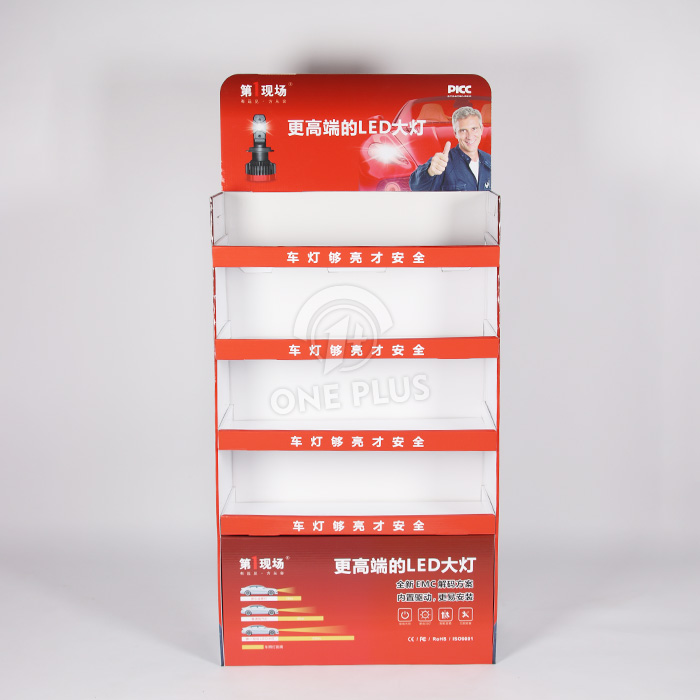
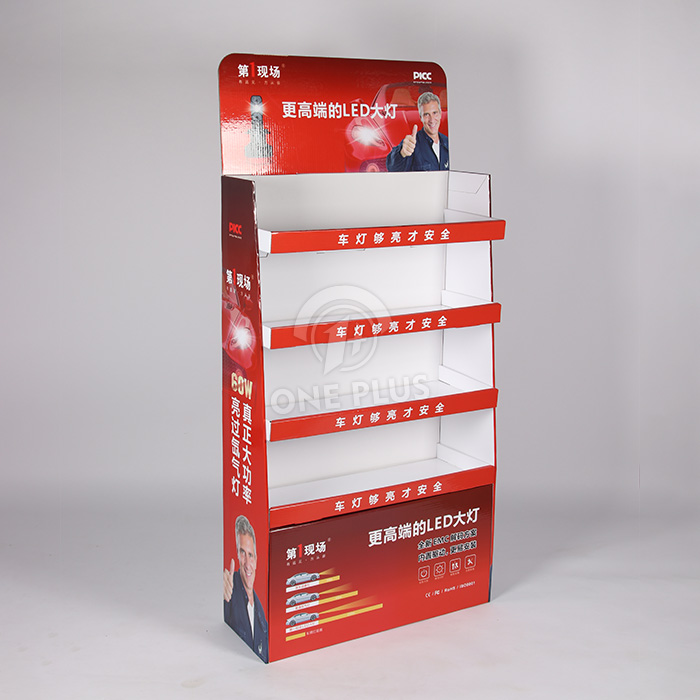
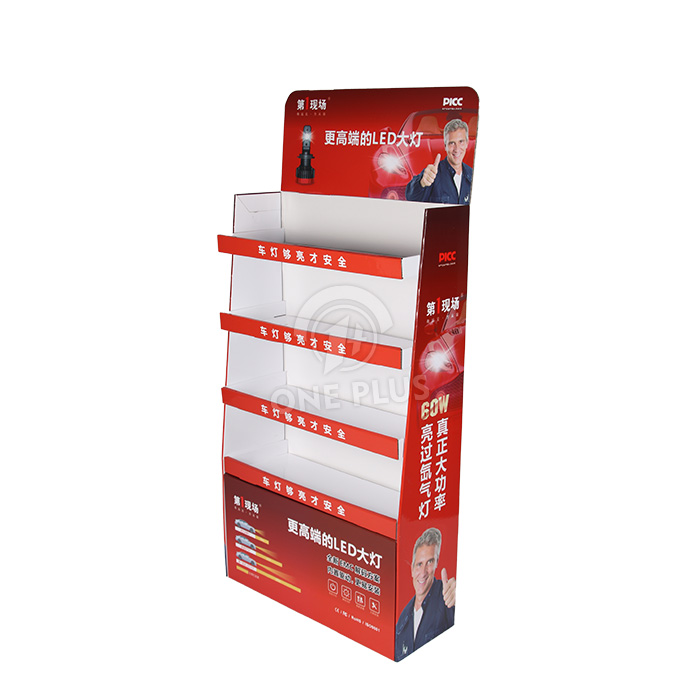
This page covers a specific build: a four-tier floor-standing display made from reinforced corrugated board with plastic clip-lock shelves, designed to hold boxed automotive LED headlight kits. It is not a generic shelf. It is a merchandising tool that solves a real problem in electronics and auto accessory retail — heavy product, limited counter space, and a need for brand visibility that survives daily handling.
Below you will find the engineering logic, material options, customization workflow, and practical deployment scenarios for this display format. If you are sourcing POP displays for an auto lighting brand or a retail chain, this will give you the technical context to specify the right unit.
Why a Floor Stand Beats Counter or Shelf Placement for LED Headlights
Auto accessory retail has a structural problem: the highest-margin products are often the hardest to display well. LED headlight conversion kits come in boxes that are wider and heavier than typical blister packs. They do not hang well on pegboard. They do not fit neatly on standard slatwall hooks. And they are too valuable to bury on a bottom shelf where customers cannot see the branding.
A free-standing floor display solves this by creating a self-contained merchandising zone. You control the height, the angle, the messaging, and the product density. For an auto parts store, this means the brand gets a dedicated footprint without requiring permanent fixture installation. For the retailer, it means a display that arrives flat, assembles in minutes, and can be repositioned as seasonal inventory changes.
The format also fits the purchasing behavior of the category. LED headlight buyers are often making a considered purchase — they want to compare color temperature, lumen output, and warranty terms. A multi-tier display lets you organize by SKU family, with the most popular fitments at eye level and related products like fog lights or spare bulbs on lower tiers. The shelf lips carry short benefit statements (“Safe,” “Bright,” “Long Life”) that answer the first question a customer asks before they pick up a box.
Compared to a free standing display unit made from metal or wire, a corrugated floor stand offers faster setup, lower tooling cost, and full-surface print coverage. You are not limited to a single brand color on a powder-coated frame. The entire side panel and header can carry photography, gradients, and regulatory text.
Structural and Engineering Decisions Behind the Clip-Lock Shelf
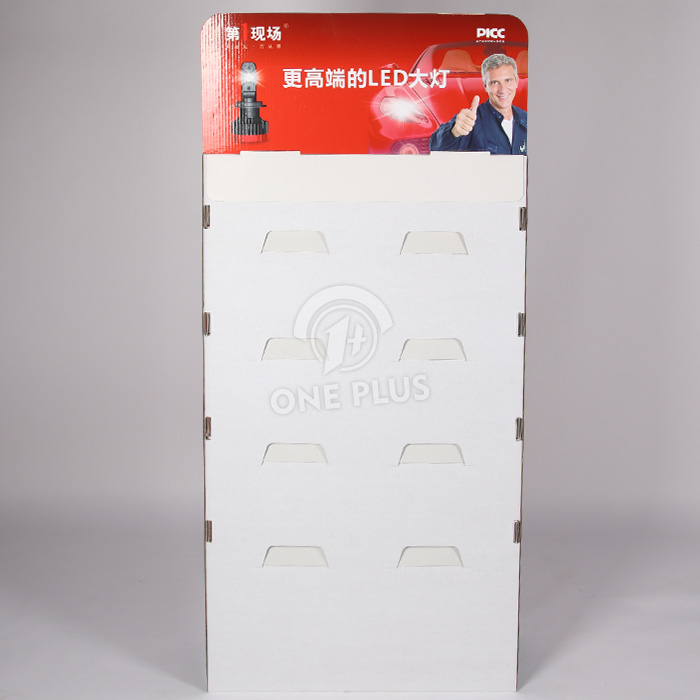
The defining mechanical feature of this display is the plastic sliding clip — often called a corrugated clip or shelf buckle. These clips are inserted through aligned slots in the shelf panel and the side wall, then rotated or slid into a locked position. The result is a mechanical joint that resists downward force far better than a friction-fit cardboard tab.
Why does this matter for LED headlights? A single boxed H4 LED kit might weigh between 0.5 kg and 1.2 kg depending on heatsink design and packaging. A shelf holding eight to ten units can exceed 10 kg. Over weeks of stocking and restocking, a glued or tabbed shelf will begin to bow, delaminate, or drop. The plastic clip distributes that load across the side wall and prevents shelf deflection.
During engineering, we consider three load paths: vertical compression on the shelf panel, shear force at the clip-to-sidewall interface, and lateral stability of the overall stand. The clip-lock design addresses the first two. For lateral stability, the base footprint and the number of tiers are adjusted together — a taller stand needs a deeper base or an angled back panel to resist tipping when customers pull product from the top shelf.
Shelf angle is another decision point. A flat shelf is easier to load and works well for large boxes. A slightly angled shelf improves visibility of the top panel artwork and encourages browsing. Many auto lighting brands choose a hybrid: flat lower tiers for heavier inventory, angled upper tiers for hero SKUs. The clip system allows the same side wall to accept both configurations if the slot pattern is designed accordingly.
Materials and Finishing Options
The primary structure is built from corrugated board selected for compression strength and print quality. For a four-tier stand holding auto parts, we typically specify a double-wall or heavy single-wall grade, depending on the total load per shelf and the number of units per display. The flute direction is oriented vertically in the side walls to maximize stacking strength.
Surface finishing affects both durability and shelf presence. A glossy lamination or UV coating protects the print from scuffing during transit and in-store handling. For auto parts environments, where displays may be wiped down or exposed to temperature shifts, a matte or satin aqueous coating can be a better choice because it resists fingerprints and does not show fine scratches as readily.
Plastic clips are injection-molded from a durable polymer — typically polypropylene or nylon — selected for flex fatigue resistance. They are reusable across multiple display cycles if the corrugated components are replaced.
While this page focuses on a corrugated build, the same structural concept can be executed in other materials when the application demands it:
- PVC foam board: Offers a smoother, more rigid surface than corrugated and is naturally moisture-resistant. Suitable for permanent or semi-permanent fixtures in humid environments or outdoor-adjacent locations.
- Acrylic: Provides a premium, glass-like appearance for high-end electronics or showroom settings. Acrylic shelves can be machined to accept metal or plastic clips and are easier to clean than corrugated.
- Hybrid construction: Corrugated side walls with PVC foam shelves, or a corrugated body with an acrylic header, can balance cost and perceived quality.
Printing options range from 4C CMYK offset for photographic artwork to direct digital printing for short runs or versioned campaigns. Lamination can be gloss, matte, or soft-touch. All dimensions — width, depth, height, shelf spacing, and clip position — are customizable within the structural limits of the chosen material.
Merchandising Strategy and Retail Placement
Where the display sits determines how it performs. For auto parts stores, the highest-traffic location is typically the main aisle between the counter and the service bay entrance, or the endcap facing the checkout queue. A four-tier floor stand with a tall header card works in both positions because it creates a vertical brand block that interrupts the visual clutter of wire racks and pegboard.
Product arrangement follows a simple hierarchy. The top shelf holds the newest or highest-margin SKU — the one you want customers to see first. The second shelf holds the most popular fitments (often H11, 9005, or H4). The third shelf carries related products: fog light bulbs, load resistors, or CANbus adapters. The bottom shelf is for bulk or promotional packs, or for spare inventory that staff can restock from without bending.
Printed shelf lips serve as silent salespeople. Instead of a generic price tag, each lip can carry a short benefit statement, a compatibility note (“Fits H11/H8/H9”), or a QR code linking to an installation video. This is a form of pretty darn quick (PDQ) merchandising — the display itself does the initial selling, reducing the burden on store staff.
The header card is the largest single message area. It should carry the brand logo, a product category statement, and one strong visual. Avoid cramming multiple messages; the header is read from ten to fifteen feet away, so simplicity wins.
Customization and Production Workflow
Every display project follows a structured path from brief to bulk production. The process is designed to catch structural issues before tooling or printing begins.
Step 1 — Brief and specification. You provide product dimensions and weights, the number of SKUs, desired shelf count, and any retailer-specific requirements (base footprint, height restrictions, header size). We confirm the material grade and clip type.
Step 2 — Structural design and sample. Our engineering team creates a digital layout and produces a white sample or printed prototype. You test assembly, load the shelves with actual product, and check shelf visibility. Adjustments to shelf angle, clip position, or header height are made at this stage.
Step 3 — Artwork and prepress. Once the structure is approved, you supply print-ready artwork or work with our design team to adapt existing brand assets. We provide a dieline template that maps every printable panel, including shelf lips and side panels.
Step 4 — Production and quality check. Bulk production runs on offset or digital presses depending on quantity. Each batch is checked for print registration, die-cut accuracy, and clip fit. Shelves are test-assembled to confirm the clip-lock engages properly.
Step 5 — Packing and shipping. Displays are flat-packed in master cartons with clips bagged separately. Assembly instructions are included. Cartons are labeled with SKU, quantity, and handling notes.
Minimum order quantities and lead times vary by complexity and material. For standard corrugated builds with plastic clips, typical bulk production runs are measured in weeks, not months. Custom tooling for unique clip designs or non-standard shelf configurations may extend the timeline.
Three Deployment Scenarios
Scenario 1: Auto Parts Chain — Seasonal LED Promotion
A regional auto parts chain runs a spring lighting promotion. They need a display that can be shipped to 40 stores, assembled by store staff without tools, and positioned in the main aisle for eight weeks. The four-tier clip-lock stand arrives flat, assembles in under ten minutes, and holds promotional multi-packs on the bottom two shelves and single kits on the top two. The header card carries the promotional price and a “Limited Time” banner. After the promotion, the display is disassembled and stored for the next campaign.
Scenario 2: Performance Shop — Branded Showroom Corner
A performance tuning shop wants a permanent-looking brand corner without building out custom millwork. They specify a display with a matte lamination, a dark color scheme, and an acrylic header panel for a premium feel. The clip-lock shelves hold high-end LED projector kits and auxiliary lighting. Because the shop environment includes occasional moisture from vehicle wash bays, the corrugated components receive an additional moisture-resistant coating.
Scenario 3: Trade Show — Portable Product Showcase
An LED lighting manufacturer exhibits at an industry trade show. They need a display that ships in a single carton, sets up on a table or floor, and survives three days of heavy foot traffic. The four-tier stand is configured with a narrower base to fit a 10×10 booth space. Shelves are loaded with display-only dummy boxes to reduce weight. The header card includes a QR code linking to a digital catalog. After the show, the display is flat-packed and returned to the warehouse.
Assembly, Packing, and Logistics
Assembly is intentionally tool-free. The side walls fold into position, the base locks into place, and the shelves slide into the pre-cut slots. Plastic clips are inserted through the shelf and side wall, then rotated or slid to lock. The process is repeatable and does not require tape, glue, or staples.
Flat-packing is a major logistical advantage. A fully assembled four-tier floor stand occupies significant cubic volume. Flat-packed, the same display can be shipped in a master carton that is a fraction of the assembled size. This reduces freight cost per unit and allows more displays per pallet. It also means retailers can store backup inventory in the stockroom without dedicating shelf space to empty fixtures.
Master cartons are labeled with product name, quantity, and a handling diagram. Clips are packed in a separate bag inside the carton to prevent loss. Assembly instructions are printed on a single sheet and included in every carton. For multi-store rollouts, we can provide individual carton labeling per store location.
Frequently Asked Questions
Why use plastic clips instead of glue or tabs?
Plastic clips provide a mechanical lock that resists downward force and lateral movement. Glue can fail under sustained load or temperature changes. Cardboard tabs alone can crush or tear when heavy boxes are repeatedly loaded and unloaded. The clip distributes the load across the side wall and keeps the shelf rigid.
Can the shelf spacing be customized?
Yes. Shelf height is determined by the slot pattern cut into the side walls. We can adjust spacing to accommodate tall packaging, short blister packs, or a mix of both. If your product line changes, a new side wall can be produced with a different slot pattern while reusing the same shelves and clips.
What is the typical load capacity per shelf?
Load capacity depends on the corrugated grade, shelf span, and clip placement. For a four-tier auto parts display with plastic clip reinforcement, a practical working range is 15 kg to 20 kg per shelf. We verify capacity during the sampling stage by loading shelves with actual product or weighted test units.
Is the display suitable for outdoor or damp environments?
Standard corrugated board is not moisture-resistant. For damp environments, we recommend a moisture-resistant coating or a switch to PVC foam board for the structural components. PVC foam board offers similar printability and greater dimensional stability in humid conditions.
Start Your Custom Display Project
If you are sourcing a floor display for automotive LED headlights, fog lights, or related electronics, the four-tier clip-lock stand is a proven format. It combines the strength of a permanent fixture with the cost and flexibility of corrugated. Every dimension, print surface, and shelf configuration is customizable.
To move forward, send us your product dimensions, approximate weight per shelf, number of SKUs, and any retailer requirements. We will return a structural recommendation, material options, and a production timeline. You can also review our full range of 골판지 바닥 디스플레이 스탠드 to see how this format fits into a broader retail strategy.
One Plus Display에 문의하기 to request a sample or discuss your next POP display program.