When the Aisle Ends, the Totem Begins
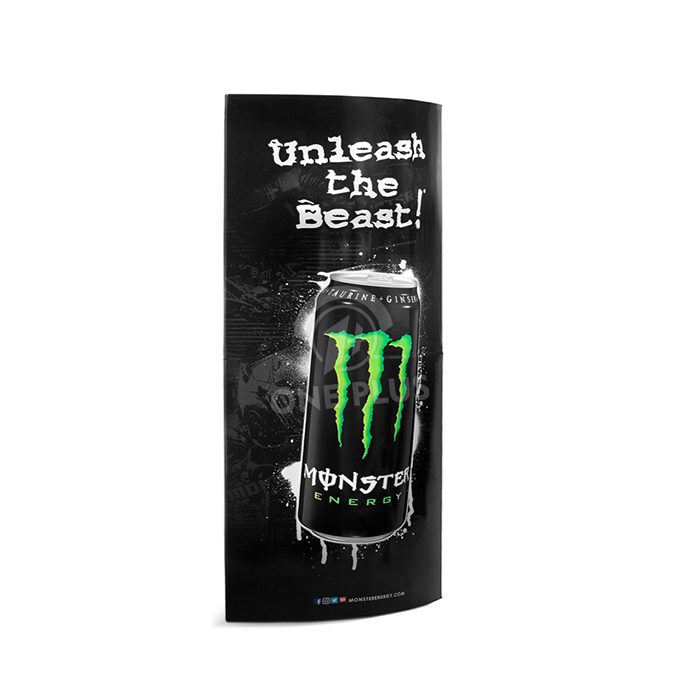
A shopper turns the corner into the beverage aisle, cart already half full, and stops. Not at the shelf, but at a tall, curved pillar rising from the floor, its convex face catching the overhead lighting and throwing a neon energy-drink logo into three-dimensional relief. The can printed on its surface looks cold, beaded with condensation that isn’t real but reads as real from six feet away. That pause is the entire point.
Beverage retail is a contest for a few seconds of attention. Shelf space is crowded, endcaps compete with each other, and the checkout lane is a blur of impulse decisions. A flat poster taped to a shelf edge disappears into the visual noise. A freestanding totem with a convex architectural curve does not. It occupies floor space, creates a physical landmark, and forces shoppers to adjust their path around it.
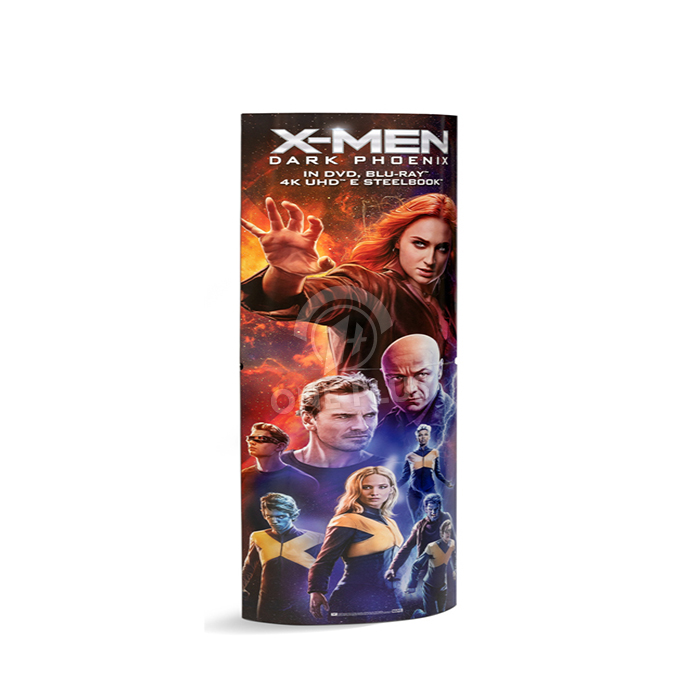
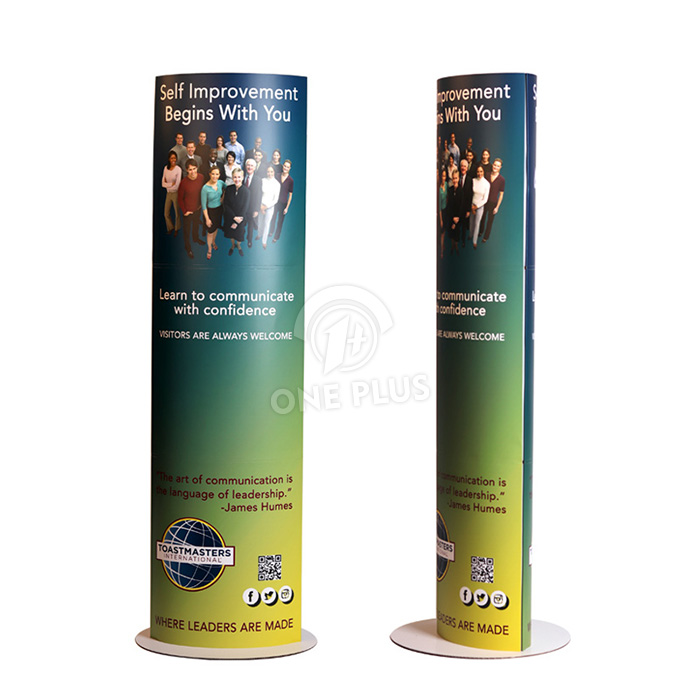
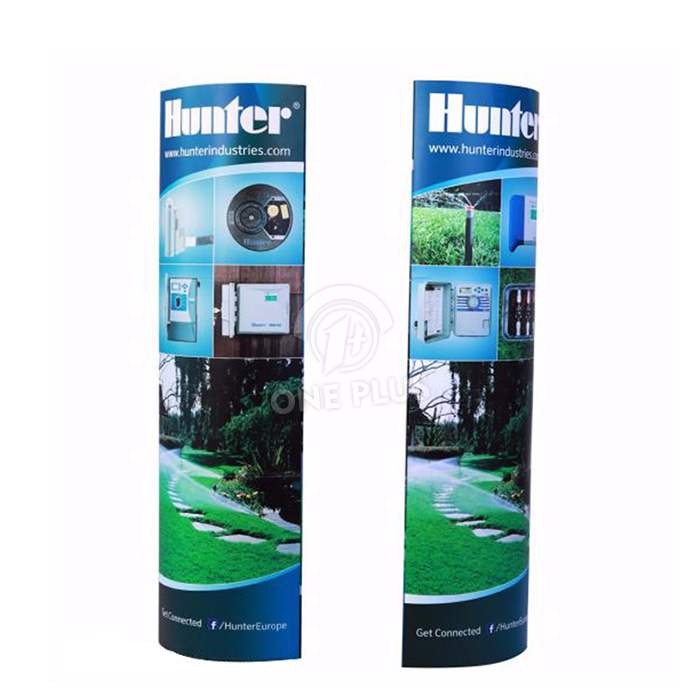
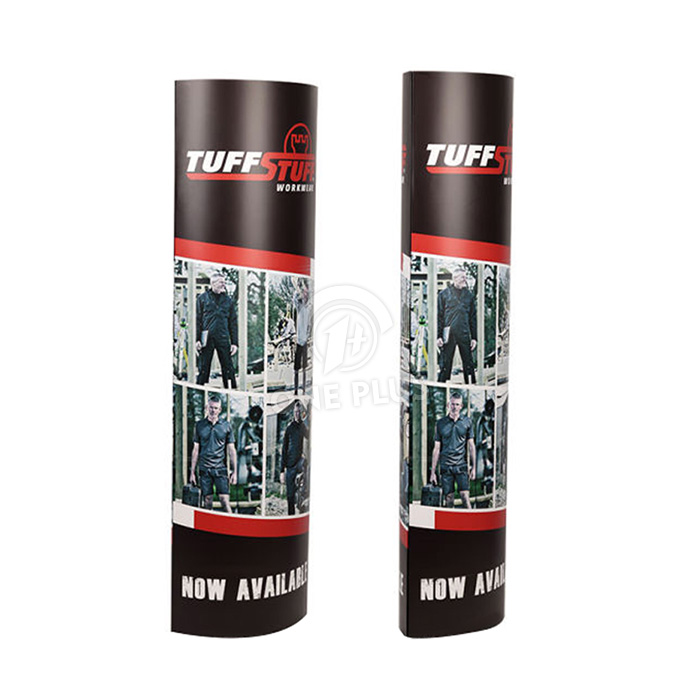
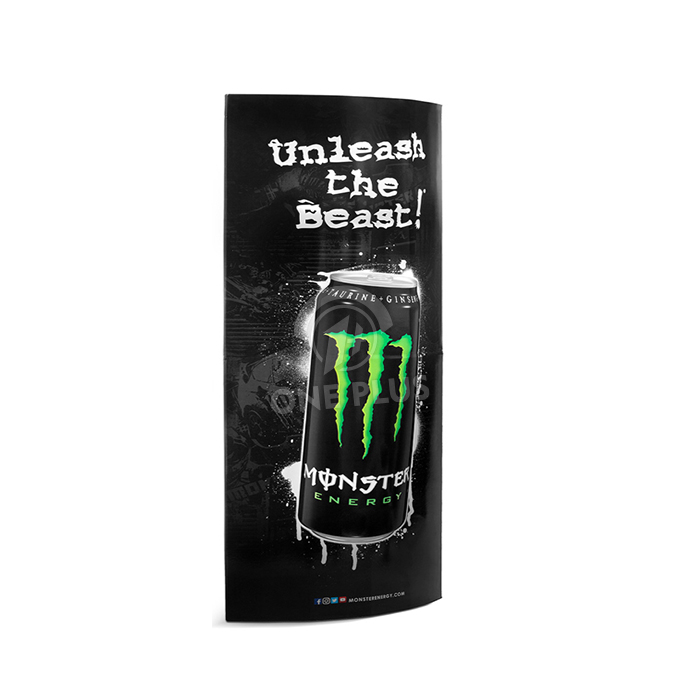
This page covers a custom cardboard totem built for exactly that job: a double-sided convex elliptical floor standee engineered for beverage brand campaigns in supermarkets, convenience stores, and grocery retail environments. It is designed to be printed at high fidelity, shipped flat, and deployed without tools in under a minute.
Why a Convex Totem Outperforms Flat Signage in Beverage Retail
Most beverage promotional signage is planar. Shelf talkers, wobblers, and flat standees all present a single flat surface to the shopper. That works when the shopper is already looking in that direction. It fails when the shopper is navigating, turning corners, or approaching from an angle. A flat panel viewed from 45 degrees compresses into a sliver.
A convex elliptical curve solves this geometrically. Because the surface bows outward, it presents a readable face across a much wider arc of approach. A shopper walking a diagonal path down a main aisle still sees the brand logo and the product rendering at near-full width. The curve also creates a self-shadowing effect: light falls off toward the edges, and the center of the graphic sits in the brightest zone. That natural highlight draws the eye to the product image without any additional lighting.
There is also a psychological dimension. A curved object reads as designed, deliberate, and premium. A flat cardboard cutout reads as disposable. For energy drinks, craft beer launches, and premium mineral water, that distinction matters. The totem is not just holding a message; it is implying something about the product’s positioning.
For brands running multi-store campaigns, the format also solves a practical problem. A convex totem can be placed in the middle of an open floor area without blocking sightlines to shelves behind it, because the curved profile is visually narrower than its footprint. Store managers are more willing to approve placement when the fixture does not create a blind spot.
Structural Engineering: How the Curve Stays Upright
The engineering challenge with any curved floor standee is balance. A flat panel has a predictable center of gravity. A convex ellipse does not, because the mass distribution changes as the panel bows outward. The solution is an internal interlocking framework that anchors the curved panels to a central spine.
Internal Interlocking Framework
The totem uses a series of die-cut internal ribs that slot into a central vertical support. These ribs are cut from the same corrugated board as the outer shell, which keeps the unit lightweight and fully recyclable. The ribs are positioned at calculated intervals along the curve, and their depth increases toward the base to lower the center of gravity. This is not a cosmetic detail; it is what prevents the totem from tipping when a shopper brushes past it in a narrow checkout lane.
Elastic Tension Pop-Up Mechanism
Flat-pack deployment is handled by pre-configured elastic band tensioners running through the internal structure. When the collapsed unit is pulled outward from its flat edges, the elastic bands pull the curved panels into their target elliptical shape. The installer then inserts a top cap and a bottom cap, which lock the geometry in place. The entire process takes seconds and requires no tools, no adhesives, and no instructions beyond a single printed diagram.
Base and Stability Considerations
The base is a separate die-cut assembly that slides into the bottom of the totem. Its width and depth are customizable, but as a rule the base footprint should be wide enough to resist lateral force from foot traffic and cleaning equipment. For high-traffic locations, we can increase the base depth or add internal ballast pockets that accept sandbags or water weights. These are optional, and the correct configuration depends on the floor surface and the expected traffic density.

Materials and Finishing for Beverage Graphics
Beverage branding is unforgiving. Dark backgrounds show every print defect. Neon logos require precise color registration. Condensation and splash effects need smooth gradients to look convincing. The material and finish choices directly determine whether the printed graphic reads as premium or as a cheap approximation.
Corrugated Board Grades
We offer high-rigidity corrugated cardboard in B-flute and E-flute, as well as eco-friendly Flex-KT board. B-flute provides greater thickness and rigidity, which suits taller totems and heavier internal structures. E-flute is thinner and takes a smoother print surface, which benefits fine graphic detail and tight registration. Flex-KT board is a denser, more rigid alternative that resists edge crush and holds a crisp curve over time. The correct grade depends on the totem height, the graphic complexity, and the expected lifespan of the campaign.
Обработка поверхности
Three finishes are available for beverage work. Anti-scratch high-gloss film gives the surface a wet, reflective quality that suits carbonated sodas and energy drinks, and it protects the print from scuffing during transport and handling. Anti-glare matte lamination reduces reflections in brightly lit stores and gives a more restrained, premium feel, which often works better for craft beer and mineral water. Spot UV finish applies a raised gloss only to selected areas, such as the logo or the condensation droplets, creating a tactile contrast against a matte background.
Alternative Substrates
While corrugated cardboard is the standard substrate for this format, the same structural design can be produced in PVC foam board or acrylic for longer-life installations. PVC foam board offers a smoother, more rigid surface and better moisture resistance, making it suitable for freezer-adjacent placements or humid environments. Acrylic provides a high-end, glass-like appearance with excellent light transmission, and is typically specified for permanent or semi-permanent retail fixtures. Both materials increase unit weight and shipping cost, so they are usually reserved for flagship locations or multi-season campaigns.
Merchandising and Retail Placement
The standard configuration functions as a pure advertising billboard: a printed cutout with no product-holding capability. That is often sufficient for brand awareness campaigns, but many beverage promotions need to close the loop and put the product in the shopper’s hand. The totem can be modified with die-cut side shelves, custom tier trays, or plastic dispenser trays integrated into the structure. These additions transform the standee from a sign into a merchandising unit that holds physical cans or bottles.
Placement strategy varies by retail format. In supermarkets, the totem works well at the head of an aisle, near an endcap, or in a designated promotional zone. In convenience stores, the highest-value position is often the checkout lane, where the convex curve can be angled toward the queue. In grocery retail, a pair of totems flanking a promotional pallet creates a frame that draws shoppers into the display area.
The double-sided configuration is important for these placements. A single-sided totem only works when shoppers approach from one direction. A double-sided unit remains readable from both sides of an aisle, which is essential in open floor areas where traffic flows in multiple directions.
Customization and Production Workflow
Every totem is built to order. The process begins with a structural brief: intended placement, traffic conditions, whether the unit needs to hold product, and the desired lifespan. From there, our engineering team produces a die-line that defines the curve radius, the internal rib positions, and the base geometry. The die-line is shared with the client’s design team or our in-house graphics team for artwork placement.
Artwork is prepared for ultra-high-definition industrial offset printing. This process handles intense dark backdrops, vivid neon logos, and realistic condensation or splash effects with consistent color across the full print run. We provide a digital proof and, where required, a physical sample for color approval before mass production.
Production covers die-cutting, printing, lamination, and assembly of the internal components. Each unit is checked for structural fit before packing. Because the totem is designed to ship flat, the finished product is folded and packed in a compact carton that protects the printed surfaces during transit.
Three Concrete Use-Case Scenarios
Energy Drink Launch in a Supermarket Chain
A new energy drink brand plans a national launch across a supermarket chain. The campaign requires a high-impact floor unit that can be placed at the head of the beverage aisle in hundreds of stores. The totem is specified with B-flute corrugated board for rigidity, high-gloss film to emphasize the neon can graphics, and a double-sided convex print. A die-cut side shelf holds single cans for sampling. The flat-pack design allows the chain’s regional distribution centers to store and deploy the units without special handling equipment.
Craft Beer Promotion in a Convenience Store
A regional craft brewery wants to promote a seasonal release in convenience stores with limited floor space. The totem is scaled to a narrower footprint and specified with anti-glare matte lamination to suit the stores’ bright fluorescent lighting. A plastic dispenser tray is integrated at mid-height to hold four-packs, turning the standee into a self-service merchandising point near the checkout lane. The convex curve keeps the brand visible from the queue and from the entrance.
Mineral Water Branding at a Grocery Retail Event
A premium mineral water brand sponsors a grocery retail event and needs a temporary fixture that conveys a clean, high-end image. The totem is produced in E-flute corrugated board with a spot UV finish that highlights the water droplet graphics against a matte background. The unit is placed in pairs flanking a promotional pallet. Because the event runs for a limited time, the flat-pack format allows the brand to ship units to multiple venues and assemble them on-site without tools.
Assembly, Packing and Logistics
The totem ships flat in a compact carton. Assembly follows a fixed sequence: remove the components, pull the collapsed shell outward until the elastic tensioners expand the curve, insert the bottom cap, insert the top cap, and slide the base assembly into position. No tools, adhesives, or special skills are required. The process is designed to be completed by store staff during a normal shift change.
For multi-store campaigns, the flat-pack format significantly reduces shipping volume compared to pre-assembled fixtures. This lowers freight cost and makes it practical to distribute units directly to individual stores rather than routing them through a central warehouse. The cartons are stackable and labeled for easy identification.
Disassembly follows the reverse sequence. The unit folds flat for storage or return, and the corrugated components can be recycled through normal paper streams. For PVC foam board and acrylic versions, the components are durable enough for repeated use across multiple campaign cycles.
Frequently Asked Questions
Можно ли модифицировать этот картонный рекламный щит для напитков, чтобы он мог вмещать настоящие консервированные продукты?
Yes. While the standard model functions purely as a high-impact advertising billboard cutout, we can integrate die-cut side shelves, custom tier trays, or plastic dispenser trays onto the structure. This allows you to display and merchandise physical cans or bottles directly from the standee.
Как автоматическая плоская конструкция раскладывается при установке?
Устройство оснащено внутренними предварительно настроенными механизмами натяжения эластичной ленты. При вытягивании из плоских краев конструкция естественным образом расширяется до целевой эллиптической формы. Просто вставьте верхние и нижние внутренние опорные колпачки, и развертывание будет завершено менее чем за 30 секунд без необходимости использования дополнительных инструментов.
What board grade should I choose for a tall totem?
Taller totems benefit from B-flute corrugated board or Flex-KT board, both of which provide greater rigidity and edge crush resistance. E-flute is better suited to shorter units where print detail is the priority. During the structural brief, we recommend a grade based on the totem height, the base footprint, and the expected traffic conditions.
Can the same design be produced in a material other than cardboard?
Yes. The structural design can be adapted for PVC foam board or acrylic when a longer lifespan, moisture resistance, or a more premium appearance is required. These substrates increase unit weight and shipping cost, so they are typically specified for permanent fixtures or flagship retail locations.
Start Your Beverage Totem Project
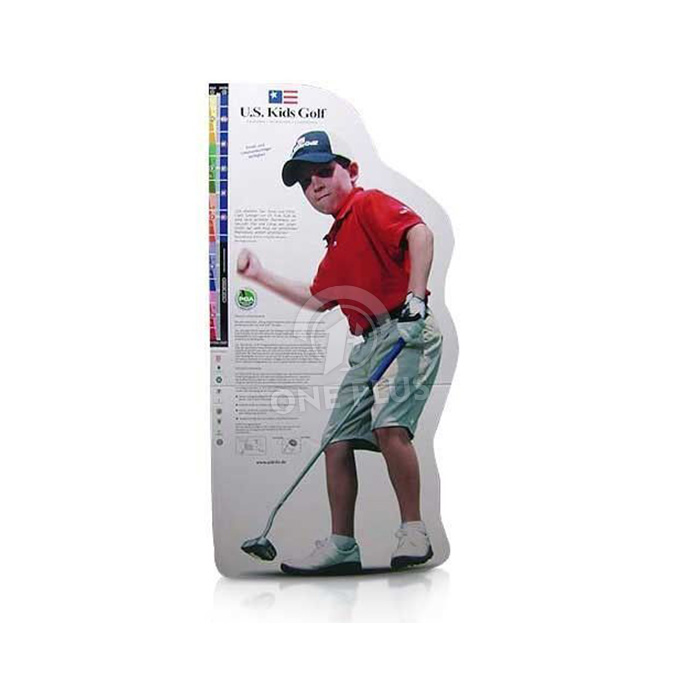
If you are planning a beverage promotion and need a floor display that earns attention in a crowded retail environment, a convex cardboard totem is a format worth evaluating. We produce these units factory-direct, which means the structural engineering, printing, and finishing are handled under one roof. You can review our full range of standee and totem displays for related formats, or look at a square column advertising stand if a straight-edged profile suits your brand better. For campaigns that rely on character or figure-based graphics, our lifesize cardboard character cutout stand shows how the same structural principles apply to a different visual style.
Send us your campaign brief, including the retail environment, the number of stores, and whether the unit needs to hold product. We will return a die-line, a material recommendation, and a production timeline.