When the Bulb Aisle Becomes a Decision Maze
A shopper stands in the lighting aisle holding a dead 60-watt equivalent. She needs a replacement, but the shelf in front of her is a wall of near-identical packages: warm white, daylight, dimmable, 2700K, 5000K, 800 lumens, 1100 lumens. Every box looks the same at arm’s length. She squints, turns a package over, puts it back, and pulls out her phone to search for the spec she actually needs. That pause is where sales leak out of the category.
Light bulbs are a specification purchase disguised as a commodity. The buyer is not browsing for pleasure; they are matching a socket, a color temperature, a brightness level and a dimmer compatibility to a fixture they already own. When the display makes those variables hard to compare, the shopper either defaults to the cheapest box or leaves to buy online.
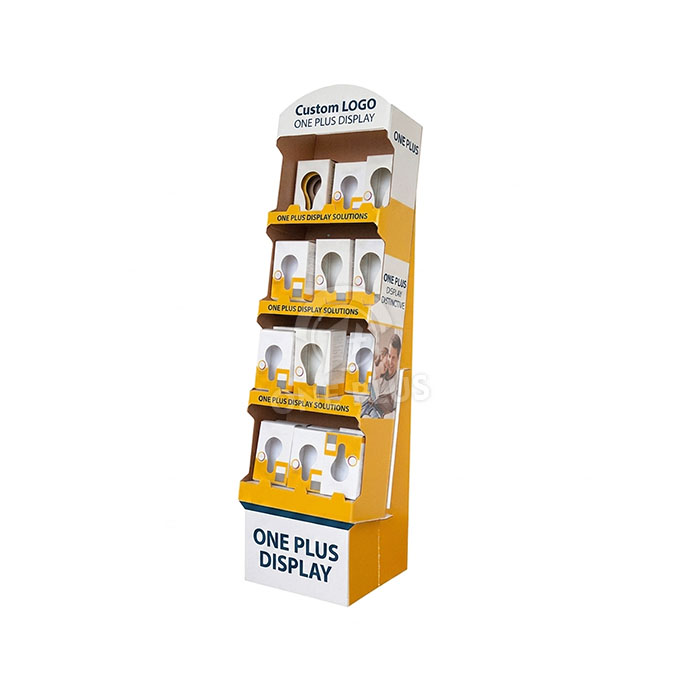
A well-engineered floor display fixes the comparison problem at the point of sale. The unit described here—a four-tier slanted merchandiser built from premium recyclable corrugated board—is designed specifically for light bulb packaging, small electronics and hardware accessories. It raises the product to eye level, tilts each package toward the shopper, and reserves the header and base for the brand story that turns a spec match into a preferred purchase.
Why a Slanted Four-Tier Floor Display Wins in Lighting
Lighting is a category where packaging carries almost all of the information. Bulb cartons are typically small, boxy and text-heavy. On a flat shelf, the shopper sees only the top edge or the front face depending on how the stock is faced. On a slanted tier, the entire front panel—wattage, color temperature, lumens, base type—angles upward toward the eye. The result is a display that behaves like a reading stand rather than a storage rack.
Four tiers also solve a merchandising problem unique to bulbs: assortment density without visual chaos. A single SKU family might include a dozen variants. Four shallow, tilted shelves let a retailer merchandise a curated matrix—say, by wattage on one tier and by color temperature on another—so the shopper can self-educate without opening a single box. That is the difference between a display that holds inventory and a display that sells it.
For brands, the format offers two high-impact branding zones that flat shelving cannot match. The header sits above the shopper’s natural sightline, catching attention from the aisle entrance. The base panel sits below the bottom tier, at the exact height where a crouching shopper or a child in a cart will look. Together they frame the product field with logo, tagline and any seasonal or launch messaging.
Structural and Engineering Decisions Behind the Unit
Every floor display is a small structure that has to survive shipping, assembly, restocking and weeks of shopper handling. The four-tier light bulb merchandiser is engineered around three priorities: shelf stability under load, package presentation angle, and a footprint that works in both countertop and compact floor positions.
Shelf geometry and tilt
The slanted tiers are not decorative. The tilt angle is set so that a standard bulb carton rests against a low front lip and presents its face to a standing shopper. The lip depth is calibrated to hold the package without obscuring the product name or the specification block. Each shelf is a folded corrugated platform with a return flange that transfers load back into the vertical side panels rather than relying on glued joints alone.
Load path and reinforcement
Corrugated displays fail at the joints, not in the panels. The side walls on this unit are double-thickness where they meet the shelf supports, and the base uses a folded internal kicker to resist racking when a shopper leans in. The header is a separate structural element, not a flimsy add-on; it ties the two side walls together at the top and keeps the unit square during handling.
Footprint and placement flexibility
The working title calls this a countertop or small FSDU format. That means the assembled footprint is compact enough for an endcap, a checkout lane or a dedicated lighting bay, but tall enough to function as a true floor merchandiser. The base is sized to keep the center of gravity low, and the tier depths are kept shallow so the unit does not become a trip hazard in narrow aisles.
Materials, Corrugated Grades and Finishing Options
The standard build uses premium recyclable corrugated cardboard, but “corrugated” is a family of materials, not a single specification. The right grade depends on how much weight each tier carries, how long the display will stay on the floor, and whether the unit will ship assembled or knocked down.
| Material option | Typical use in this display | Customizable considerations |
|---|---|---|
| Single-wall corrugated (B-flute or E-flute) | Header panels, base skirts, light-duty shelves | Print surface quality, fold crispness, recycled content |
| Double-wall corrugated (BC-flute) | Side walls, shelf platforms, load-bearing tiers | Edge crush strength, stacking tolerance, moisture resistance |
| PVC foam board | Shelves or headers where rigidity and wipe-clean surfaces matter | Thickness range, color matching, screen-print or vinyl application |
| Acrílico | Optional front lips, dividers or product risers | Thickness, edge finish, clarity or tint, laser-cut profiles |
Print and finish options include litho-lamination for photographic brand imagery, flexographic printing for high-volume cost efficiency, and direct digital printing for short runs and versioned campaigns. Matte or gloss aqueous coatings protect the graphics without the plastic sheen that can make a display look temporary. For premium lighting brands, a soft-touch or satin varnish on the header can signal quality before the shopper reads a single word.
Because exact material thicknesses and load ratings depend on the final tier span and product weight, One Plus Display confirms these specifications during the quoting process rather than publishing fixed numbers that may not apply to your assortment.
Merchandising and Retail Placement Strategy
The four-tier format is deliberately flexible. In a hardware store, it can anchor a bulb-and-battery endcap. In an electronics department, it can sit adjacent to smart-home hubs and LED strip kits. In a supermarket, it can merchandise a seasonal security-light or decorative-bulb program near the checkout lane.
- Aisle-endcap anchor: Use the header for a brand promise and the base for a value message or compatibility guide.
- In-line category bay: Place the display at the start of the lighting aisle to intercept shoppers before they reach the standard shelving.
- Checkout-lane impulse: A compact footprint and a single high-margin SKU family—such as decorative or smart bulbs—can work as a last-second add-on.
- Trade-show or showroom: The same structure functions as a countertop sample stand for sales meetings and distributor presentations.
Retailers often ask how to merchandise the tiers. A practical approach is to dedicate the top tier to the newest or highest-margin SKU, the middle tiers to the core assortment, and the bottom tier to bulk or value packs. The slanted shelves make every tier equally readable, so there is no dead zone at the bottom.
Customization and Production Workflow
This display is built to order. The customization process starts with a structural brief: product dimensions, package weights, desired tier count, branding zones and retail environment. From there, the engineering team produces a dieline and a 3D visual so the buyer can see the assembled unit before tooling begins.
Graphic production follows the structural approval. Artwork is laid out to the dieline, with bleed and safe zones confirmed for each panel. Proofs are issued for color and copy accuracy. Once approved, production runs on the appropriate corrugated grade, with die-cutting, folding, gluing and finishing completed in-house. Units ship either flat-packed for retailer assembly or pre-assembled for drop-in placement, depending on the program.
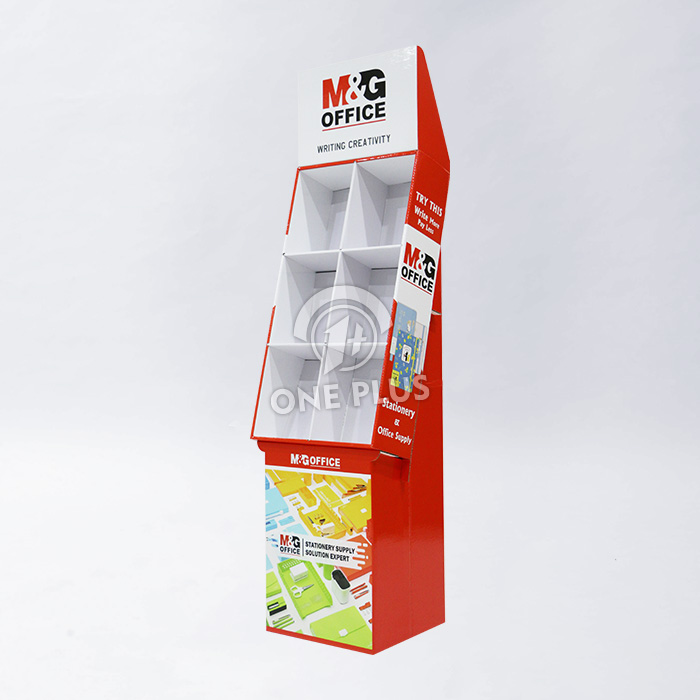
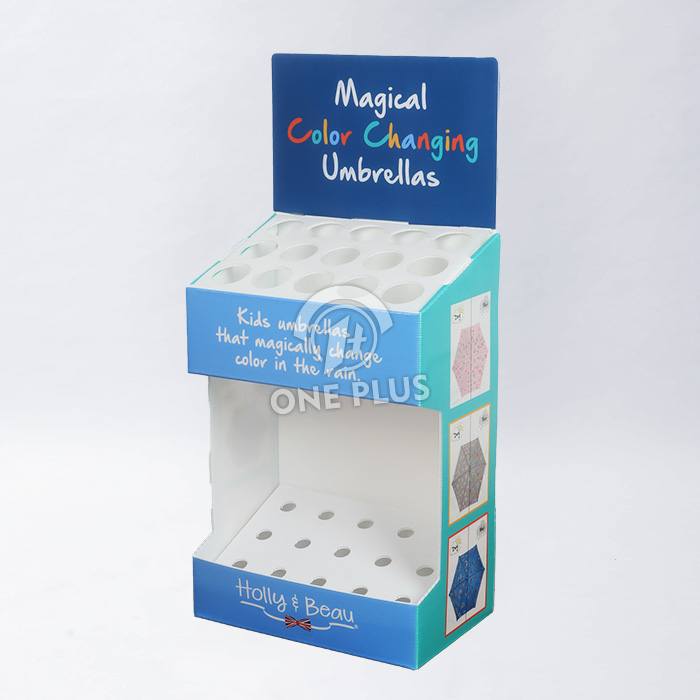
For buyers who need a different structural approach, the same engineering team can adapt the concept to a cardboard floor display stand with different tier geometry or a larger footprint. Related formats include a custom cardboard floor display rack for stationery and office supplies, which uses a similar tiered logic for small packaged goods, and a durable PVC pegboard floor rack for umbrellas and parasols, which trades corrugated lightness for long-life rigidity.
Three Concrete Use-Case Scenarios
Scenario 1: National hardware chain, LED retrofit program
A hardware buyer needs to promote a new line of dimmable LED bulbs across several hundred stores. The display ships flat-packed with a header that carries the brand’s retrofit messaging and a base panel with a simple compatibility chart. Store staff assemble each unit in under a few minutes and place it at the end of the lighting aisle. The four tiers hold the core wattages, and the slanted shelves let shoppers compare color temperatures without opening a box.
Scenario 2: Regional electrical distributor, countertop sample stand
An electrical distributor wants a countertop unit for its trade counter, where contractors stop between jobs. The same four-tier structure is scaled to a compact footprint, with a smaller header and a base that fits a standard counter depth. The tiers are loaded with sample bulbs and spec cards, giving counter staff a hands-on selling tool that stays organized during busy periods.
Scenario 3: Smart-home brand, seasonal launch
A smart-lighting brand launches a new color-changing bulb line and needs a display that can be versioned for different retailers. The header and base panels are printed separately from the structural body, allowing the brand to run retailer-specific messaging without changing the die-cut. The slanted tiers present the app-compatible packaging face-up, and the base panel carries a QR code to the setup guide.
Assembly, Packing and Logistics
Most corrugated floor displays are designed for flat-packed shipping to reduce freight cost and warehouse space. The four-tier light bulb merchandiser can be shipped as a single knocked-down unit with a clear assembly sequence: fold the base, erect the side walls, insert the shelf supports, then lock the header into place. No tools are required for the standard configuration, and the unit can be assembled by one person on the sales floor.
For retailers that prefer drop-in placement, the display can be pre-assembled and shipped as a standing unit, though this increases freight volume. Packaging includes a protective outer carton and, where needed, corner boards to prevent crushing during transit. Each shipment includes a printed assembly guide and, for larger programs, a digital version for store communications.
Because the unit is built from recyclable corrugated board, end-of-life disposal is straightforward. Retailers can break the display down and place it in standard cardboard recycling streams, which is increasingly a requirement for sustainability-minded buying teams.
Frequently Asked Questions
Can the display be customized for different bulb package sizes?
Yes. Tier depth, front lip height and shelf spacing are all adjustable during the structural design phase. The slanted shelves can be sized to standard bulb cartons or to larger specialty packaging, such as smart bulbs or decorative globes.
Is the corrugated board strong enough for a full retail cycle?
The standard build uses premium recyclable corrugated cardboard, with double-wall grades available for load-bearing side walls and shelf platforms. The exact grade is specified based on product weight and expected display duration, so the unit performs throughout the promotion without sagging or racking.
Can I order a small test run before committing to a national rollout?
Yes. Short runs are available using digital printing, which allows brands and retailers to validate the display in a few stores before scaling to a larger program. The structural design carries over to the full production run, so only the print method changes.
Does the display ship assembled or flat?
Both options are available. Flat-packed shipping lowers freight cost and storage space, while pre-assembled shipping reduces in-store labor. The choice usually depends on the retailer’s receiving and assembly capabilities.
Request a Quote for Your Light Bulb Display Program
If you are planning a lighting promotion, a new SKU launch or a category reset, the four-tier slanted merchandiser can be engineered around your exact product matrix and branding requirements. One Plus Display works factory-direct, which means structural design, printing and production are handled under one roof—no middle layers, no markup surprises.
Send us your product dimensions, target retail environment and branding assets, and we will return a dieline, a 3D visual and a production quote. Whether you need a compact countertop unit or a full floor-standing program, the goal is the same: a display that makes the specification decision easier for the shopper and more profitable for the retailer.