When a Hat Wall Collapses, the Sale Is Already Lost
You have seen it happen in a mall aisle: a floor stand loaded with snapbacks, one customer pulls a cap from the middle, the stack above shifts, and three more hats slide onto the floor. The customer steps back, picks up a different style from a neater section, and walks away. The product was fine. The display failed.
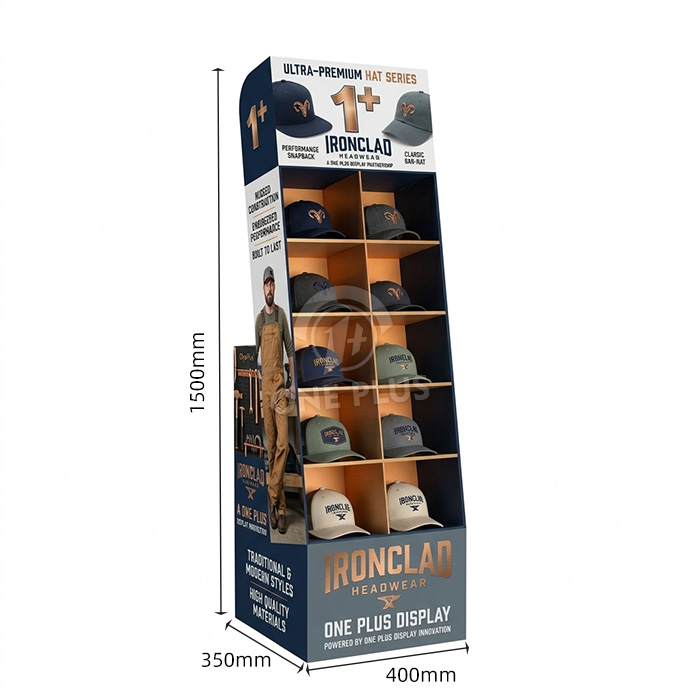
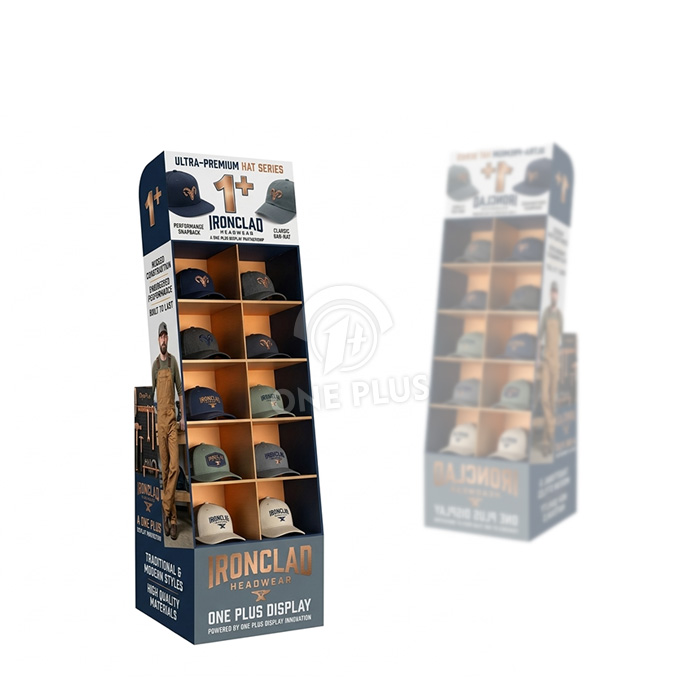
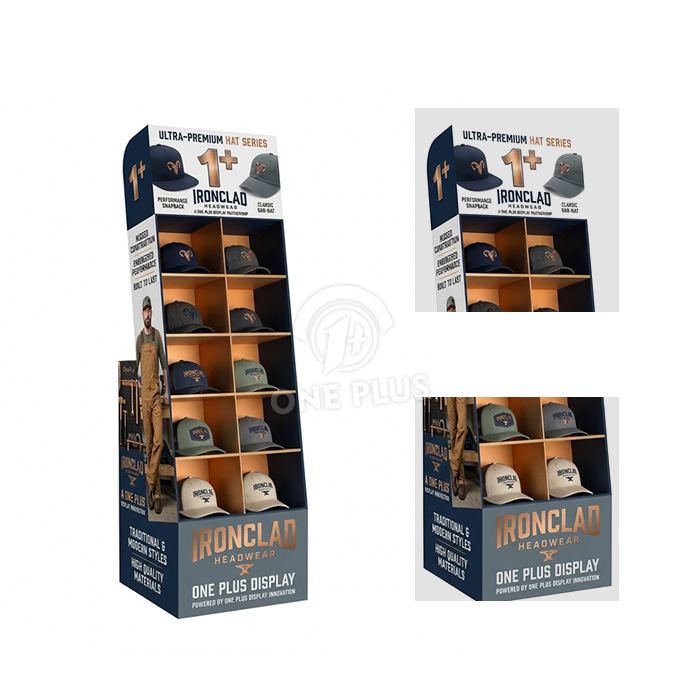
For headwear, the display is not a neutral container. Hats are lightweight, usually unstructured, and easily deformed by compression. Their value depends on silhouette, shape retention, and an unbroken graphic presentation. A flat shelf forces hats into stacks where the bills get crushed and color stories disappear. A slanted grid floor display solves that by giving every cap its own compartment, angled toward the shopper, with gravity holding it in place rather than pulling it down.
This page explains how a backward-leaning grid floor display is engineered, specified, and produced for apparel brands that sell baseball caps, beanies, bucket hats, and streetwear headwear. If you are comparing display formats for a retail launch, a stadium store, or a seasonal promo aisle, the details below will help you write a clearer brief and avoid returns.
Why a Slanted Grid Beats Flat Shelving for Headwear
Flat shelves are designed for boxed goods. They work when the product is rigid, stackable, and readable from the side. Headwear fails all three tests. A cap placed on a flat shelf either lies flat and hides its crown, or sits upright and obscures the compartment behind it.
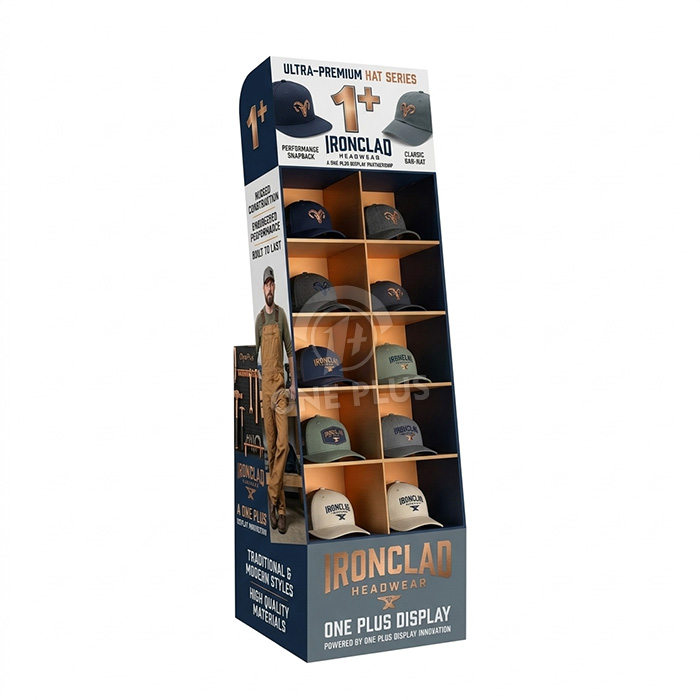
A slanted floor display changes the geometry. The grid tray is set at a backward angle, so each cell presents its contents to the shopper at a natural viewing height. Lower tiers become visible without bending. Upper tiers do not require the customer to reach over a lip. The result is a display that reads like a wall of faces rather than a pile of fabric.
The tilt also creates a passive retention system. Because the hat rests against the back panel, gravity keeps it seated in the cell. There is no shelf lip to snap over, no hook to miss, and no stack to disturb. When a shopper removes one cap, the neighboring cells remain untouched.
- Visibility: the angled face exposes the crown, logo, and bill of every unit.
- Security: light items stay in place without secondary fixtures or elastic bands.
- Sorting: color, team, or size families can be grouped by row or column.
- Integrity: individual cells prevent bill crushing and crown deformation.
Structural and Engineering Decisions
A floor display for apparel carries a different load profile than one for beverages or hardware. The total weight is low, but the demand for dimensional stability is high. The stand must resist wobble when shoppers pull hats from the top tiers, and it must hold its grid alignment after weeks on a sales floor.
The starting point is the grid geometry. Cell width, height, and depth are derived from your actual headwear assortment. A standard baseball cap needs enough depth to hold the crown without pressing the bill. A beanie needs a narrower cell so it does not slump sideways. A bucket hat needs more vertical clearance. Because these requirements vary by collection, we do not publish one fixed cavity size. Instead, we treat the grid as a parameter and build the die-cut tooling around your specification.
The backward tilt angle is another variable. A shallow tilt improves readability but reduces the gravity assist. A steeper tilt keeps hats more secure but can make deep crowns harder to remove. The correct angle depends on hat height and cell depth, and it is usually resolved during structural sampling rather than guessed from a drawing.
Support comes from a combination of internal corrugated ribs and a reinforced base. The base must be wide enough to prevent tipping when the upper grid is fully loaded, yet compact enough to fit the intended floor footprint. Side panels act as both graphic surfaces and structural bracing. In many builds, a horizontal shelf or tie panel behind the grid locks the vertical walls together and stops the unit from twisting.
| Design Variable | Typical Range | Influenced By |
|---|---|---|
| Overall height | Countertop to full floor height, often around 1.6–1.8 m | Ceiling height, aisle sightlines, product count |
| Grid cell width | Narrow beanie slots to wide snapback cells | Hat type, bill width, merchandising plan |
| Grid cell depth | Shallow face-forward to deep crown-supporting | Crown height, whether hats sit flat or upright |
| Backward tilt | Shallow to moderate angle | Visibility target, gravity retention, removal ease |
| Área da base | Compact to wide stabilizing platform | Stability requirement, floor space, pallet plan |
For apparel buyers, the practical takeaway is that the grid should be engineered from a product sample or a detailed spec sheet, not selected from a catalog photo. A display that fits a generic cap will fit no specific cap well.
Materials and Finishing Options
Most slanted grid floor displays for hats are produced in corrugated board because it is light, printable, and cost-efficient at retail volumes. The standard build uses a BE-flute corrugated board with a 350 g CCNB liner. This combination gives a smooth white print surface on the face and enough flute depth to resist bending in the vertical panels. For heavier hats or larger footprints, a higher flute grade or a double-wall construction can be used in the base and load-bearing shelves.
Where the retail environment is humid, or where the display will be reused across multiple seasons, PVC foam board is a common upgrade. It is more rigid than corrugated, resists moisture, and can be cleaned. Acrylic is another option for premium or permanent fixtures, particularly for clear dividers, polished edges, or a high-end department store presentation. These are not mutually exclusive: a corrugated graphic body with PVC reinforcements or acrylic cell dividers is a practical hybrid.
Printing is typically full-color CMYK offset or digital, depending on run length and artwork complexity. Offset printing holds fine detail and brand colors well on large runs, while digital printing reduces setup cost for shorter or test programs. Finishing options include matte or gloss varnish, spot UV on logos, and laminated surfaces for scuff resistance. All graphic areas—header, base, side panels, and the grid face itself—can be printed, which means the display can carry a campaign message even when the grid is not fully stocked.
Materials should be specified against the retail channel, not just the product. A pop-up store that lasts six weeks does not need the same board as a stadium team store that will be restocked every weekend.
Merchandising and Retail Placement
A grid display is a sorting tool as much as a presentation tool. Before the structure is designed, decide how many SKUs will appear on the floor and how they should be grouped. A sports brand might organize by team, with each column representing a franchise. A fashion label might organize by colorway, creating a gradient across the grid. A licensed collection might group by character or league.
The grid can also support a tiered pricing or collection story. Upper tiers can hold hero styles at eye level, while lower tiers carry entry-price or promotional units. Because the slant exposes all rows, the lower tiers are not penalized visually, which makes them viable for volume items.
Placement matters. A slanted floor display works best at the end of an aisle, near a fitting room, or adjacent to a checkout zone where shoppers pause. In a mall corridor, the angled face should point toward the dominant walking direction. In a store, the display can be turned slightly so that approaching customers see the grid at an angle rather than straight on. If the display is double-sided or has side graphics, it should be positioned where those surfaces are visible from more than one approach path.
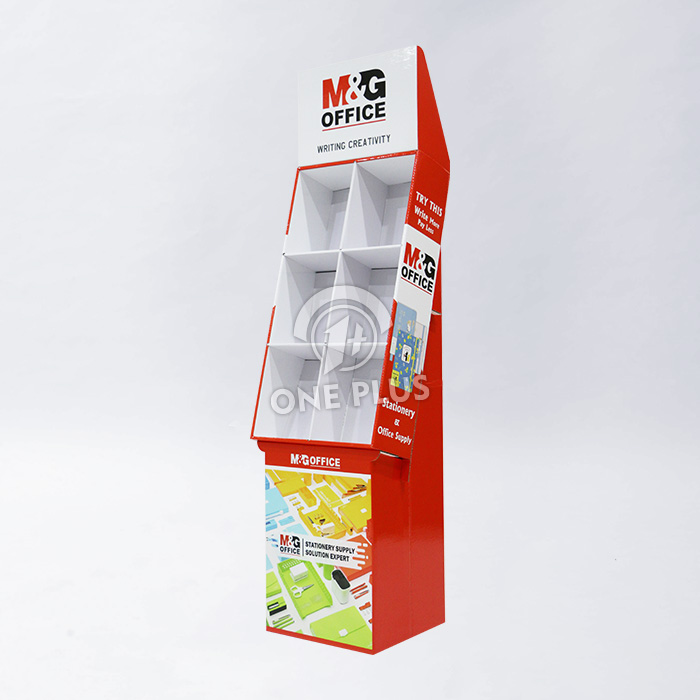
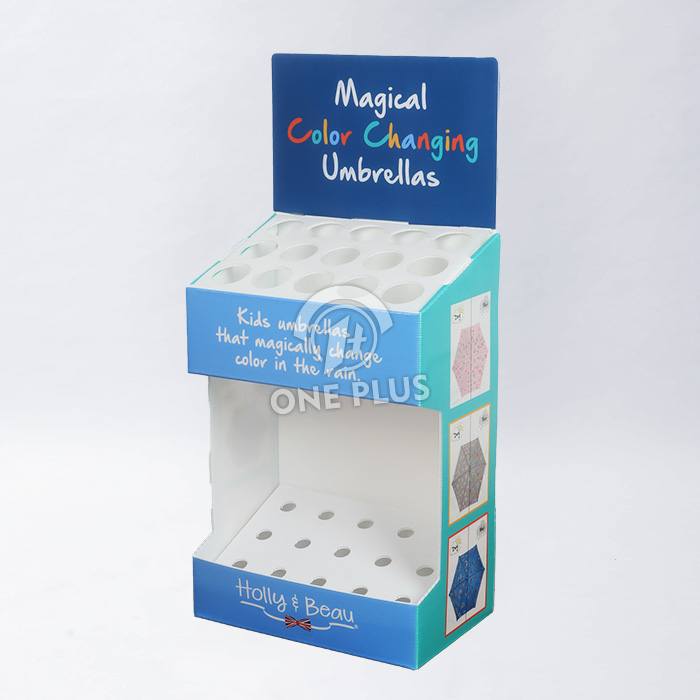
For broader floor display formats, including open-shelf and pegboard configurations, see our range of expositores de piso em papelão. If your assortment includes non-apparel accessories, a different structural approach may be more suitable, such as this cardboard floor display rack for stationery and office supplies. For heavier hanging merchandise where moisture resistance is required, a PVC pegboard floor rack for umbrellas uses a comparable engineering logic with different materials.
Customization and Production Workflow
As a direct manufacturer, the customization process starts with your product and your retail plan, not with a stock design. The typical workflow moves through five stages.
- Brief and product review: you provide hat samples or detailed dimensions, target SKU count, and placement constraints.
- Structural design: we propose a grid layout, tilt angle, base footprint, and assembly method, with a flat-pack plan.
- Graphic layout: artwork is fitted to the header, base, sides, and visible grid surfaces, with dielines supplied for accurate placement.
- Sampling: a physical prototype is produced for fit, stability, and print review. This is where cell size and tilt are confirmed.
- Production and shipping: after approval, the run is printed, die-cut, packed flat, and shipped according to the agreed carton plan.
OEM and ODM services are available. That means we can build to your drawings or develop the structure from a brief. Grid size, number of tiers, footprint, header shape, and material grade are all adjustable. Minimum order quantity is 100 pieces, which allows for test programs and regional rollouts without committing to a full container of a single design.
One practical note: the earlier the display is designed alongside the packaging and the product photography, the more consistent the shelf presence will be. A grid cell sized to the actual hat will outperform a generic cell every time.
Three Concrete Use-Case Scenarios
1. Stadium Team Store
A baseball franchise needs a floor display that can hold multiple cap styles during a home stand. The grid is organized by team colorway, with the home cap at eye level and alternate caps below. The base carries a team logo, and the header carries the season campaign. Because the stand is restocked frequently, the grid cells are sized for quick drop-in placement, and the corrugated structure is specified for repeated handling. The slant keeps caps facing the entrance as fans walk in.
2. Streetwear Pop-Up
A streetwear label opens a two-week pop-up and needs a display that ships flat, assembles without tools, and looks premium enough for photography. The grid is built with slightly wider cells for unstructured caps and a matte laminated finish. The side panels carry campaign photography, and the base includes a QR code for the online drop. Because the run is short, digital printing is used, and the display is designed to be recycled or reused at the next event.
3. Department Store Accessories Department
A department store wants a semi-permanent fixture that can be refreshed each season. The body is corrugated for the graphic areas, while the grid dividers and base inserts are made from PVC foam board for rigidity and wipe-clean maintenance. The display is placed near the fitting rooms, where shoppers pause, and the grid is organized by price tier. Seasonal graphic panels slide into place without replacing the structure.
Assembly, Packing, and Logistics
Floor displays are shipped flat to reduce freight cost and storage space. Assembly is designed to be intuitive, typically using tab-and-slot interlocking, with no special tools. A printed assembly guide is included, and we can provide a video walkthrough for retail staff. The grid section is usually a separate sub-assembly that locks into the vertical frame, which simplifies handling and reduces damage during transport.
Packing is planned around the retail distribution channel. For direct-to-store shipments, displays can be packed in individual cartons. For warehouse or 3PL distribution, they can be packed in master cartons with a defined unit count. The carton dimensions and weight are determined by the final structure, so they are confirmed after sampling. If the display is shipped with product, the packaging plan should account for the combined load and any pallet configuration requirements.
Durability during transit is a design concern, not an afterthought. Score lines, corner protection, and the placement of heavy components in the carton are reviewed during sampling. For international shipments, the flat-pack format usually compares favorably with pre-assembled fixtures on freight cost per unit.
Frequently Asked Questions
Can the grid compartments be sized for different hat types?
Yes. The grid is designed around your assortment. Wider slots can be specified for snapbacks and structured caps, while narrower cells suit beanies and folded accessories. Cell depth and height are adjusted at the same time so the hat sits correctly rather than loosely.
Why choose a slanted display instead of a straight vertical one?
A slanted floor display improves the viewing angle on lower tiers and uses gravity to keep lightweight hats seated. It also reduces the chance of hats falling forward when a shopper removes one from the grid. The trade-off is that the tilt angle must be matched to hat height and cell depth, which is resolved during sampling.
Do you provide OEM and ODM services?
Yes. We work from your drawings or develop the structure from a brief, including grid layout, tilt, base design, and graphic dielines. Full-color printing is handled in-house, and the finished display is packed flat for shipping.
What is the minimum order quantity?
The standard minimum order quantity is 100 pieces. This applies to custom structures and custom printing. For larger rollouts, we can schedule production in phases to match your retail calendar.
Start With Your Hat, Not a Template
If you are planning a headwear display for an upcoming season, the most useful first step is to send us a sample cap or a clear specification: crown height, bill width, and the number of styles you intend to show. From there, we can propose a grid layout, a tilt angle, and a material specification that fits your retail channel. One Plus Display produces custom floor displays as a direct manufacturer, which means the structure can be adjusted before tooling rather than after. Request a quote and a structural proposal for your hat program.