When a Sunglass Brand Needs to Own the Aisle
A shopper walks into a boutique optician, pauses at the entrance, and scans the room. Within seconds, their eyes land on a freestanding unit near the window—a tiered display holding rows of sunglasses at an easy viewing angle. The brand that owns that unit owns the first impression. That is the quiet power of a well-engineered floor display in the eyewear category: it does not just hold product, it frames the shopping decision before the customer reaches the counter.
Eyewear is a tactile, try-on category. Shoppers pick up frames, check hinge tension, hold lenses to the light, and compare silhouettes against their face. A floor display must therefore do two jobs at once: present dozens of SKUs in a browsable hierarchy, and survive constant handling without losing its graphic punch. This page explains how a custom cardboard floor display stand built specifically for eyewear and sunglasses achieves both—and how the format differs from a simple countertop tray.
One Plus Display manufactures these units factory-direct from high-density corrugated, with optional PVC foam and acrylic components for buyers who need extra rigidity or a premium lens-level finish. The structure discussed here is a floor-standing tiered merchandiser, but every dimension, tier count, and graphic panel is engineered to your product mix and retail footprint.
Why a Floor Format Wins for Eyewear and Sunglasses
Countertop displays have their place—they suit impulse-priced reading glasses and add-on accessories. But sunglasses and fashion eyewear are destination purchases. They need vertical presence, a clear brand statement, and enough capacity to show a full collection rather than a token selection. A floor display delivers three advantages that a counter unit cannot match.
Vertical storytelling and brand presence
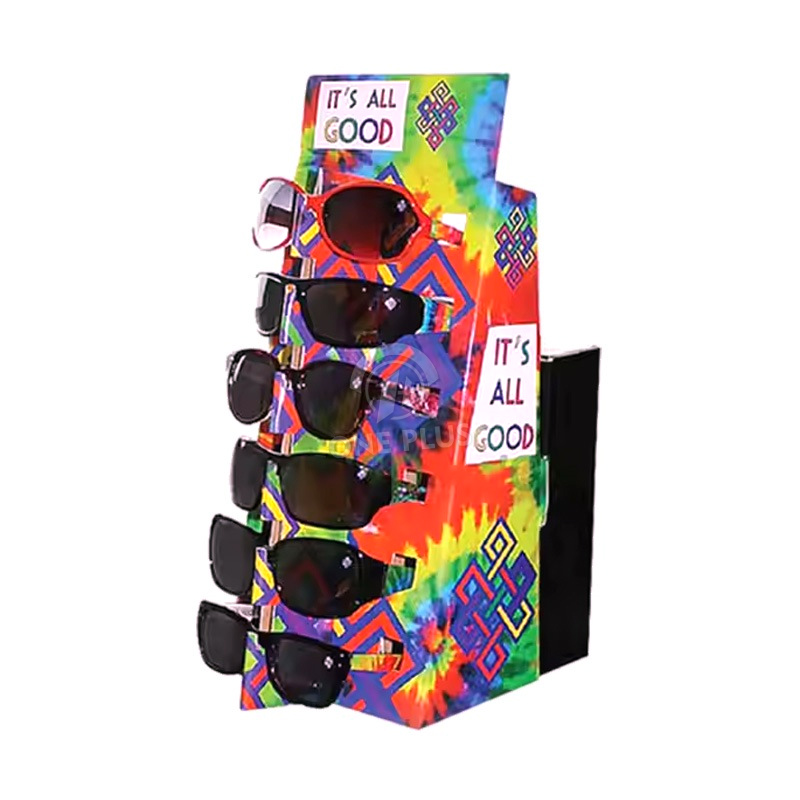
Eyewear is displayed at eye level for a reason. A floor unit lets you position the hero frame at natural sightline, with supporting styles cascading below. The full-surface graphic area turns the display into a branded column in the aisle—visible from across the store and from the entrance. For licensed brands and seasonal collections, that surface is prime real estate for campaign artwork, color stories, and logo placement.
Capacity without clutter
A well-designed tiered floor unit can hold multiple pairs per shelf across several levels, organized by style, gender, or price band. Shoppers browse vertically, which mirrors how they compare frames—top to bottom, not left to right. The structure keeps product orderly during peak hours and makes restocking a matter of sliding new inventory into place rather than rearranging a chaotic pile.
Flexible placement in high-traffic zones
Floor displays can be positioned at entrances, endcaps, window-adjacent zones, or in dedicated eyewear sections. They do not depend on counter space, which is often reserved for checkout and fitting. That flexibility lets retailers test locations and rotate the unit as store layouts change.
Structural and Engineering Decisions
An eyewear display lives with constant touch. Shoppers lift frames, rotate them, and set them back—often not gently. The engineering brief therefore prioritizes stability, shelf integrity, and a presentation angle that reduces handling damage.
Tier geometry and viewing angle
Tiers are typically set with a slight forward tilt so frames face the shopper naturally. The number of tiers and the spacing between them are customized to your frame sizes—oversized sunglasses need more vertical clearance than reading glasses. Rather than fixed shelves, the design uses stepped platforms or ledge profiles that keep frames from sliding forward while allowing easy lift-off.
Base and footprint
A floor display’s footprint must balance stability against aisle space. We engineer the base to sit low and wide enough to resist tipping when a shopper leans in, while keeping the overall footprint compact enough for narrow retail lanes. Where floor space is tight, a deeper base with a slimmer upper column can preserve the vertical presence without blocking traffic.
Load paths and material thickness
Corrugated displays fail at joints, not panels. The engineering focus is on how weight transfers from each tier down through the vertical supports to the base. Internal fluting direction, glue tabs, and interlocking shelf supports all contribute to a structure that stays square after weeks of use. For heavier collections or larger frame counts, we increase board thickness or introduce PVC foam reinforcement at critical stress points.
Materials and Finishing Options
The right material combination depends on retail environment, budget, and desired lifespan. We do not publish fixed load ratings because every structure is custom; instead, we match material grade to your product weight and handling profile during sampling.
| Materiał | Typical Use in Eyewear Displays | Key Characteristics |
|---|---|---|
| High-density corrugated cardboard | Main structure, tiers, graphic panels | Lightweight, printable full-surface, recyclable, cost-effective for seasonal and semi-permanent programs |
| PVC foam board | Reinforced shelves, base plates, rigid back panels | Higher stiffness, moisture resistance, smooth edge finish, supports heavier loads or repeated cleaning |
| Acrylic | Lens-level shelves, dividers, small sign holders | Transparent or tinted, premium feel, easy to wipe clean, ideal for high-end frame presentation |
Print finishing options include matte or gloss lamination, spot UV for logo emphasis, and soft-touch coatings that reduce glare under store lighting. For eyewear, a matte finish often outperforms gloss because it prevents reflections that compete with the product. Edge treatments—such as folded, taped, or painted edges—affect both durability and perceived quality.
Merchandising and Retail Placement
Where the unit stands changes how it should be configured. A window-adjacent display benefits from a single strong graphic and fewer, larger tiers—passersby see the brand before they see individual frames. An in-aisle unit needs denser capacity and clearer category labeling so shoppers can self-navigate.
Brands often use the top tier for hero or new-season frames, middle tiers for core collection, and lower tiers for price-point or promotional styles. Because the display is custom, we can build in signage areas for price callouts, lens technology messaging, or QR codes linking to virtual try-on tools. The graphic panels are not an afterthought; they are part of the structure and can be updated on future production runs without re-engineering the unit.
For retailers managing multiple locations, a floor display can be standardized across stores while allowing regional graphic variations. That consistency builds brand recognition and simplifies planogram compliance.
Customization and Production Workflow
Every eyewear display project starts with your product dimensions and retail constraints. We ask for frame widths, temple lengths, stack heights, and the number of SKUs you need to show. From there, our team produces structural drawings and a physical sample for fit and finish review.
- Discovery: Share product specs, target store environments, and branding assets.
- Structural design: We propose tier count, footprint, material grades, and assembly method.
- Graphic integration: Artwork is mapped to panels with bleed and safe zones defined for print.
- Sampling: A prototype is produced for handling tests and merchandising review.
- Production: Factory-direct manufacturing with quality checks at cutting, printing, and assembly.
- Delivery: Flat-packed or partially assembled units shipped with assembly instructions.
Lead times depend on complexity and finishing, but the sampling stage typically runs in parallel with graphic approval to compress the overall schedule. Because we manufacture in-house, changes to tier spacing or panel dimensions can be made without retooling delays.
Three Use-Case Scenarios
1. Boutique optician with a curated luxury collection
A high-end optician needs to present a limited number of premium frames in an environment that feels considered, not crowded. Here, a floor unit with acrylic lens-level shelves and a matte-laminated back panel creates a boutique fixture feel. Fewer tiers with generous spacing let each frame breathe, and the transparent shelves keep the focus on the product rather than the structure.
2. Sunglass brand launching a seasonal collection
A fashion brand rolls out a summer collection across multiple retail partners. The display must carry bold campaign graphics and hold enough SKUs for shoppers to compare colorways. A full-surface corrugated unit with high-density board and reinforced shelves handles the capacity, while the graphic panels are printed to campaign specification. The unit is designed for semi-permanent use and can be refreshed with new graphics in the next season.
3. Department store eyewear department
A department store needs a freestanding unit that fits a defined floor zone, survives heavy daily traffic, and supports multiple brands. PVC foam reinforcement at the base and shelves extends service life, and modular signage areas allow different brand headers to be swapped without changing the structure. The footprint is engineered to align with the store’s aisle width and planogram requirements.
Assembly, Packing, and Logistics
Eyewear displays are typically shipped flat to reduce freight volume and protect graphics during transit. Assembly is designed to be intuitive—most units use interlocking tabs, fold-and-lock joints, or a small number of reusable fasteners. We provide step-by-step instructions and, where needed, numbered parts for error-free setup.
Packing considers both protection and retail handling. Printed panels are interleaved and corner-protected; structural components are bundled by assembly sequence. For multi-store rollouts, we can pack by location or by unit to simplify distribution. If the display includes acrylic components, those are wrapped separately to prevent scratching.
Because floor displays occupy valuable retail space, we also consider how the unit is serviced after installation. Shelf access, restocking clearance, and graphic replacement are all part of the design brief—not afterthoughts.
Frequently Asked Questions
Can the display be customized to hold different frame sizes?
Yes. Tier spacing, shelf depth, and ledge profiles are all adjustable during the design phase. We work from your actual frame dimensions to ensure oversized sunglasses and smaller reading glasses both sit securely without excessive clearance.
Is corrugated cardboard strong enough for a floor display?
High-density corrugated is engineered for retail floor use when the structure is designed correctly. Load paths, fluting direction, and joint design matter more than the material alone. For heavier collections, we specify thicker board or add PVC foam reinforcement at stress points.
How long does a custom eyewear display last in a store?
Service life depends on material choice, finishing, and handling conditions. Corrugated units are commonly used for seasonal or semi-permanent programs, while PVC-reinforced and acrylic components extend durability for longer installations. We match the material specification to your intended campaign length.
Can you produce displays for multiple retail locations with different branding?
Yes. We can standardize the structural design and vary the printed graphics per region or per retail partner. This keeps assembly consistent while allowing localized branding. Contact us with your rollout plan and we will map the production and packing approach.
Start Your Eyewear Display Project
If you are planning a sunglass launch, refreshing an optician’s floor space, or rolling out a multi-store eyewear program, the fastest path is a conversation about your product dimensions and retail environment. Share your frame specs, capacity targets, and branding assets, and we will return a structural proposal with material recommendations and a sampling plan.
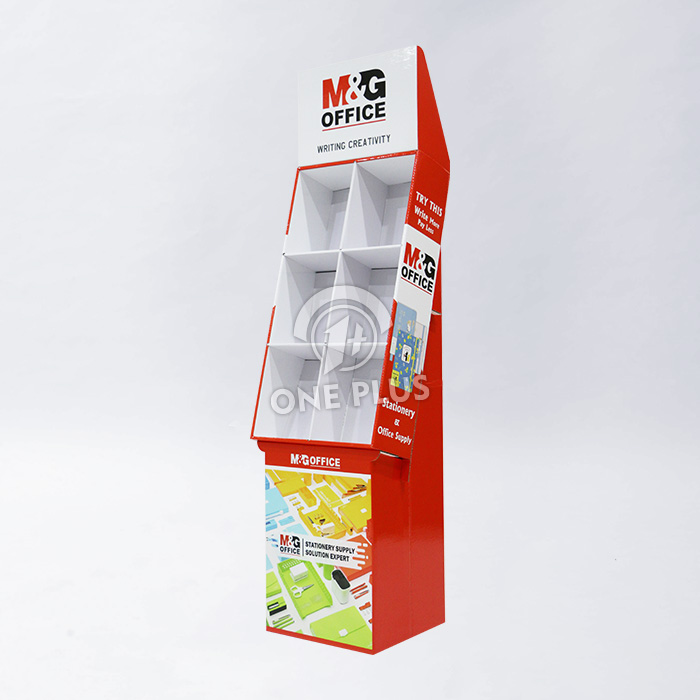
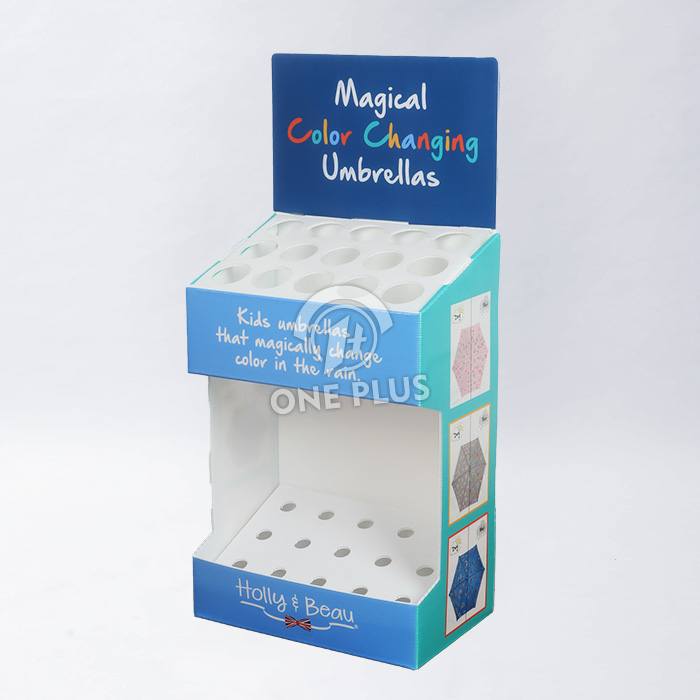
Explore our broader range of tekturowych ekspozytorów podłogowych for other retail categories, or see how similar engineering applies to a custom cardboard floor display rack for stationery and office supplies. For applications requiring higher rigidity and moisture resistance, review our PVC display stand floor rack for umbrellas and parasols.
One Plus Display manufactures factory-direct, which means your project moves from concept to sample to production without third-party handoffs. Send us your brief and let’s build a display that earns its floor space.