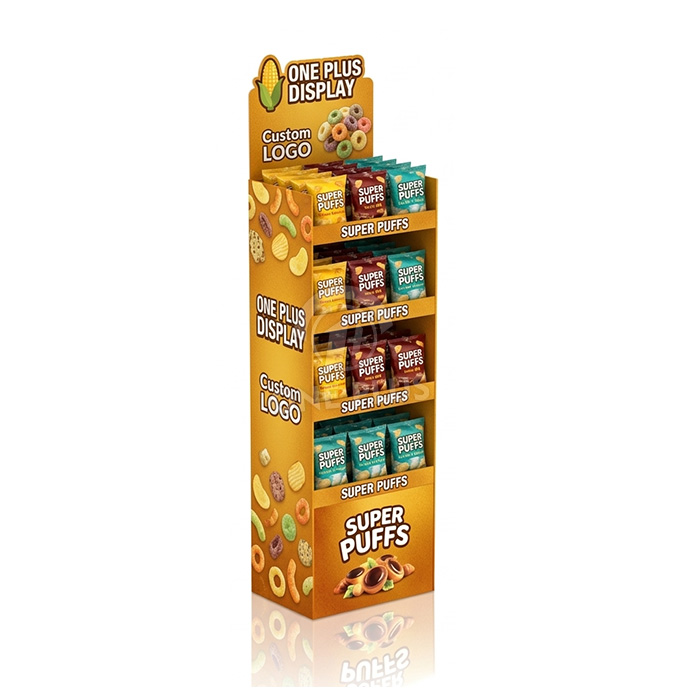
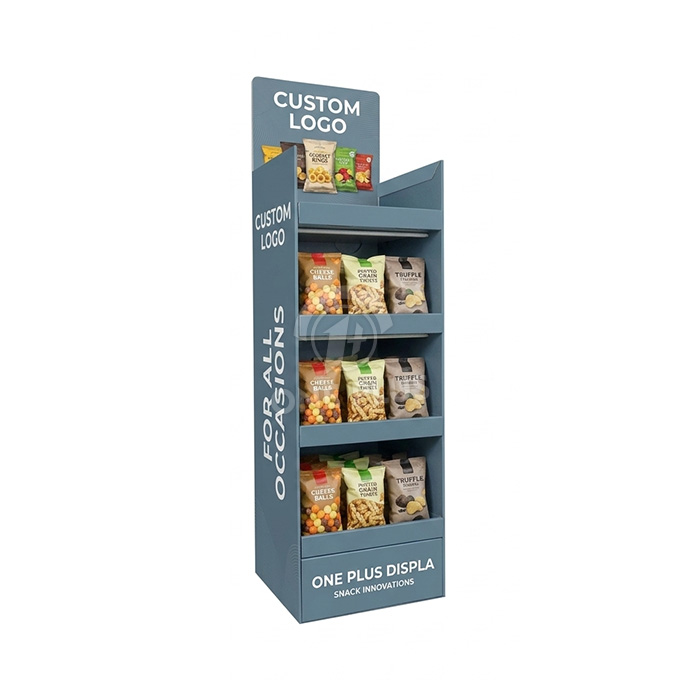
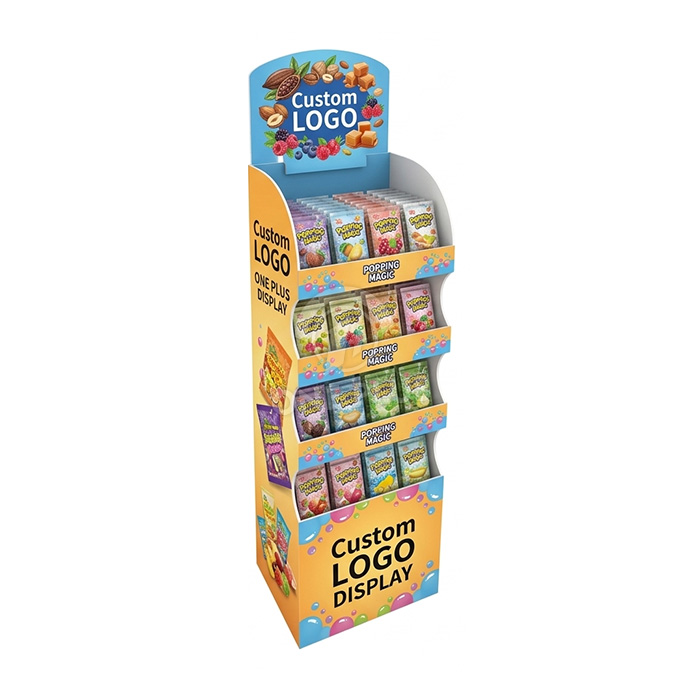
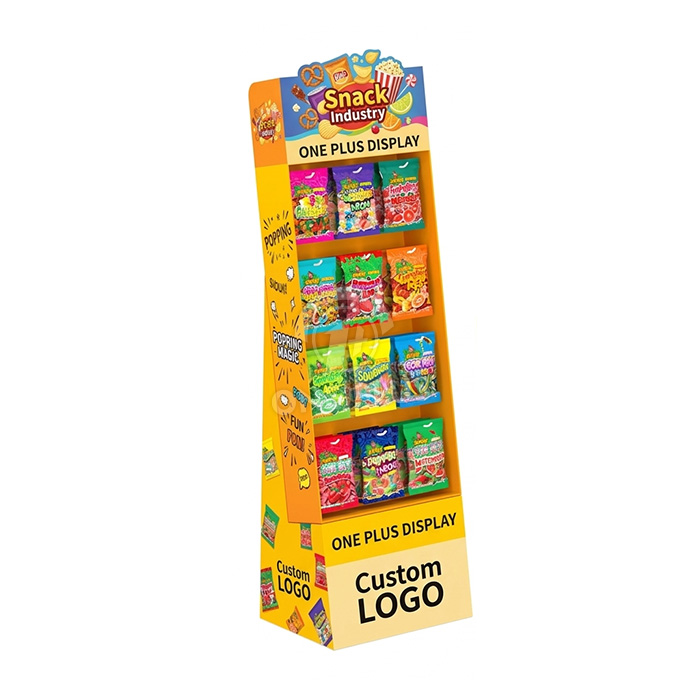
Retail-Ready Structure for Coffee and Beverage Aisles
A store manager in a busy urban market needs to move coffee bags and bottled cold brew quickly. She has a 60 cm wide endcap near the checkout, and she needs a display that can hold the weight of glass bottles and dense coffee bags without sagging, while still looking sharp enough to stop a shopper in three seconds. Off-the-shelf cardboard stands fail here—they bow under load, the shelves collapse, and the branding looks generic. That is exactly the problem this 4-tier floor display solves.
This unit is purpose-built for food and snack retail, where products are heavy, turnover is high, and the display must survive daily restocking. It uses a reinforced corrugated structure with four deep shelves, each rated for 8–12 kg, and a high-definition printed finish that can carry coffee bean imagery, steaming cups, or juice splashes without looking cheap.
Below, we break down why this format works for coffee and packaged beverages, the engineering decisions behind the load capacity, material and finishing options, merchandising placement, customization workflow, and practical logistics for buyers who need displays that perform in real stores—not just in a showroom.
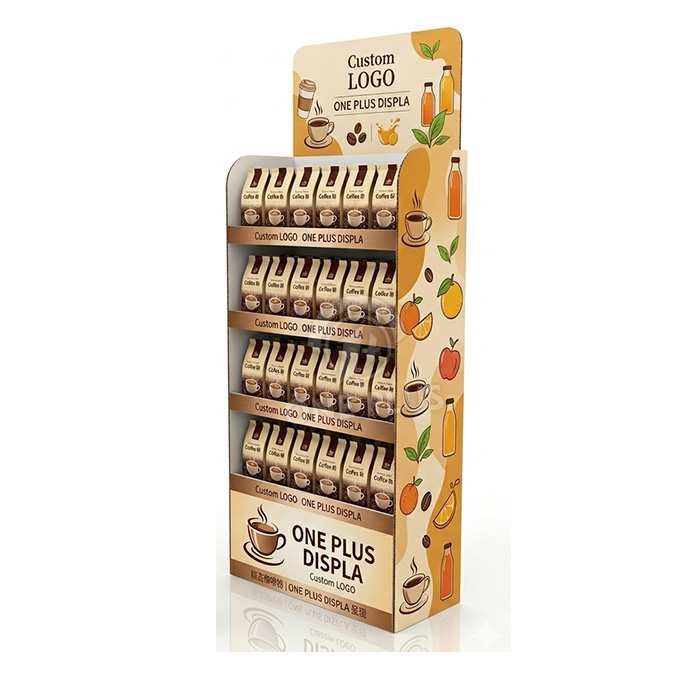
Why a 4-Tier Floor Display Wins for Coffee and Packaged Beverages
Coffee bags and bottled beverages share a merchandising reality: they are dense, they are often purchased in multiples, and they compete for the same shopper attention as candy, snacks, and impulse items. A floor display placed at the end of an aisle or near the checkout captures that shopper when they are already in a buying mindset. But the display must do three things well: hold significant weight without deformation, present multiple SKUs or flavors clearly, and communicate brand quality at a glance.
Four tiers is the sweet spot for this product category. It provides enough vertical capacity to stock a meaningful quantity of coffee bags (typically 6–12 units per shelf depending on bag size) or bottled drinks (8–16 bottles per shelf depending on diameter), while keeping the overall footprint compact. Unlike a 5-tier or 6-tier unit, a 4-tier display maintains a lower center of gravity, which reduces tipping risk in high-traffic areas.
The open-shelf design also simplifies restocking. Staff can see exactly what needs replenishing without pulling the display apart. For beverages, this matters because cold-chain products often arrive in cases that need quick transfer to the shelf. For coffee bags, the tiered layout allows you to group by roast, origin, or flavor, turning the display into a mini category destination rather than a random pile of product.
Structural and Engineering Decisions
The core challenge with any cardboard floor display for liquids and dense bags is sag. Corrugated board is strong in compression but can deflect under sustained point loads, especially when humidity rises. To prevent this, the horizontal supports in this unit are reinforced with a double-wall or multi-layer corrugated insert that distributes weight across the full depth of each shelf. This is not a cosmetic upgrade—it is the difference between a display that lasts a weekend promotion and one that survives a full quarter.
The vertical uprights are also engineered with a folded profile that increases rigidity without adding excessive material cost. Each shelf sits on a locking tab system that prevents forward tipping when a shopper pulls a heavy bottle from the front row. The base is widened slightly to improve stability, and the overall structure uses interlocking panels that assemble without tools—important for retail staff who may not have time for complex setups.
Load capacity is stated as 8–12 kg per tier. This range reflects the variability in corrugated grades and finishing options. For heavier loads—such as glass bottles or large coffee bag formats—we recommend specifying a higher-grade board and additional internal supports. The engineering principle is simple: the load is transferred from the shelf surface to the vertical uprights, which then transfer it to the base. Any weak point in that chain reduces the overall capacity.
Another consideration is moisture. While the display is paper-based, it can be finished with a protective film that offers minor splash resistance. This is not a substitute for a plastic display in a refrigerated case, but it is sufficient for ambient retail where occasional condensation from cold bottles may occur. For environments with constant moisture, we recommend exploring PVC display stand floor rack solutions that use foam board or acrylic components.
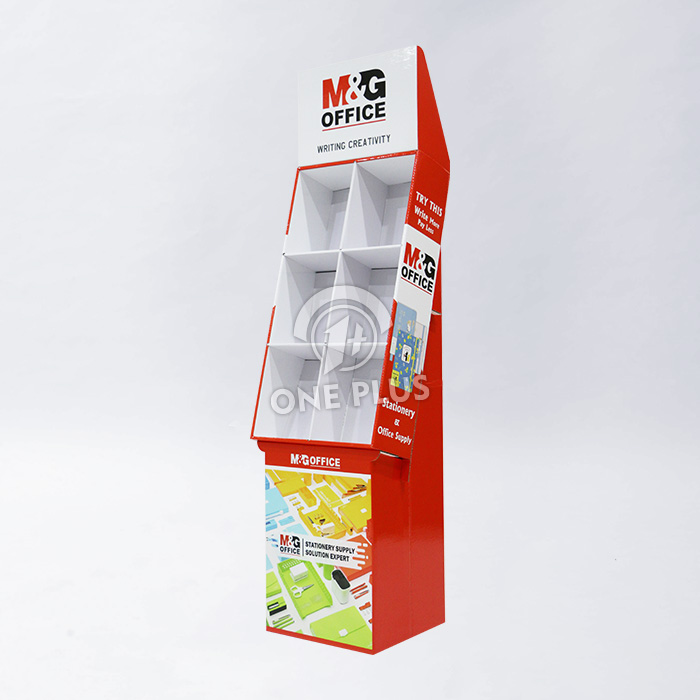
Materials and Finishing Options
The standard material for this display is heavy-duty recyclable B-flute corrugated cardboard. B-flute offers a good balance of strength and printability, with a thickness that provides rigidity while remaining lightweight enough for cost-effective shipping. For higher load requirements, we can upgrade to BC-flute or EB-flute, which increases the board’s compression strength and resistance to bending. The choice depends on the weight of your products and the expected lifespan of the display.
Surface finishing is where branding comes alive. We offer gloss or matte lamination with high-definition printing. Gloss lamination enhances color vibrancy and provides a slight moisture barrier, making it a good choice for beverage displays where condensation may be present. Matte lamination offers a premium, tactile feel and reduces glare under store lighting—often preferred for coffee brands that want a warm, artisanal aesthetic. Both options can be combined with spot UV or embossing for a tactile logo effect, though these are custom upgrades.
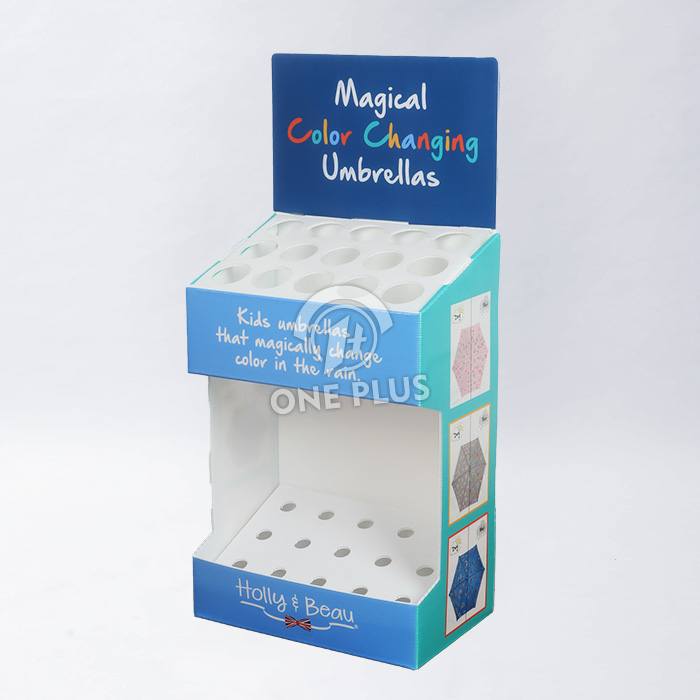
While corrugated cardboard is the default for cost and recyclability, we also work with PVC foam board and acrylic for components that need extra durability or a different visual finish. For example, a PVC foam header can be reused across multiple corrugated bases, or acrylic shelf lips can provide a clear, premium look for bottled beverages. These materials are not standard for this SKU but can be specified during customization. If your application involves stationery or office supplies, where loads are lighter but organization is key, a custom cardboard floor display rack for stationery and office supplies may be a better fit.
Customizable Ranges
- Board grade: B-flute, EB-flute, BC-flute, or custom combinations
- Print method: Litho-lamination, flexo, or digital printing
- Finish: Gloss lamination, matte lamination, aqueous coating, or none
- Shelf depth: Customizable to accommodate bag width or bottle diameter
- Header style: Curved, flat, or die-cut to shape
- Base options: Standard flat base, reinforced base, or hidden wheel base (upon request)
Merchandising and Retail Placement
Where you place this floor display determines its success as much as its engineering. For coffee bags, the highest-converting locations are typically near the coffee aisle endcap, adjacent to creamers or filters, or in a front-of-store impulse zone if the brand has strong recognition. For packaged beverages, the display works well in the cold vault transition area, near checkout, or in a dedicated beverage aisle where it can interrupt the shopper’s path.
The four-tier layout supports a merchandising strategy called vertical blocking—grouping similar products or flavors on the same shelf so shoppers can scan vertically. For example, you might dedicate the top tier to premium single-origin coffee bags, the second tier to flavored instant mixes, the third to bottled cold brew, and the bottom tier to bulk-value packs. This creates a clear price and product hierarchy.
The large curved top header and front shelf lips provide multiple branding touchpoints. The header can carry a campaign message, while the shelf lips can repeat the logo or highlight a specific promotion. This repetition builds recognition from a distance and reinforces the brand when the shopper is close enough to read product details. For maximum impact, keep the header simple—one strong image and one clear message. Cluttered headers dilute attention.
Customization and Production Workflow
Every retail environment has different constraints—shelf height, aisle width, product dimensions, and brand guidelines. Our customization process starts with your product specifications and placement requirements. You provide the bag or bottle dimensions, the number of SKUs, and the desired footprint. We then propose a structural layout and a dieline for approval.
Once the structure is approved, we move to graphics. You can supply print-ready artwork or work with our design team to adapt existing brand assets to the display’s panels. We provide a 3D rendering or a white sample for fit and load testing before mass production. This step is critical for heavy products—it allows you to verify that the shelves can hold the weight and that the display assembles correctly.
Production typically involves die-cutting the corrugated board, printing the graphics, laminating if specified, and then gluing or tab-locking the structure. We ship displays flat-packed to reduce freight costs. The entire workflow is designed to move from concept to delivered production in a timeframe that aligns with your promotional calendar. For buyers who need a faster turnaround, we can prioritize digital printing and simplified finishing.
Three Concrete Use-Case Scenarios
1. Supermarket Endcap for a Regional Coffee Roaster
A regional roaster launches a new seasonal blend and needs a display that can hold 48 bags of coffee across four shelves. The bags are 340 g each, so total load per shelf is approximately 4 kg—well within the 8–12 kg capacity. The display is placed at the end of the coffee aisle for a four-week promotion. The header features the seasonal artwork, and the shelf lips repeat the roaster’s logo. Staff restock from the top down, and the reinforced shelves show no sagging after the promotion.
2. Convenience Store Checkout for Bottled Cold Brew
A convenience store chain wants to drive impulse purchases of bottled cold brew. The display is placed near the checkout, where space is tight. The footprint is customized to fit a 50 cm wide zone. Each shelf holds 12 bottles (250 ml glass), totaling about 6 kg per shelf. The gloss lamination protects against condensation from the cold bottles. The curved header catches the eye of customers waiting in line, and the front lips display the price and flavor.
3. Health Food Store for Instant Mixes and Snack Bars
A health food store uses the display to cross-merchandise instant coffee mixes and snack bars. The top two shelves hold boxed instant mixes, while the bottom two shelves hold snack bars. The display is placed in a high-traffic area near the entrance. The matte lamination gives it a natural, organic feel that matches the store’s aesthetic. The open shelves make it easy for customers to grab products, and the structure remains stable even when the bottom shelves are fully loaded.
Assembly, Packing and Logistics
The display ships flat-packed with clear assembly instructions. Most retail staff can assemble it in under 10 minutes without tools. The interlocking tabs and pre-scored folds are designed for intuitive setup—no glue or tape required for the main structure. For added stability, we recommend placing the display in its final position before fully stocking it. Moving a fully loaded display is not recommended, as the weight can stress the base.
If mobility is essential, we can design a custom base with hidden wheels. This is a modification that must be specified during the customization phase, as it affects the structural design and load distribution. Wheeled bases are typically used for displays that need to be repositioned frequently, such as for promotional events or seasonal resets.
Packing is optimized for freight efficiency. The flat-packed components are bundled and wrapped in protective material, then boxed. We provide a packing list and assembly guide with every shipment. For international orders, we can adjust packing to meet specific pallet or container requirements. Our goal is to minimize shipping volume while ensuring the display arrives undamaged.
Frequently Asked Questions
Czy ten stojak kartonowy poradzi sobie z wilgocią z zimnych napojów butelkowanych?
While the material is paper-based, our floor display units can be coated with a protective film that offers minor splash and moisture resistance for retail settings. This is sufficient for ambient displays where occasional condensation occurs. For constant moisture or refrigerated environments, we recommend a different material such as PVC foam board or acrylic.
Is this model easy to move once fully loaded?
We recommend positioning the display before fully stocking it. For permanent mobility, we can offer custom bases with hidden wheels upon request. This must be specified during the design phase, as it changes the structural requirements.
What is the maximum weight each shelf can hold?
The standard design supports 8–12 kg per tier, depending on the corrugated grade and finishing options. If your products exceed this range, we can engineer a reinforced version with additional internal supports. Always provide your product weight during the customization process so we can recommend the appropriate board grade.
Can I customize the number of shelves or the overall height?
Yes. This 4-tier configuration is a standard starting point, but we can adjust the number of shelves, shelf depth, and overall height to fit your products and retail space. The structural engineering will be adapted to maintain stability and load capacity. Contact us with your requirements for a custom proposal.
Get a Custom Floor Display for Your Coffee or Beverage Brand
If you are planning a retail promotion for coffee bags, bottled beverages, or snack products, a well-engineered floor display can be the difference between a display that sells and one that sits in a back room. This 4-tier unit is designed for real-world retail: heavy loads, frequent restocking, and the need to look good while doing it.
Contact our team to discuss your product dimensions, load requirements, and branding needs. We will recommend the right corrugated grade, finishing options, and structural reinforcements. Whether you need a single display for a test market or a full production run for a national rollout, we can scale to your volume. Let’s build a display that works as hard as your products do.
Talk to the Factory
Send your artwork and target dimensions and our team will return a render and a factory-direct quote. Start with our guide to Custom Cardboard Floor Display Stands.