














Why Pet Supplement Brands Need a Purpose-Built Counter Display
Walk into any independent pet store or veterinary clinic and look at the checkout counter. Between the impulse-purchase treats, the loyalty-program brochures, and the cash register, there is a narrow strip of real estate that determines whether a new supplement brand gets noticed or gets buried. A dropper bottle of omega-3 oil, a boxed joint-support chew, or a shampoo for sensitive skin has roughly three seconds to communicate its purpose before the customer’s attention moves on.
That is the problem a counter display solves — not by shouting, but by organizing. A well-engineered desktop unit holds products upright, presents labels at a readable angle, and uses the structure itself to signal what the product is for. When the base is built with recessed slots cut to the exact footprint of your bottle or carton, the display does something a generic tiered rack cannot: it makes the product look like it belongs there.
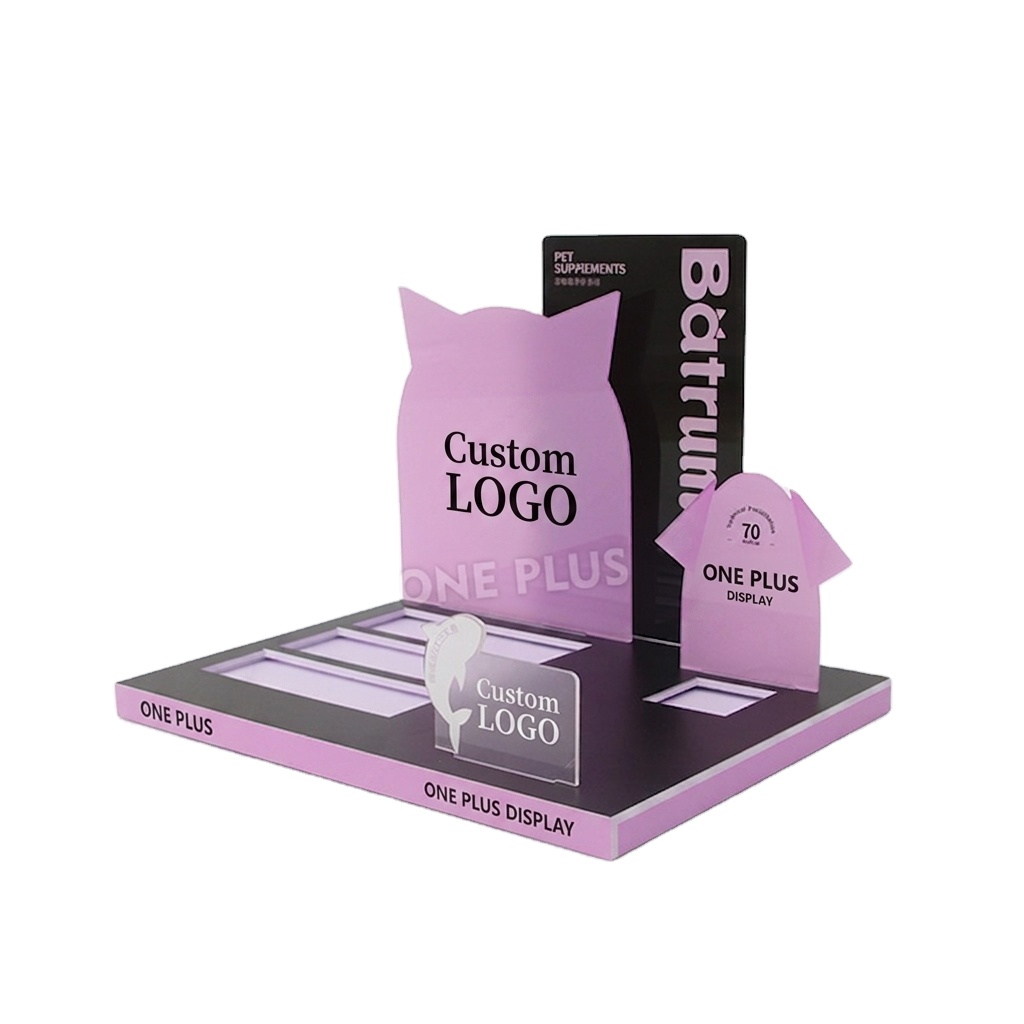
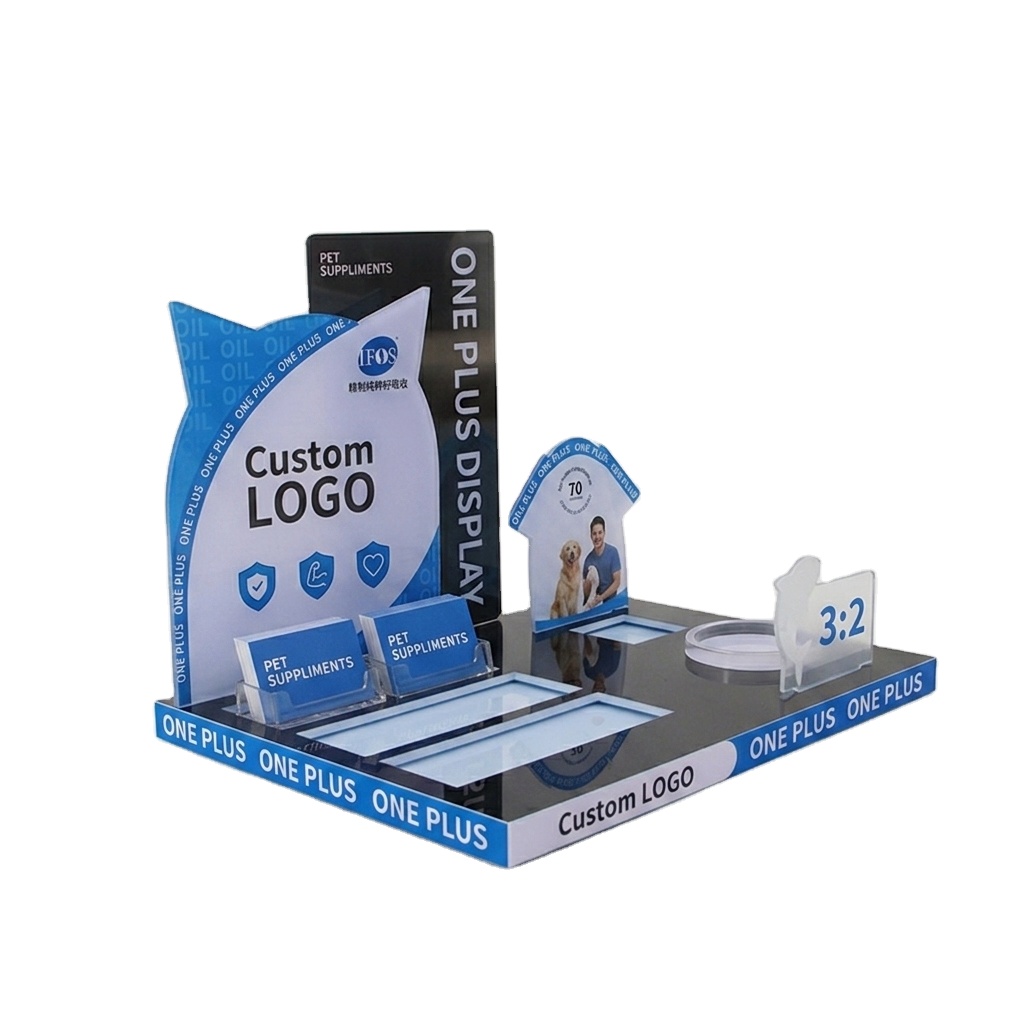
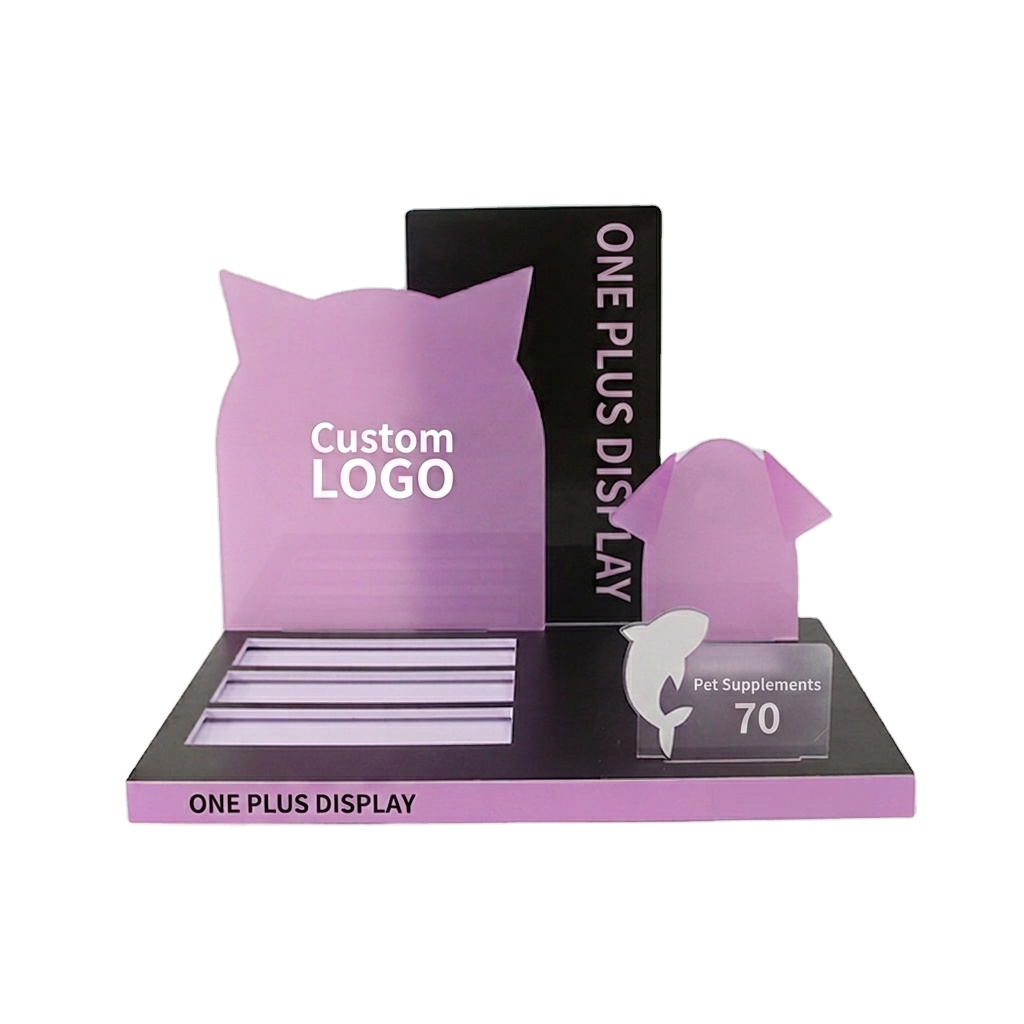
This page covers the engineering, material, and production decisions behind a custom PVC counter unit designed specifically for pet nutrition products — vitamins, droppers, shampoos, and boxed chews — with acrylic accents where transparency or rigidity adds value.
Why PVC Foam Board and Acrylic Win for Pet Nutrition
Pet supplements sit in an awkward category. They are consumables, but they are also health products, which means the packaging has to feel clinical enough to earn trust and warm enough to feel caring. Corrugated cardboard can be printed beautifully, but it dents, absorbs spills, and reads as temporary. A PVC foam board unit reads as permanent.
PVC foam board — often called Andy Board in the display trade — is a lightweight, rigid, closed-cell plastic sheet. It cuts cleanly on a CNC router or laser, holds a matte finish that photographs well under store lighting, and is fully waterproof. If a dropper bottle leaks or a shampoo cap loosens, the display can be wiped down without swelling, warping, or losing print quality. That matters in a category where liquids are common.
Acrylic enters the picture when you need transparency or added structural rigidity. A clear acrylic back panel lets a printed graphic sit behind it for depth. An acrylic shelf edge can create a clean, glass-like lip that frames products. Acrylic is also useful for small removable dividers or risers that need to stay dimensionally stable over years of use. The combination — PVC body, acrylic accents — gives you the printability and cost profile of foam board with the premium feel of a harder plastic where it counts.
Structural and Engineering Decisions
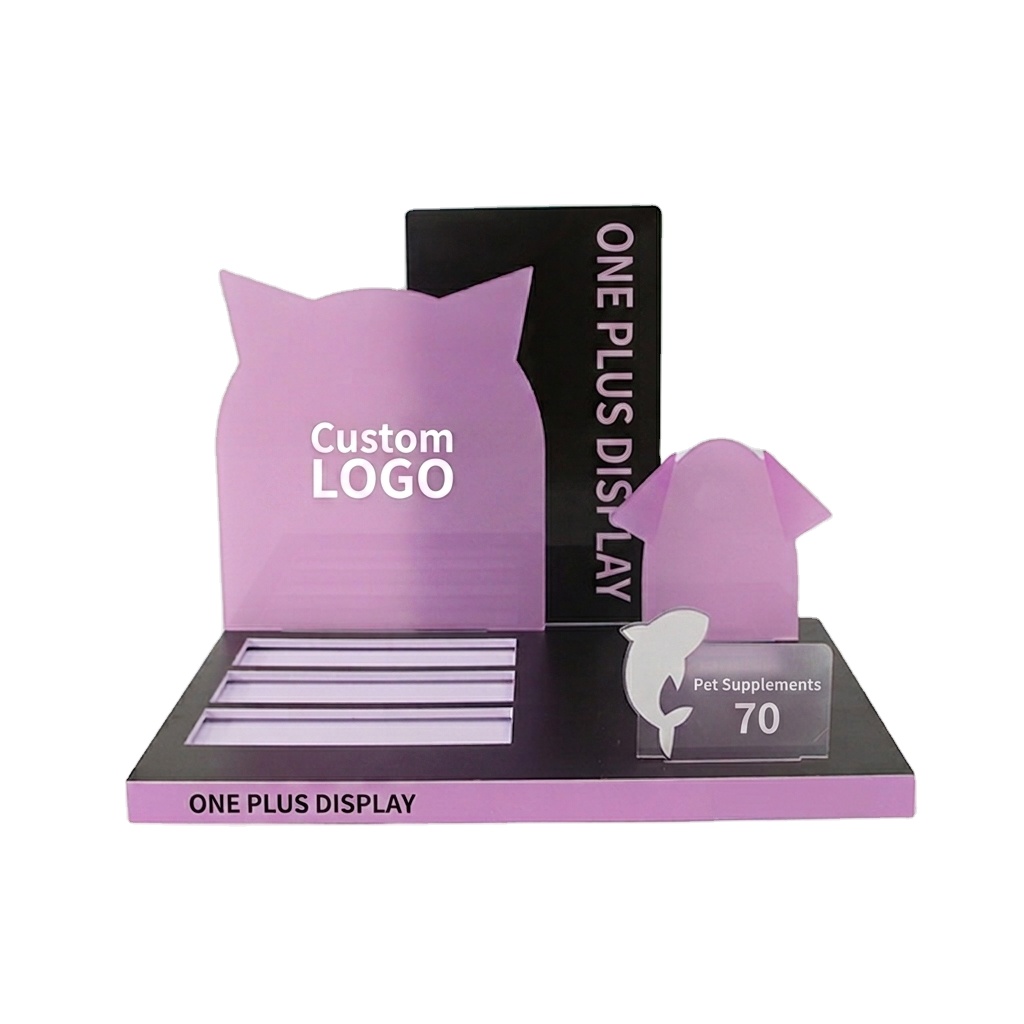
The most important engineering decision in a counter display is not the shape of the back panel — it is the geometry of the base. A recessed slot cut to the exact contour of your bottle or box does three things: it stops products from sliding or tipping, it keeps facing consistent when customers pick up and replace items, and it allows you to merchandise multiple SKUs in a fixed, repeatable layout.
Slots are typically cut with a small tolerance so the product sits firmly but lifts out without resistance. For cylindrical dropper bottles, a circular cut with a slight chamfer works well. For rectangular cartons, a rounded-corner rectangle prevents corner crush. If your range includes both bottle and box formats, the base can be divided into zones with different cut profiles — no need for separate displays per SKU.
Wall thickness and material grade are chosen based on the weight and height of the products. Taller, heavier items benefit from a thicker PVC sheet and a deeper slot. Lighter items can use a thinner sheet, which keeps the unit easy to move and ship. Where a display needs to hold its shape over a long period, acrylic can be laminated to the PVC in high-stress areas such as the base or the vertical spine.
Load and stability considerations
Counter units are bottom-heavy by design. The base provides the footprint, and the vertical structure is kept as narrow as the product range allows. For a desktop PDQ with multiple tiers, each shelf should be supported on both sides rather than cantilevered. If the display will sit on a counter where customers lean or reach across it, a slightly wider base and a low center of gravity reduce the chance of tipping.
We do not publish fixed load ratings because the right figure depends on your product weight, slot count, and material thickness. Instead, we design to your product sample or specification and validate the structure before production. If you can send a physical bottle or box, that is the most reliable input.
Materials and Finishing Options
Three material families are available for this format, and they are often combined in one unit.
| Materiaal | Typical use | Finishing options |
|---|---|---|
| PVC foam board (Andy Board) | Main body, base, back panel, shelves | UV flatbed digital printing, matte or satin finish, laser-cut shapes, CNC-routed slots |
| Acrylic | Accent panels, shelf lips, dividers, transparent windows | Clear, frosted, or colored sheet; polished edges; screen or UV printing; laser cutting |
| Corrugated board | Low-cost trial runs or secondary shipper displays | Litho-laminated print, die-cut, water-based coating |
For the counter unit described here, the primary structure is PVC foam board with acrylic accents. Sheet thickness can range from a few millimeters for light internal dividers to thicker stock for the base and vertical supports. The exact thickness is specified after we review your product dimensions and quantity.
Printing is done with UV flatbed digital presses, which cure ink instantly and bond to the PVC surface. This produces high-resolution graphics — logos, ingredient callouts, breed silhouettes, or lifestyle imagery — that resist scratching and moisture. Because UV printing is digital, there is no plate cost, which makes short runs economically viable. If you need a spot varnish, a matte overlaminate, or a specific color match, those can be discussed at the sampling stage.
Laser cutting allows the structure itself to become branding. A back panel can be cut into a cat-head silhouette, a paw shape, or a simplified product icon. The cut edge is clean and paintable or printable, so the silhouette reads clearly against the products in front of it. This is where a custom display stops being a shelf and starts being a piece of retail storytelling.
Merchandising and Retail Placement
Counter displays work hardest in three retail contexts: the checkout counter, the grooming or treatment area, and the clinic reception desk. Each has a different traffic pattern and a different dwell time.
At the checkout counter, the customer is stationary for a few seconds and often looking for a last-minute addition. A compact unit with a clear product hierarchy — one hero SKU plus one or two supporting items — performs better than a crowded rack. Recessed slots help here because the product faces stay aligned even after repeated handling.
In a grooming or treatment area, the display is seen by customers who are already thinking about their pet’s skin, coat, or joint health. A unit that holds shampoos, conditioners, and topical supplements in a vertical arrangement keeps the range visible from a standing position. A waterproof PVC surface is a practical advantage in a wet environment.
At a clinic reception desk, the display functions more as a recommendation than an impulse buy. A cleaner, more clinical look works well: matte PVC, restrained graphics, and acrylic accents that suggest hygiene and precision. The same structural platform can be adapted to all three contexts by changing the slot layout, the back-panel graphic, and the overall footprint.
Customization and Production Workflow
The process starts with your product dimensions. Send us a sample bottle or box, or provide accurate measurements including cap diameter, label height, and base footprint. If you have a range, send one of each format. From there we produce a structural drawing showing slot positions, tier heights, and overall footprint.
Once the drawing is approved, we move to a physical sample. The sample is produced on the same materials and printing method as the bulk order, so what you approve is what you receive. This is also the stage to test fit: place your actual product in the slots and confirm that it lifts out comfortably and sits level.
After sample approval, bulk production begins. UV printing, CNC routing, laser cutting, and assembly are handled in-house. Lead time for bulk production is typically 12–15 days, depending on quantity and finishing complexity. If you need to hit a trade show or a seasonal launch, build that buffer into your schedule.
For brands launching a new supplement line, the minimum order quantity of 100 sets is deliberately low. It allows you to test a retail rollout, gather sell-through data, and iterate the display design before committing to a larger run.
Three Concrete Use-Case Scenarios
Scenario 1: A new dropper-bottle line entering independent pet stores
A brand launches three SKUs of liquid joint supplements in 30ml dropper bottles. The display is a single-tier PVC counter unit with three circular slots, a printed back panel showing the dosing chart, and a clear acrylic lip along the front edge. The unit sits at the checkout counter of independent pet stores, where the small footprint and clear product orientation make it easy for staff to recommend.
Scenario 2: A grooming brand consolidating shampoo and conditioner SKUs
A grooming company wants to present a shampoo, a conditioner, and a leave-in spray together. The display uses two tiers: the bottom tier has rectangular slots for the taller shampoo bottles, and the top tier has smaller circular slots for the spray. The PVC body is printed with a water-themed graphic, and the base is sealed so it can be wiped down after use in a wet grooming environment.
Scenario 3: A veterinary clinic promoting a prescription diet supplement
A clinic wants a discreet, professional-looking unit for a new supplement recommended after dental procedures. The display is a low-profile PVC unit with a single row of slots for boxed product, an acrylic front panel holding a printed information card, and no loud graphics. It sits on the reception counter, where it reads as a clinical recommendation rather than a retail promotion.
Assembly, Packing and Logistics
Small countertop units can be shipped fully assembled or flat-packed, depending on your preference and shipping budget. Fully assembled units are ready to place on the counter immediately, which reduces labor at the store level. Flat-packed units take up less volume in transit, which lowers freight cost, but require a short assembly step.
Each unit is individually packed in a carton with foam protection. For assembled units, the foam is shaped to hold the display securely and prevent movement during transit. For flat-packed units, the panels are separated with protective layers and the hardware is bagged. We can print assembly instructions on the carton or include a printed leaflet.
Because the display is made from PVC foam board and acrylic, it is relatively light compared to wood or metal. That keeps shipping costs manageable, even for international orders. If you are distributing to multiple retail locations, we can pack in master cartons with a fixed number of units per carton to simplify receiving.
Frequently Asked Questions
What is PVC foam board, and why use it instead of cardboard?
PVC foam board — sometimes called Andy Board — is a rigid, closed-cell plastic sheet. Unlike cardboard, it is waterproof, does not delaminate, and holds a clean printed surface that can be wiped down. For pet supplements, where spills are possible and presentation matters, it offers a more durable and premium-looking alternative.
Can the base slots be cut to fit my specific bottle or box?
Yes. We cut the base layer to match your exact product dimensions. Send us a sample or accurate measurements, and we will produce a structural drawing for approval before cutting. If you have multiple formats in your range, we can cut different slot profiles into the same base.
Does the display ship assembled?
Small countertop units can ship fully assembled or flat-packed. Assembled units are ready to use out of the carton. Flat-packed units reduce shipping volume and cost but require a brief assembly step. We can advise based on your order size and destination.
Is the UV printing durable enough for a retail environment?
UV flatbed printing cures the ink instantly onto the PVC surface, creating a bond that resists scratching and moisture. In normal retail use, the print holds up well. If you expect heavy handling or cleaning, we can discuss a protective overlaminate or a more robust finish at the sampling stage.
Ready to Build Your Counter Display?
If you are launching or expanding a pet supplement line, the fastest way to move forward is to send us your product dimensions and a rough idea of how many units you need. We will come back with a structural concept, a material recommendation, and a sample plan. With a minimum order of 100 sets and a 12–15 day bulk lead time, you can test the retail shelf without overcommitting. Explore our acrylic display stands for related formats, or contact us directly to start your custom PVC counter unit project.