Countertop Pegboard Display for Makeup Brushes That Earns Its Space
At the beauty counter, a shopper picks up a foundation bottle, then glances sideways at the brush wall. In that half-second, she decides whether to add a tool to her basket or walk away. A slanted pegboard countertop display sits exactly in that decision window. It lifts carded brushes and cosmetic kits off the counter, angles them toward the eye, and turns a flat surface into a small, shoppable category.
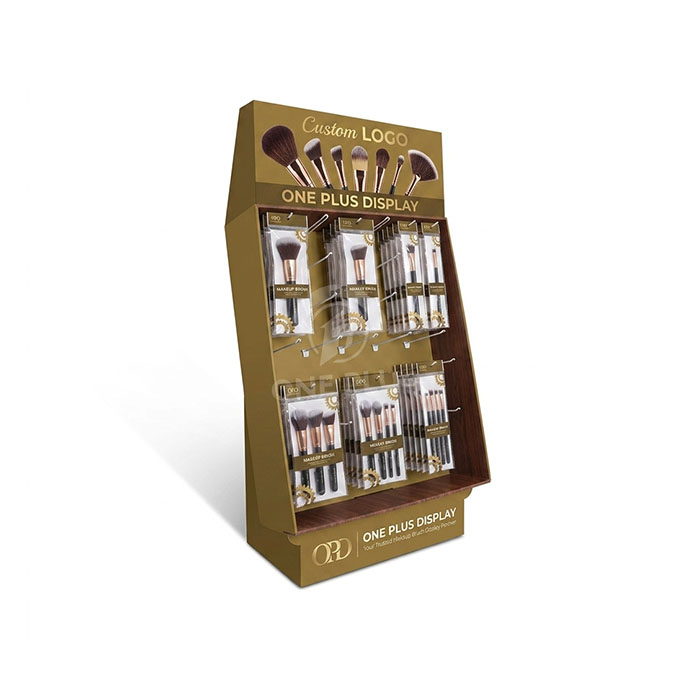
This unit is built for that job: a countertop display unit (CDU) with an angled backing panel, multiple peg hooks, and a custom top header. It is designed for single makeup brushes, brush sets, cosmetic applicators and high-visibility checkout promotions. The body is fabricated from premium recyclable corrugated cardboard, which keeps it light enough to reposition and strong enough to hold a full merchandising load on a store counter.
The format is not a generic hook rack. Every decision — the slant angle, the hook pitch, the header height, the bronze and gold surface treatment — is made to put brush handles and brush heads at the natural reading height of a shopper standing at the register.
Why a Slanted Peg Hook Beats a Flat Tray for Brushes
Makeup brushes are long, thin and easily lost in a pile. A flat tray forces the customer to dig; a peg hook keeps each carded item separated, facing forward, and quickly countable. The slant is the important part. When the backing panel tilts back a few degrees, gravity holds the cards against the panel instead of letting them swing and cross over one another. Products stay in neat rows even after dozens of shoppers have handled them.
There is a second benefit that matters to brand managers: face-out visibility. A slanted peg hook display shows the full card face — logo, brush silhouette, shade name — without the customer having to lift anything. For cosmetics, where packaging is part of the product, that is not a small advantage.
- Visual scanning: cards sit in vertical columns, so a shopper can compare brush types top to bottom.
- Restocking speed: staff slide new cards onto hooks without rebuilding the display.
- Shrink control: individual hooks make gaps obvious, which helps spot missing product during a shift.
- Cross-merchandising: a short hook row can hold cosmetic applicators or sponges next to the main brush line.
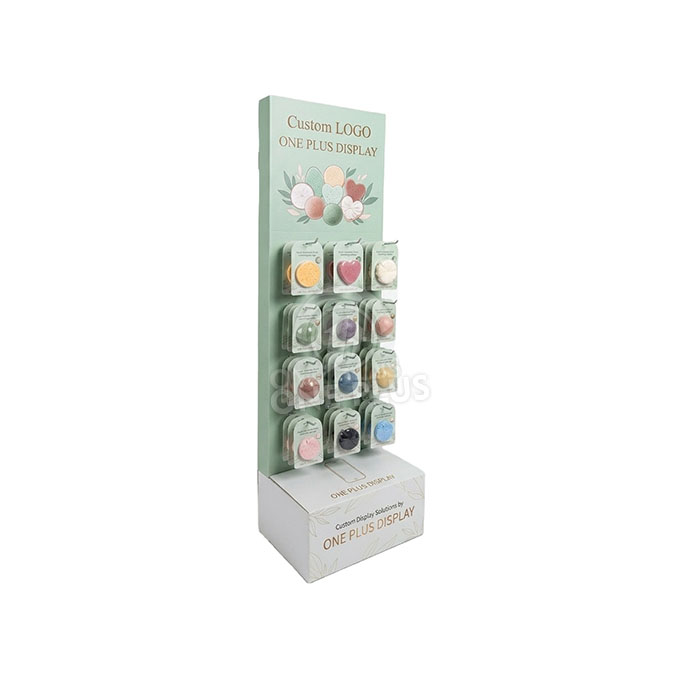
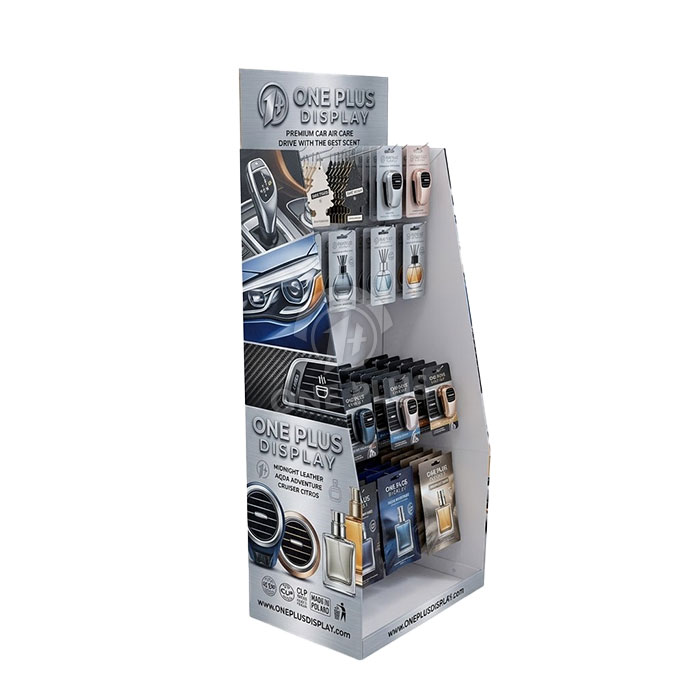
For brands that need a larger footprint, we also build floor-standing versions with the same hook logic, such as this pegboard floor rack for car air fresheners. The countertop version follows the same engineering, scaled down for checkout and vanity fixtures.
Structural and Engineering Decisions
A countertop display has to survive a retail environment: it gets bumped, slid, wiped, and stacked near other fixtures. The engineering therefore focuses on three things — stability, hook retention, and header rigidity.
Base and stability
The base is a folded corrugated foot, sized to keep the center of gravity low. Because brushes are light, the display does not need a heavy counterweight; it needs a wide enough footprint that a hip check does not topple it. We tune the base depth to the panel height so the unit feels planted without taking over the counter.
Slanted panel and hook pitch
The backing panel is set at a slight backward angle. Hook positions are laid out in a grid with consistent vertical spacing so carded brushes of different lengths can share the same panel. The hook pitch is a customizable range — denser for single brushes, wider for multi-piece sets — and can be mixed within one display. Hooks are specified so carded products stay seated during normal handling but release easily when a customer lifts an item.
Header and branding zone
The top header is the billboard. It carries the custom logo and, on this cosmetic build, gold foil typography over a bronze field with realistic brush graphics. The header is die-cut as part of the same corrugated sheet wherever possible, which reduces assembly steps and keeps the silhouette clean.
Materials and Finishing Options
The standard build uses premium recyclable corrugated cardboard. Corrugated is the right default for cosmetic tool displays because it is light, printable over large areas, and inexpensive to ship. We select flute grades based on the load and the finish: a finer flute for crisp print and tight folds, a heavier board for larger headers or longer hook rows. Exact caliper and board grade are matched to your project rather than fixed in advance.
Where a project needs more rigidity or a premium feel, we offer alternative substrates:
| Materiaal | Best for | Typical finish |
|---|---|---|
| Corrugated cardboard | Countertop CDUs, seasonal promotions, recyclable programs | Litho-lam or direct print, matte/gloss varnish, foil accents |
| PVC foam board | Longer-life fixtures, wipe-clean beauty counters | Direct UV print, laminated surfaces, routed edges |
| Acrylic | High-end brush lines, clear or tinted premium look | Polished edges, screen print, frosted panels |
Finishing for the cosmetic segment usually includes a bronze base tone, gold foil or metallic-look print for the logo, and realistic product graphics on the header. Spot UV can add gloss to a brush handle image without making the whole panel reflective. All decorative choices are specified per project; we do not publish fixed color or foil codes because each brand palette is different.
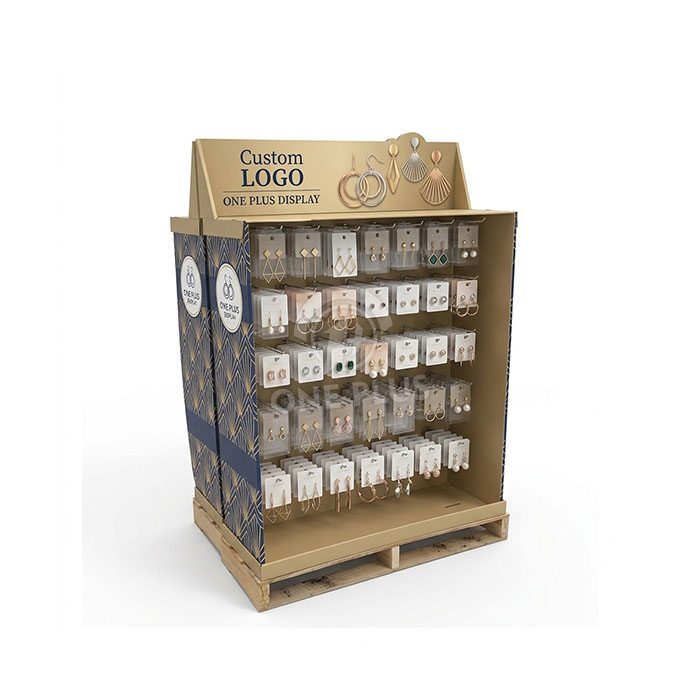
The same material and finish logic applies to smaller jewelry-adjacent builds, as shown in this cardboard earring display stand, where fine detail print and light weight matter just as much.
Merchandising and Retail Placement
Where the display sits changes how it should be built. Three placements are common for makeup brush CDUs:
- Checkout counter: short, narrow, high header. The goal is impulse add-on. Hooks hold single brushes or travel-size applicators.
- Beauty aisle shelf-end: slightly wider base, more hook columns, header readable from several meters away.
- Brand wall or gondola top: coordinated with a larger fixture, often with the header aligned to a shelf-mounted graphic.
Planogram thinking should start before artwork. Decide how many SKUs share the panel, whether brush sets hang beside singles, and whether any hook needs to hold a heavier kit. Those answers set the hook count and spacing, which in turn sets the panel width. Getting that sequence right avoids a beautiful display that cannot hold the assortment.
Customization and Production Workflow
Every unit is made to order. The process typically runs through these stages:
- Brief and assortment review. You share SKU dimensions, card sizes, hook count and placement goals.
- Structural design. We propose a die-line with base, slanted panel, hook layout and header proportions.
- Artwork and proofing. Brand graphics, foil areas and product imagery are placed on the dieline for approval.
- Sampling. A physical sample lets you test hook fit and counter presence before mass production.
- Production and QC. Print, die-cut, fold and pack, with checks on hook alignment and header registration.
Customizable variables include overall height and width, slant angle, hook quantity and pitch, header shape, substrate, and finish. If you already know your counter depth and SKU count, the design can usually be locked quickly. If not, we can work from a planogram sketch.
Three Concrete Use-Case Scenarios
1. Prestige brush launch at a department store counter
A brand launches a five-piece brush set alongside singles. The display runs a bronze body with gold foil logo and a header showing the full set. Hooks are pitched to hold both carded singles and boxed sets, and the panel is narrow enough to sit beside the register without blocking the card terminal.
2. Drugstore checkout impulse program
A retailer wants a low-cost, recyclable unit for travel brushes and applicators. Corrugated construction keeps unit cost and shipping weight down, and the compact base fits a crowded checkout lane. The header carries a simple price-point message rather than a full brand story.
3. Pop-up beauty event or salon retail corner
A temporary activation needs a display that assembles in minutes and can be packed flat afterward. The slanted peg panel and folding base ship knocked down, and the unit can be re-used across several events before recycling.
Assembly, Packing and Logistics
The unit ships flat. Assembly is a sequence of folds: erect the base, lock the slanted panel into the base slots, then attach or fold up the header. No tools are required, and a store associate can build it in a few minutes. We include a simple assembly sheet with each carton.
Packing is designed around retail distribution. Units are stacked flat, wrapped for moisture protection, and packed in master cartons sized to standard pallet footprints. Because corrugated is light, freight cost per display is low compared with wood or metal fixtures. For multi-store rollouts, we can bundle quantities per region so each distribution center receives a carton count that matches its store list.
If you need a hook display for a different category, our pegboard hook displays range covers countertop, shelf and floor formats using the same structural approach.
Frequently Asked Questions
Can the hook layout be changed for our SKU cards?
Yes. Hook count, vertical pitch and hook type are all customizable. Send us a carded sample or card dimensions and we will design the panel around them.
Is corrugated strong enough for a full countertop load?
For makeup brushes and cosmetic applicators, corrugated is well suited because the products are light. We match flute grade and base geometry to the expected load, and can move to PVC foam or acrylic if a project requires more rigidity.
Can we print a metallic or foil logo on the header?
Yes. Gold foil, metallic-look inks and spot UV are all available on the header area. Exact colors are matched to your brand artwork during proofing.
What is the minimum order and lead time?
Both depend on size, finish and quantity. Share your project details and we will confirm a production schedule and minimum quantity for your specific build.
Start Your Makeup Brush Display Project
If you are planning a cosmetic tool launch, a checkout impulse program, or a counter refresh, send us your SKU list, card sizes and counter dimensions. We will return a structural proposal with hook layout, header proportions and material options for your review. One Plus Display builds factory-direct, so you work with the team that produces the display, not a middle layer.