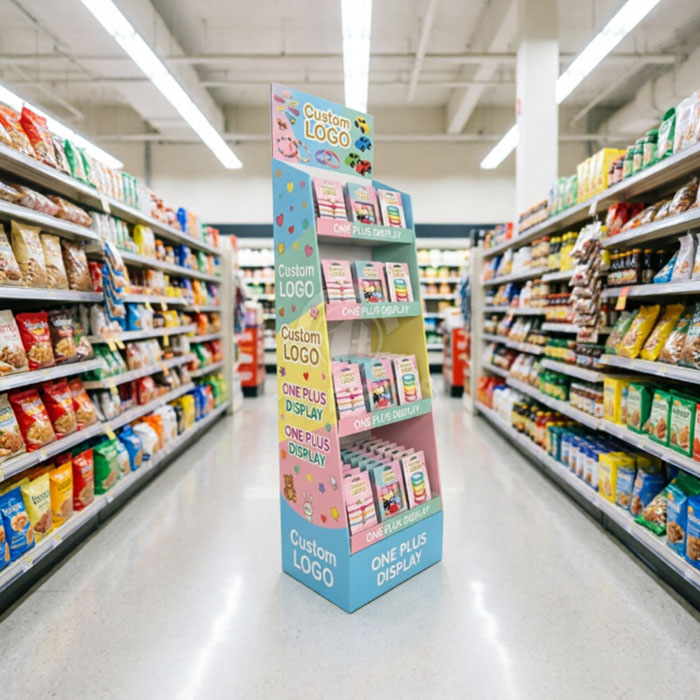
Tilpasset Papirdisplay Stand for Toy Accessories & Small Novelties | Retail Floor Merchandiser SKU-202609030907331
Supplier selection · Updated 2026 · 8-minute read
When a quotation arrives for a custom cardboard display, the first question is not “how much?” but “who is actually making it?” A trading company and a factory can both return a professional quote, a realistic render and a competitive price. The difference shows up later — in the sample, the load test, the colour match and the conversation when something goes wrong.
This guide compares the two models for cardboard display sourcing: what each one controls, where the costs sit, when a trading company is genuinely the better choice, and how to tell the difference before you pay a deposit. It is not an argument that one model always wins; it is a framework for choosing the right one for your programme.
The short answer
A direct factory is usually better when the display is structurally custom, load-critical, compliance-sensitive or produced in volume. A trading company can be better when you need a small mixed order across several materials, a single export contact, or consolidated shipping from suppliers you do not want to manage individually.
For a custom corrugated POP display, the structural and quality risk is concentrated in the factory. That is why buyers increasingly ask to deal with the producing entity directly — or at least to know exactly which entity is accountable.
What a trading company actually does
A good trading company is not simply a middleman with an email address. It can add real value:
- Sourcing breadth — it may work with several factories and combine corrugated, acrylic, metal and printed components in one order.
- Export administration — documentation, consolidation, booking and communication with forwarders.
- Language and time-zone coverage — a single account manager for buyers who do not want to manage multiple Chinese suppliers.
- Small-order aggregation — it can place a small order with a factory that would not accept it directly.
The risk is not that the model is illegitimate. The risk is unclear accountability: when the display fails, the trader has to negotiate with the factory, and the buyer is not in that conversation.
What a factory actually controls
A display factory controls the variables that decide whether the unit survives the promotion:
- Board grade and liner — the material decision that determines load capacity and moisture resistance.
- Structural engineering — the load path, base geometry, lock design and assembly sequence.
- Print and colour — the press, the profile and the operator who matches the brand colour.
- Die and tooling — the cut quality and the dimensional consistency across the run.
- Quality decision — who signs the inspection and what happens when it fails.
If those decisions sit with a third party, the buyer is relying on a chain of instructions rather than a single accountable team.
Side-by-side comparison
| Decision area | Direct factory | Trading company |
|---|---|---|
| Structural engineering | In-house review of load path, board grade and retail rules | Relays the brief to a factory; engineering depth varies |
| Sampling | Sample made on the same line and board as bulk | Sample may come from a different factory than bulk |
| Price structure | Factory cost plus the factory margin | Factory cost plus a trading margin and handling costs |
| MOQ flexibility | Set by the factory’s setup and material minimums | Can aggregate small orders across factories |
| Quality accountability | One QC team and one inspection signature | Responsibility is split between trader and factory |
| Communication | Direct with engineers and production, but a language gap is possible | Usually smoother in English, with an extra layer between buyer and line |
| Lead-time control | Production slots and material planning controlled internally | Depends on the factory queue and the trader’s other orders |
| IP and tooling | Die ownership and confidentiality can be contracted directly | Tooling may sit with the factory; ownership needs to be documented |
| Multi-material sourcing | Limited to the factory’s own capabilities | Can combine several suppliers in one shipment |
The total-cost view
Buyers often compare the unit price and stop there. The more useful comparison is the landed cost of a display that passes the retailer’s requirements on the first attempt:
- Unit price — board, print, tooling, assembly and packing.
- Sample cost — including courier and the cost of a second sample if the first fails.
- Freight and duty — modelled on the same Incoterm and pallet plan.
- Failure cost — rework, air freight, missed installation dates and the retail relationship.
- Management time — the hours spent chasing a trader, a factory and a forwarder separately.
A trading company can be cheaper on the first line and more expensive on the last two. A factory can be cheaper overall and harder to onboard if it lacks export experience or English-language project management.
When a trading company is the better choice
- You need a small mixed order across corrugated, acrylic, metal and printed parts, and no single factory makes all of it.
- You do not have an export or logistics team and want one contact for documentation, consolidation and shipping.
- You are testing a market with a low volume that falls below most factories’ direct MOQ.
- You already have a factory relationship but need help with quality inspection, consolidation or a second source.
In those cases, choose a trader that is transparent about which factory will produce the order and allows you to meet or audit that factory. A trader who refuses to disclose the production site is a red flag, not a service.
When a direct factory is the better choice
- The display is structurally custom and the load path needs engineering, not just a catalogue selection.
- The retailer requires audit documentation for the producing site, such as FSC, BSCI, Sedex, GMI or a Walmart/Disney approval.
- The programme is large enough to justify a direct relationship and a factory-owned die.
- Colour and finish are brand-critical and you want to talk to the people running the press.
- You need multi-material assembly — for example corrugated shelves with acrylic dividers and a PVC header — under one quality system.
Format-specific requirements also differ: floor stands are load- and base-critical, palldisplayer are footprint- and club-store-critical, and hylleklar emballasje is judged on case-to-shelf performance.
One Plus Display is built around this model: a 23,000+ m² plant in Dongguan, in-house printing, laminating, die-cutting, CNC cutting and assembly, and a published MOQ from 100 pieces. The manufacturer guide sets out the certifications, sampling process and lead times in detail.
Eight questions that reveal the difference
- Which legal entity will produce the order, and what is the factory address?
- Which production steps are in-house, and which are subcontracted?
- Who owns the die, and can it be transferred if we change supplier?
- Who signs the pre-shipment inspection, and against which golden sample?
- Can we see a live video tour of the line that will run our job?
- Which certificates are held by the producing entity, not the group?
- What happens if the loaded sample fails the agreed test?
- Is the quotation FOB, CIF or DDP, and what is excluded?
Ask the same eight questions to a factory and a trader. The answers will tell you more about accountability than any brochure.
Red flags
- The business licence name, quotation name and bank account name do not match.
- The supplier cannot name the factory or refuses a video tour.
- Certificates belong to a different company or have expired.
- The quote is dramatically below the others with no explanation of board grade or print method.
- No written sample approval or inspection standard.
- Payment is requested to a personal account or a third-party account without a contract.
A hybrid model can work
Some brands use a factory for the structural design and bulk production, and a local partner or trader for consolidation, warehousing and last-mile delivery. That can be the best of both models, provided the golden sample, the quality standard and the IP ownership are documented across every party. The failure mode is a chain where nobody owns the final inspection.
Factory vs trading company: FAQ
Is it cheaper to buy directly from a factory?
Usually, because there is no trading margin, but not always. A trader may aggregate a small order, negotiate a better factory rate or include services you would otherwise pay for separately. Compare the landed cost and the quality responsibility, not just the unit price.
Are trading companies less reliable?
Not inherently. A good trader can be a valuable export partner. The risk is unclear accountability: if the trader does not disclose the production site or cannot share the factory’s certificates, the buyer has less control over quality and compliance.
Can a trading company provide FSC or BSCI documents?
It can pass through documents from the factory, but the certificate must cover the producing entity and site. Ask to see the certificate and confirm the name on it matches the factory that will make your order.
What MOQ should I expect from a direct factory?
For custom offset-printed cardboard displays, 100–500 pieces per design is a common starting range, with digital print supporting lower quantities. The MOQ depends on the structure, print method and material, so ask for the basis in writing.
How do I protect my design and tooling?
Use an NDA, specify ownership of artwork and dielines in the contract, and state who owns the die and where it is stored. Ask for the tooling to be returned or transferred if you change supplier.
Can I audit a factory that works through a trader?
You should. Make factory access and audit rights part of the agreement. A trader that will not disclose or allow access to the production site is a poor fit for a compliance-sensitive retail programme.
Next step
If you are comparing a factory quote with a trader quote, send both the same specification, the same Incoterm and the same pallet plan. Then ask the eight questions above. Our cardboard display manufacturer guide shows how a factory answers them, and the contact form is the fastest way to request a like-for-like quote.
Factory capabilities and certifications → | China sourcing checklist → | Top manufacturers 2026 →