
Built for the Walmart Impulse Aisle
A shopper walks past the automotive aisle endcap, glances at a floor rack, and within two seconds registers a row of hanging air fresheners at eye level. That brief moment is where the sale is won or lost. For brands selling car air fresheners, vent clips, and small hanging perfumes, the display must do three jobs at once: stop foot traffic, present dozens of SKUs without clutter, and survive the restocking cycle of a big-box retail environment. A freestanding pegboard display rack built specifically for hanging product does all three.
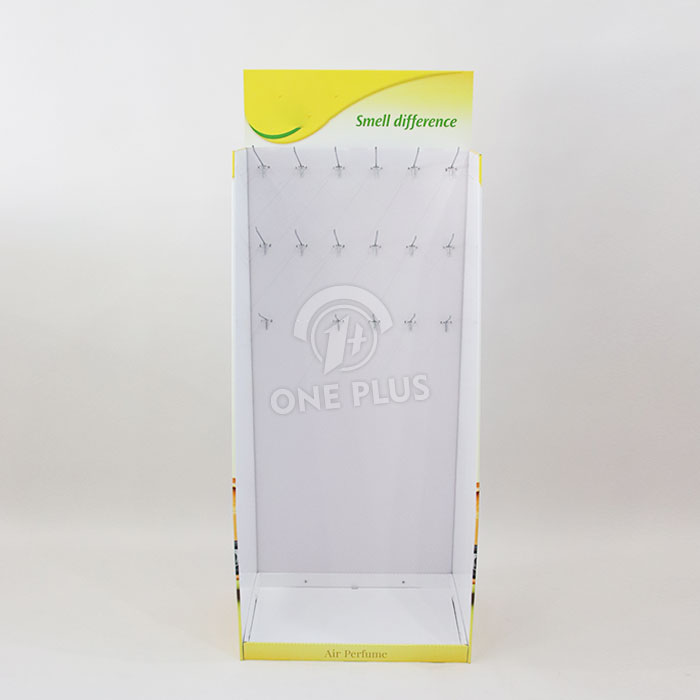
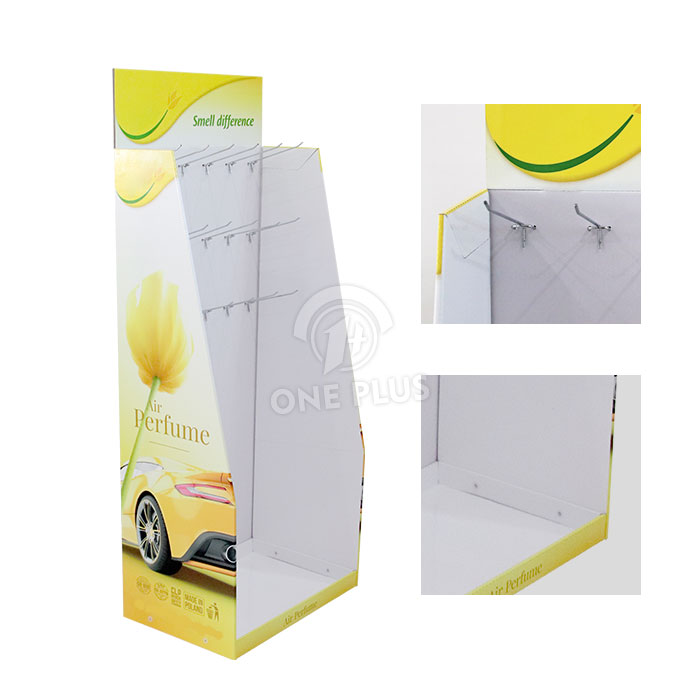
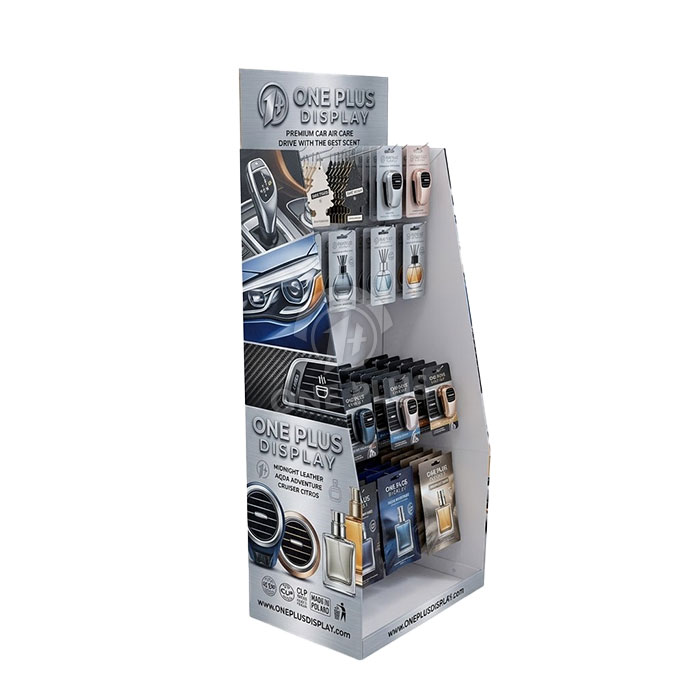
This page covers the engineering, merchandising, and production details behind a custom cardboard pegboard floor rack designed for car air fresheners and similar lightweight hanging automotive accessories. It is written for retail buyers, brand managers, and category managers evaluating a display program for Walmart or a similar high-traffic retailer. The unit shown in our reference builds uses a reinforced corrugated body, a pegboard face with metal hooks, and a fully branded headboard — but the structure, dimensions, and graphics are customized per program.
If you are sourcing a display that must fit a specific floor footprint, hold a defined product mix, and ship economically to multiple store locations, the sections below explain how the format works and where the design decisions actually matter.
Why a Pegboard Floor Rack Wins for Air Fresheners
Car air fresheners are small, light, and highly visual. They are also sold in high volumes across multiple scent variants, which creates a merchandising problem: a flat shelf forces shoppers to pick through a pile, while a pegboard lets every unit hang face-out and readable. For a category driven by scent selection and impulse purchase, face-out presentation is not a nice-to-have — it is the primary sales mechanism.
Three characteristics make the pegboard floor format a strong fit for this application:
- Vertical density. A floor rack uses height rather than shelf depth, so a compact footprint can hold a wide assortment of hanging SKUs. This matters in Walmart aisles where floor space is allocated tightly and every square foot must justify its sales per square foot.
- Restock speed. Store staff can reload hooks from a single flat-packed carton without disassembling the unit. Faster restocking means fewer out-of-stocks and less labor cost per unit sold — a point retail operations teams care about as much as brand teams do.
- Brand canvas. The headboard and side panels are large, flat surfaces that carry high-resolution graphics. A pegboard rack can communicate a scent theme, a brand color system, or a promotional message at a distance, which a standard shelf cannot.
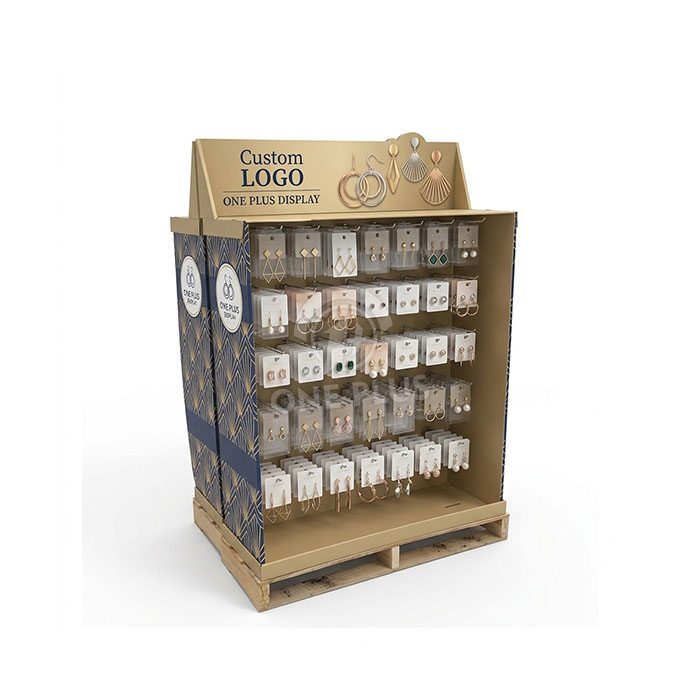
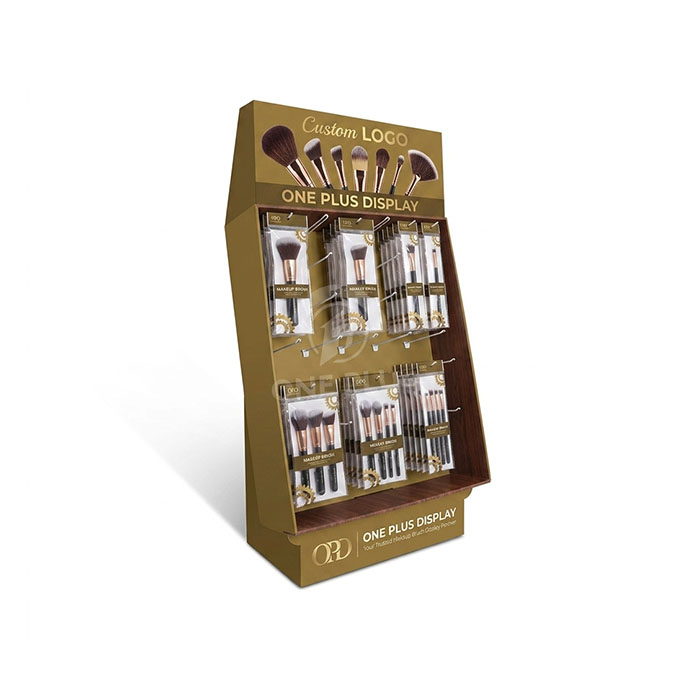
For related small-format merchandising applications, the same structural logic applies to jewelry and cosmetics — see our custom cardboard display stand for earrings and our makeup brush merchandiser for comparable hook-based configurations.
Structural and Engineering Decisions
The visible part of a pegboard display is simple: a panel with holes and hooks. The engineering happens behind that panel. Because the unit is freestanding and loaded with hanging product, the critical forces are lateral sway, forward tipping, and point loading at each hook insertion.
Base and stability
The base must be wide enough to resist tipping when a shopper pulls a product from a high hook. In practice, we size the base relative to the overall height and the expected load distribution, and we add internal corrugated bracing at the floor contact points. For taller configurations, a two-piece base with interlocking tabs distributes load more evenly than a single panel.
Pegboard panel and hook interface
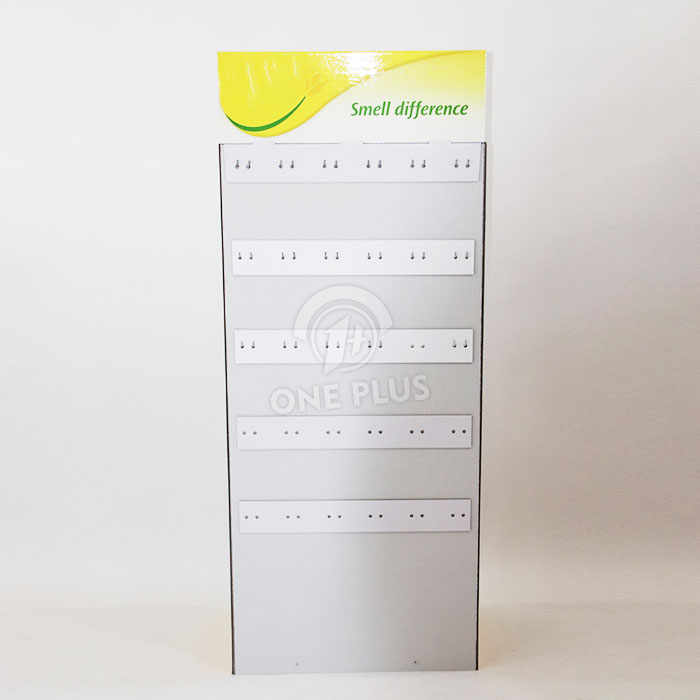
Hooks are inserted through pre-punched holes in the pegboard face and lock into position. The hole spacing and diameter are matched to the hook gauge you specify. For lightweight air fresheners, standard metal hooks are sufficient; for heavier hanging items, we upgrade the panel thickness, reduce hole spacing, or add a secondary backing layer so the hook load transfers into the panel rather than tearing through it.
Reinforcement strategy
Reinforcement is added where the structure experiences the most stress: the base, the vertical spine, and the headboard joint. Internal fluting orientation matters here — vertical flutes in the upright panels resist bending, while horizontal flutes in the base panels resist compression. We specify flute direction per panel rather than applying a single blanket rule.
For buyers who need a broader overview of hook-based formats, our pegboard hook displays page covers the range of configurations available.
Materials and Finishing Options
The default material for this format is recyclable corrugated cardboard, selected for its strength-to-weight ratio and flat-pack shipping efficiency. However, cardboard is not the only option, and the right choice depends on load, lifespan, and retail environment.
| Materiale | Best suited for | Notes |
|---|---|---|
| Corrugated cardboard (single or double wall) | Short-to-medium term programs, lightweight hanging product | Recyclable, low tooling cost, flat-packs efficiently |
| Reinforced corrugated with internal bracing | Heavier loads or taller freestanding units | Adds rigidity without changing the visual footprint |
| PVC foam board | Longer in-store life, humidity resistance, premium feel | Heavier than corrugated; better for permanent fixtures |
| Acrylic | High-end presentation, transparent panels, durable pegboard face | Highest cost; often used for the hook panel only |
Printing is typically high-resolution offset or UV printing, which allows vivid brand colors and photographic scent imagery on the headboard. Finishing options include glossy or matte lamination for scuff protection and a consistent surface sheen. Exact dimensions, panel thicknesses, and load capacities are set per project based on your product weight and floor space — we do not publish fixed numbers because the correct values depend on the specific mix you are merchandising.
Merchandising and Retail Placement
Where the rack sits determines how it should be designed. In a Walmart automotive aisle, the unit competes with established planogram fixtures and must fit within a defined footprint while remaining visible from the main walkway. Three placement patterns work well for air fresheners:
- Endcap-adjacent floor position. Places the rack at the transition between the automotive aisle and a cross-aisle, capturing shoppers moving between categories.
- Checkout-adjacent placement. At gas station or front-end checkout zones, the rack functions as a pure impulse unit, with top hooks reserved for the highest-margin or seasonal scents.
- In-aisle branded shop-in-shop. A taller rack with a full headboard can act as a mini destination within the auto care section, grouping scents by variant.
Hook placement should follow a simple hierarchy: eye-level hooks carry the best-selling scents and new launches, lower hooks carry refills and secondary variants, and the headboard carries the brand message. This structure makes restocking predictable and keeps the presentation consistent across multiple store locations.
Customization and Production Workflow
Every unit is built to order. The process typically follows this sequence:
- Brief and structural concept. You share product dimensions, weights, target SKU count, and floor footprint. We propose a structure and hook layout.
- Graphic design. Your brand assets are applied to the headboard, side panels, and base. We provide dielines for accurate artwork placement.
- Sampling. A physical sample is produced so you can verify structure, print color, and hook fit before committing to bulk.
- Bulk production. Once the sample is approved, the full run is manufactured, inspected, and packed.
Minimum order quantity is 100 pieces. Sample lead time is typically 3–5 days, and bulk production runs 10–12 days depending on quantity and finishing complexity.
Three Concrete Use-Case Scenarios
1. National air freshener brand launching a scent collection
A brand introducing six new scent variants needs a display that presents all six face-out with clear variant labeling. A pegboard rack with color-coded hook zones and a headboard featuring the collection artwork allows the full range to be merchandised in a single compact footprint.
2. Gas station chain with limited counter space
A gas station operator needs a compact floor unit that holds hanging perfumes and air fresheners near the register. A narrow-footprint rack with a weighted base and a small headboard fits the space while still holding enough SKUs to drive add-on purchases.
3. Automotive aftermarket retailer promoting a seasonal scent
A retailer running a seasonal promotion needs a display that can be assembled and disassembled quickly across multiple stores. A flat-packed corrugated rack with pre-punched pegboard panels and interchangeable headboard graphics supports fast rollout and easy refresh for the next promotion.
Assembly, Packing, and Logistics
Units ship flat-packed in a master carton, which reduces shipping volume and freight cost compared with pre-assembled fixtures. Assembly is designed to be tool-light and intuitive: panels interlock, the pegboard face attaches to the upright structure, and hooks are inserted after the frame is standing. We provide assembly instructions and, where needed, a short assembly video for store teams.
Because the unit is flat-packed, it can be shipped to a distribution center and then distributed to individual stores without the damage risk associated with pre-built displays. For multi-store rollouts, this is often the deciding factor in material selection.
Frequently Asked Questions
How are the metal hooks secured to the pegboard panel?
Hooks are inserted through pre-punched holes in the pegboard face and lock into position. The hole spacing and hook gauge are matched to your product weight, so the hooks stay stable even when fully loaded.
What weight can this hook display hold?
Capacity depends on the panel material, thickness, and reinforcement strategy. For lightweight car air fresheners and hanging perfumes, standard corrugated construction is sufficient. For heavier items, we upgrade to reinforced corrugated, PVC foam, or acrylic and adjust the internal bracing accordingly.
Can the display be customized to match our brand?
Yes. The structure, headboard, side panels, and base are fully customizable. We apply your graphics using high-resolution offset or UV printing, with glossy or matte lamination for protection. We provide dielines so your artwork fits accurately.
What is the minimum order and lead time?
Minimum order is 100 pieces. Samples are typically produced in 3–5 days, and bulk production takes 10–12 days depending on quantity and finishing. Exact timelines are confirmed once the specification is finalized.
Request a Custom Pegboard Display Quote
If you are planning a car air freshener or small automotive accessory program for Walmart or another high-traffic retailer, send us your product dimensions, target SKU count, and floor footprint. We will propose a structure, hook layout, and material specification, then produce a sample for your approval before bulk production. Contact our team to start the conversation.