A Slanted Peg Hook Countertop Display That Earns Its Space
Picture a convenience store counter at 10:40 PM. The register queue is four deep, and the only product a customer can reach without stepping out of line is what sits on the counter itself. Carded air fresheners and fragrance pendants live or die in that six-inch strip of real estate. If the cards are stacked flat in a tray, nobody reads them. If they hang on a vertical peg panel, the bottom row disappears behind the customer’s own hand. The format that keeps working in this environment is the slanted peg hook countertop display: an angled backing panel that tilts the product face toward the shopper’s eye line, so every card stays legible from a standing position.
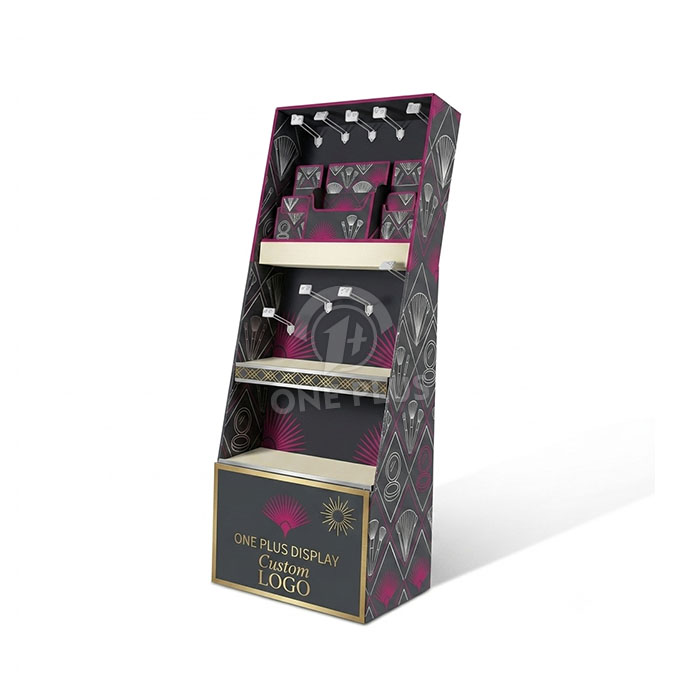
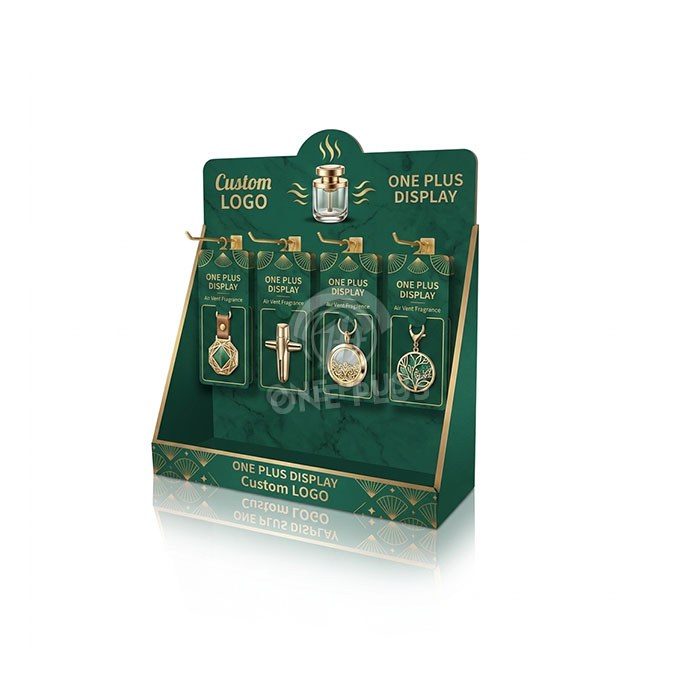
This page covers how that format is engineered, what it costs you in material and finishing choices, and how to brief a build that fits your specific product mix. The reference unit behind this article, SKU-202608210705578-FRAGRANCE-DISPLAY, is a countertop display unit (CDU) built in recyclable corrugated board with a die-cut top header, metal peg hooks, and an emerald-and-gold print treatment. The principles below apply whether you sell car air fresheners, perfume pendants, essential oil diffusers, or any other carded fragrance accessory.
Why a Slanted Peg Panel Beats a Flat Tray or Vertical Board
The angle is not decorative. It solves three merchandising problems at once.
Readability from standing height. A customer at a checkout counter looks down at roughly a 30- to 45-degree angle. A vertical peg panel presents product parallel to that sight line, which compresses the artwork and hides the lower cards. Tilting the panel back a modest amount rotates each card face upward, so the brand name, scent name, and price point stay readable without the shopper crouching or lifting a product off the hook.
Gravity-assisted restocking. On a vertical hook, a card that is removed leaves a gap and the remaining cards do not self-align. On a slanted hook, cards slide gently back toward the panel face and settle in a consistent presentation. Store staff spend less time straightening product, and the display looks intentional between restocks rather than picked-over.
Higher visual density per square inch. Because the panel is angled rather than upright, the hooks can be staggered in rows without the front row shadowing the rear row. That means more facings in the same countertop footprint, which matters when you are paying for a fixed amount of checkout space.
For a broader look at how peg-based structures scale from counter to floor, our pegboard hook displays overview walks through the hook patterns and panel constructions we build most often.
Structural and Engineering Decisions
Every countertop display is a small piece of structural engineering. Four decisions drive whether it survives a retail floor.
Panel angle and hook geometry
The backing panel tilt is set by the die-cut side walls, not by a separate bracket. This keeps the unit to a single folded piece where possible. The hook pitch — the vertical and horizontal spacing between hook positions — is matched to the width of your carded product plus a working clearance, so cards hang freely without overlapping and without wasting space. Hook length is chosen so the card sits proud of the panel and the header artwork behind it remains visible.
Base and center of gravity
A slanted panel shifts weight forward. The base footprint is therefore sized to keep the loaded center of gravity inside the base perimeter even when the front hooks are full and the rear hooks are empty — a common real-world condition. A locking tab or interlocking base panel keeps the unit from splaying under load.
Hook retention
Metal peg hooks are anchored through the corrugated panel with a backing washer or a folded reinforcement layer. On heavier product, we add an internal corrugated doubler behind the peg field so the board does not oval out over time. Hook count and spacing are fully configurable; we do not publish fixed load ratings because performance depends on board grade, hook gauge, and product weight, so we test against your actual sample.
Header and sight line
The die-cut top header is where brand recognition happens. It is cut as part of the same blank, so it folds up from the rear panel and stays rigid without extra hardware. Height is tuned so the header does not block the cashier’s view of the customer or the register screen.
Materials and Finishing Options
Corrugated cardboard is the default for countertop fragrance displays because it is light, recyclable, printable edge-to-edge, and inexpensive to ship flat. But it is not the only option, and the right substrate depends on product weight, expected service life, and how premium the brand needs to feel.
| 소재 | Best for | Notes |
|---|---|---|
| Corrugated cardboard (single wall) | Light carded pendants, short promo runs | Lowest cost, ships flat, fully recyclable |
| Corrugated cardboard (double wall or reinforced) | Heavier multi-packs, longer floor life | Better peg retention and base rigidity |
| PVC foam board | Wet or humid environments, wipe-clean surfaces | Moisture resistant, crisp edges, heavier |
| Acrylic | High-end fragrance, permanent counter fixtures | Clear or tinted, premium feel, higher unit cost |
Finishing is where a display earns its “sophisticated” label. The emerald-and-gold look on the reference unit is achieved with a deep green marble pattern printed across the panel faces, gold trim applied as a printed band or foil accent, and custom typography in the header. We can matte- or gloss-laminate the print to protect it from handling, add spot UV to highlight a logo, or leave the board uncoated for a natural kraft look. Edge colors can be printed to match the face so the folds read cleanly from the side.
Board thickness, flute profile, hook gauge, and finish are all specified per project rather than pulled from a fixed catalog. If your fragrance pendants are unusually tall or your cards are oversized, the panel and hook field are re-cut around them.
Merchandising and Retail Placement
Countertop displays succeed when the placement decision matches the purchase occasion. Fragrance accessories are almost always impulse buys, so the display belongs where the customer is already waiting: the checkout lane, the service counter, the parts counter, or the queue rail.
- Checkout counter: the classic position. Keep the header below the cashier’s sight line and angle the panel toward the customer side, not the staff side.
- Automotive parts counter: pairs naturally with car air fresheners, vent clips, and hanging pendants bought alongside interior accessories.
- Boutique and gift retail: perfume pendants and essential oil diffusers read as gifts, so a countertop unit near the register captures add-on purchases.
- Multi-location rollouts: a small CDU is easy to replicate across stores with consistent branding, unlike one-off shelf arrangements.
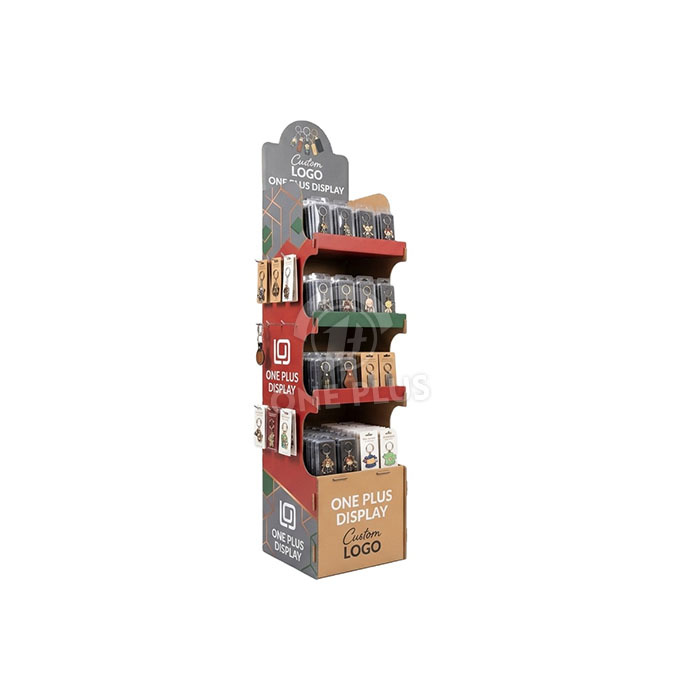
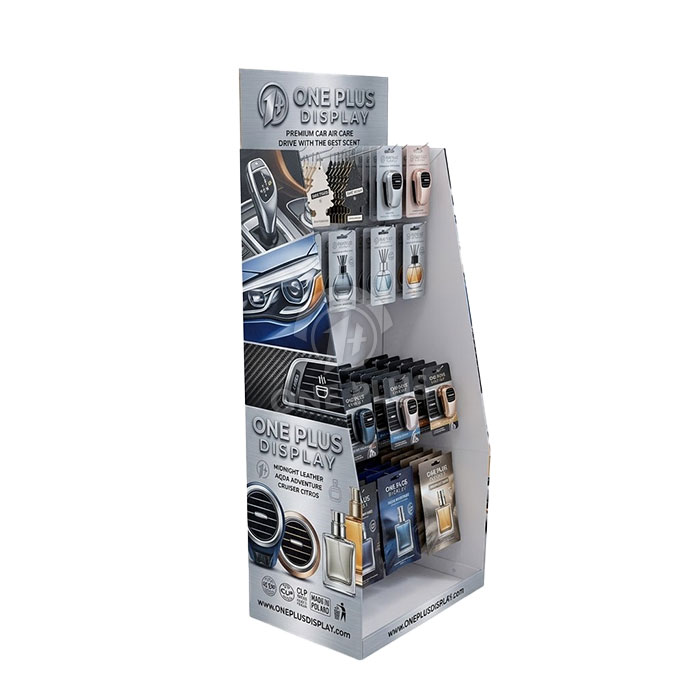
If your assortment outgrows a countertop footprint, the same slanted-peg logic scales up. Our custom cardboard pegboard display floor rack for car air fresheners applies the same hook and panel principles in a freestanding format for larger planogram sets.
Customization and Production Workflow
A custom display project usually moves through five stages. Knowing them helps you brief accurately and avoid revision loops.
- Brief and product sample. You share card dimensions, product weight, hook count target, countertop footprint limit, and brand assets. Physical samples of the carded product are the single most useful input.
- Structural concept. We propose a panel angle, base footprint, hook pitch, and header shape, shown as a flat die-line so you can see how it folds.
- Graphic application. Artwork is placed on the die-line with bleed and fold allowances. Header typography and trim placement are checked against the structural cut lines.
- Prototype. A physical white or printed sample is produced for fit and load testing with your actual product.
- Production and packing. Approved units are printed, die-cut, and packed flat for shipment.
Because the tooling is a die-line rather than a metal mold, revisions between prototype and production are relatively fast and inexpensive. That makes the format practical for seasonal fragrances, limited-edition scents, and test-market runs as well as year-round programs.
Three Concrete Use-Case Scenarios
Scenario 1: Convenience store chain, car air freshener program
A regional chain wants a branded countertop unit for a seasonal air freshener line across several hundred stores. The unit needs a small footprint, a header that reads from the queue, and enough hooks for four to six SKUs. Slanted peg hooks keep the cards angled toward waiting customers, and flat packing keeps per-store freight negligible. The same die-line is reused for the next seasonal scent with new artwork only.
Scenario 2: Auto parts retailer, fragrance pendant and diffuser mix
An automotive retailer carries hanging fragrance pendants alongside vent-clip diffusers. Product weights vary, so the peg field uses a reinforced doubler behind the hooks and a slightly deeper base. A two-tier panel separates pendant cards from boxed diffusers, letting staff restock by category without reorganizing the display.
Scenario 3: Fragrance boutique, premium perfume pendant launch
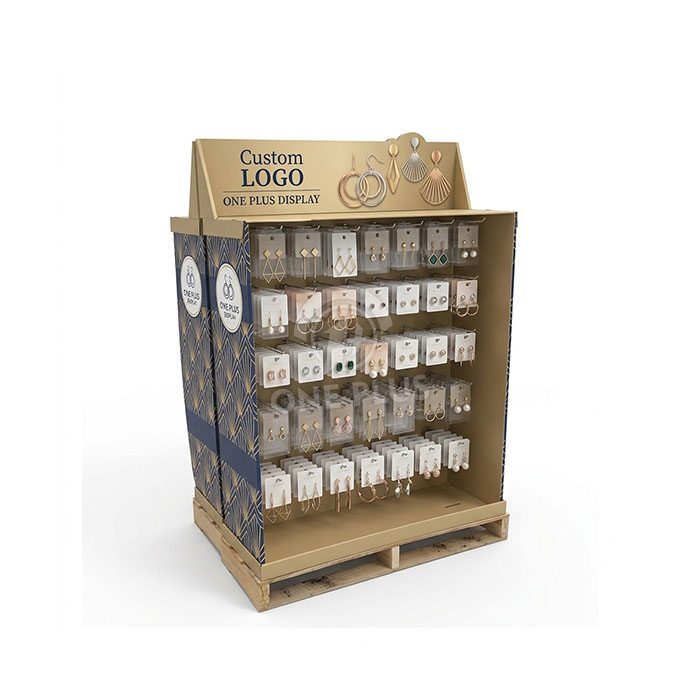
A boutique launching a premium perfume pendant line needs a fixture that feels consistent with glass and lacquer cases nearby. Here the specification shifts to acrylic or PVC foam with a printed marble graphic and gold foil trim, or a heavy corrugated unit with matte lamination. The slanted panel and die-cut header stay the same; only the substrate and finish change. For a comparable approach to small-format jewelry merchandising, see our custom cardboard display stand for earrings.
Assembly, Packing and Logistics
Countertop displays are shipped flat and assembled on site, which is the main reason they are economical for multi-store programs. Assembly typically involves folding the base, inserting interlocking tabs, rotating the slanted panel into position, and pressing the peg hooks through their pre-punched holes. No tools are required on a standard corrugated unit. Acrylic and PVC foam versions may use solvent-welded or mechanically fastened joints, which arrive pre-assembled or with simple hardware.
Packing is designed around the store-level reality that a fixture must survive a distribution center and a stockroom before it reaches the counter.
- Units are nested flat with protective interleaving between printed faces.
- Peg hooks ship in a separate bag or compartment to prevent puncturing the print during transit.
- Cartons are labeled with SKU and store-ready assembly instructions.
- Master carton quantities are set to match your distribution multiples.
Because the display ships flat, dimensional weight is low relative to an assembled fixture, and replacement parts — a single panel or a handful of hooks — can be shipped to individual stores without rebuilding the whole unit.
Frequently Asked Questions
Can the peg hooks be repositioned for different card sizes?
The hook field is custom-punched for your product, so spacing is set at the die-line stage. If you expect your assortment to change, we can build in extra punched positions or provide a hook pattern that accommodates a defined size range. We do not quote fixed load ratings in advance because capacity depends on board grade, hook gauge, and product weight; prototypes are tested with your actual cards.
Is corrugated strong enough for a retail countertop display?
For carded fragrance pendants and air fresheners, yes — particularly with a reinforced doubler behind the peg field and a double-wall base. If your product is heavier or the counter environment is damp, PVC foam board or acrylic is the more appropriate substrate. We recommend based on your product sample rather than a generic rule.
What is the minimum order quantity?
MOQs depend on the structure, material, and finishing — foil, spot UV, and acrylic change the economics. Share your target quantity and we will confirm what is practical for your project rather than quoting a blanket minimum.
Can you match our existing brand colors and header typography?
Yes. We work from your brand assets and print to your specified color references, with a proof before production. Custom typography, die-cut header shapes, and trim treatments such as gold bands or marble patterns are all part of the graphic stage.
Start With Your Product, Not a Catalog Number
The most reliable way to get a countertop fragrance display that actually performs is to send us the product it will hold. Card dimensions, weight, and the number of SKUs determine the panel angle, hook pitch, and base footprint — and those decisions matter more than any stock template. One Plus Display builds countertop and floor displays factory-direct in corrugated, PVC foam, and acrylic, from single prototypes through multi-store rollouts. Share your product sample and countertop constraints, and we will return a die-line concept, material recommendation, and quote for your program.