When a Fragrance Launch Needs Its Own Stage
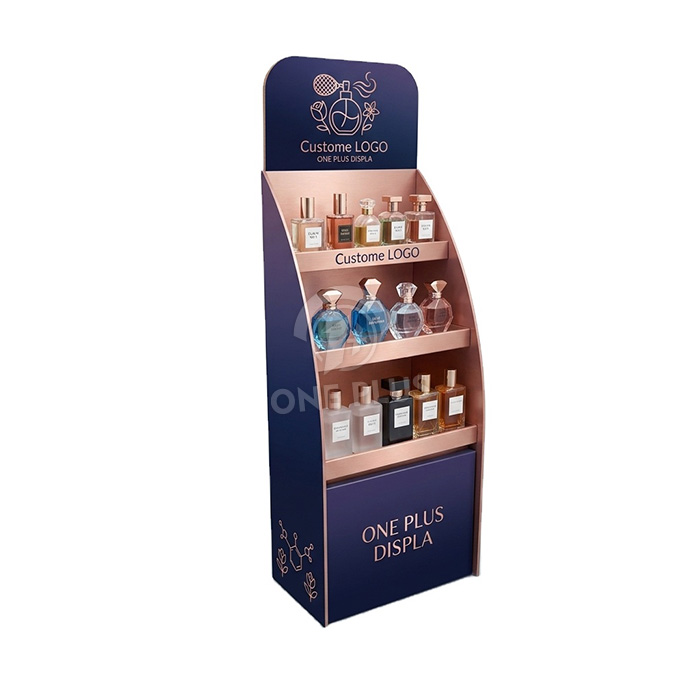
Picture the flagship beauty hall on a Saturday afternoon. A shopper drifts past the mass skincare aisle, stops at a matte navy tower with a rose gold interior, and lifts a tester bottle from the middle shelf. That pause is the entire point of a floor display: it converts a shelf-edge decision into a walk-in moment. For a fragrance house launching a new eau de parfum, the fixture has to look like it belongs in the same room as the glass counter and the polished brass signage, even though it ships flat and gets recycled at the end of the campaign.
This merchandiser, built as a three-tier step display with a metallic rose gold interior against a deep matte navy exterior, is designed for exactly that moment. It is a cosmetic floor display that carries the visual weight of a permanent fixture while remaining a temporary, recyclable POP unit. Each tier is a step-style shelf, so the rear bottles sit slightly higher than the front row, which means no bottle is hidden behind another when the shopper looks down from standing eye level.
Perfume is an awkward product to merchandise on cardboard. Glass is heavy, bottles are irregular, and the packaging inside the box is often more valuable than the bottle itself. The engineering below explains how a corrugated structure handles that load, and where customization begins and ends.
Why a Free-Standing Tiered Unit Beats a Counter Tray for Fragrance
Counter trays work when a brand has a single hero SKU and a captive audience at the register. Fragrance rarely works that way. A launch usually includes an eau de parfum, a travel spray, a body lotion, and a gift set, and the shopper wants to compare them side by side. A tiered floor unit gives each of those its own visual row, and it does so at standing height, where the shopper is already looking.
There is also a practical argument. Fragrance testers get handled constantly, and a display that sits on the floor is less likely to be knocked sideways than a counter unit that gets pushed into the sink. A wider base and a lower center of gravity keep the unit planted. This is the same logic behind a free standing display unit: it owns a patch of floor and does not need a shelf to exist.
The third argument is brand control. A temporary display lets a fragrance brand dictate the lighting backdrop, the color of the interior, and the placement of the logo, rather than negotiating shelf talkers with a retailer. That is closer to the logic of a PDQ display, where the unit is designed to be placed quickly and merchandised without a planogram debate.
What the three tiers actually do
- Top tier — hero bottle or gift set, at the highest point so it reads from across the aisle.
- Middle tier — tester row, at hand height for the shopper who wants to spray.
- Bottom tier — backstock or secondary SKUs, available to staff without a stockroom trip.
Structural and Engineering Decisions
The visible surface is art paper and foil, but the load path runs through the corrugated board underneath. A three-tier step display carries a surprising amount of weight: six to ten glass bottles per tier is common, and a 100ml fragrance bottle with its cap can weigh several hundred grams on its own. The structure has to resist two failure modes — shelf sag and forward tilt.
Shelf sag is handled by the direction of the flutes and by the depth of the shelf. When the flutes run front-to-back on the shelf panel, the board behaves like a series of small vertical columns, which is far stiffer than flutes running side-to-side. The shelf is also supported along its full back edge by the riser that separates the tiers, so the span is short and the deflection stays minimal. In practice, a shelf rated for the 5–8 kg range handles a full tester set with margin, and heavier configurations can be quoted with a doubled shelf or an internal support.
Forward tilt is a base problem. The unit needs a footprint wide enough that a shopper brushing past it does not tip it. The base panel is usually the heaviest single piece of board in the build, and where the client expects high traffic, we add a double-thickness base or a low internal ballast pocket that the retailer can fill with the display’s own shipping insert. That keeps the shipping weight down while letting the assembled unit behave like a much heavier fixture.
Assembly as a structural feature
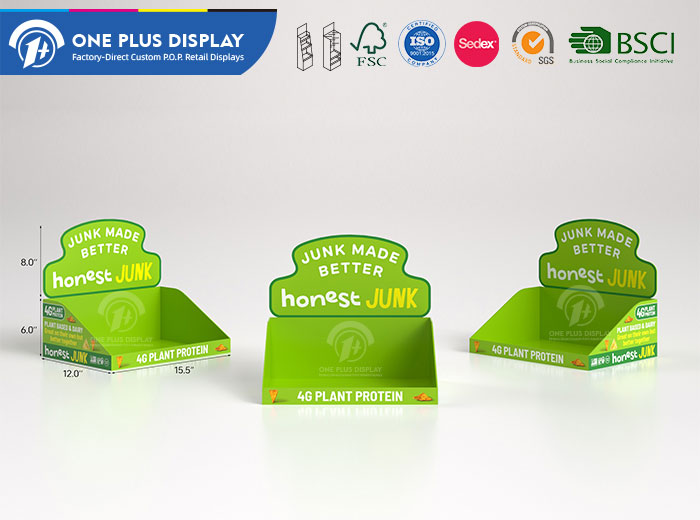
Every tab and slot is part of the structure, not just a fastening method. Slot-and-tab joints spread force across a larger area of board than glue alone, and they allow the unit to be assembled on site by store staff in a few minutes. The trade-off is tolerance: die-cut slots must be cut accurately enough to hold without being so tight that the board crushes during assembly. That tolerance is set at the die-making stage and validated with a physical sample before production.
Materials and Finishing Options
The specification below reflects a luxury fragrance brief, but each line is a starting point rather than a fixed recipe.
| Element | 標準仕様 | Customizable range |
|---|---|---|
| Corrugated grade | Reinforced B-flute | E-flute for a finer, more rigid surface; BC double-wall for heavier loads |
| Surface paper | Premium art paper wrap | Textured, soft-touch, or uncoated kraft-look stock |
| 仕上げ | Matte lamination with metallic foil stamping | Gloss, soft-touch, spot UV, or embossing |
| Metallic tone | Rose gold | Silver, gold, champagne, bronze, or a matched Pantone metallic |
| Primary structure | Corrugated board | PVC foam board for a rigid permanent-look shell; acrylic for shelf lips, dividers, or a clear tester tray |
| Shelf load | Approx. 5–8 kg per shelf | Higher ratings available with reinforced or doubled shelves |
Two material substitutions are worth calling out for cosmetics. First, PVC foam board can replace corrugated on the front fascia and side panels when a brand wants the display to survive multiple retail cycles or look indistinguishable from a permanent fixture. It machines cleanly, holds a sharp edge, and accepts the same print finishes, though it adds weight and cost. Second, acrylic is often used for small parts rather than the whole unit: a clear shelf lip that stops bottles from sliding forward, a divider that keeps tester bottles upright, or a small tray that makes the tester area look deliberate.
Corrugated remains the default because it is recyclable, light, and inexpensive to ship. A fragrance display that travels to forty doors does not need to be permanent; it needs to look permanent for eight to twelve weeks. That is a different engineering target, and it is the one corrugated is good at.
Merchandising and Retail Placement
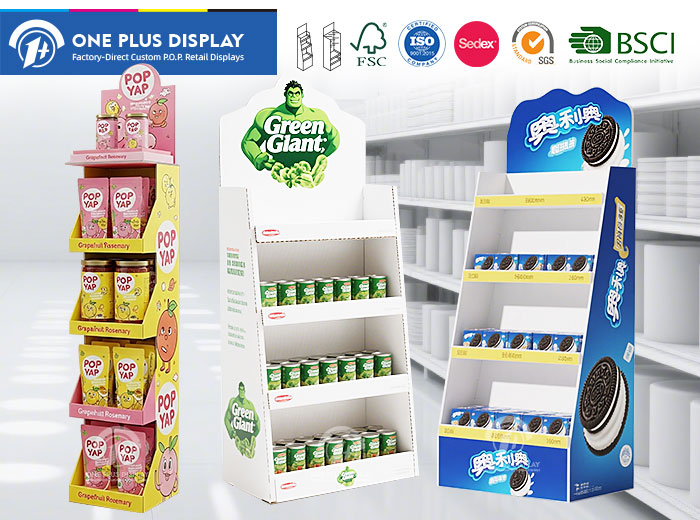
Placement decisions are usually made by the retailer, but the display can be designed to make the preferred placement obvious. A unit with a strong header and a deep navy exterior reads well against a light floor, which is why it tends to be placed at the end of an aisle or in a dedicated fragrance zone rather than against a wall. The rose gold interior catches overhead light and pulls the eye down the tiers.
Branding zones should be planned before the artwork is finalized, because each zone has a different viewing distance:
- Header — read from across the hall; keep it to a logo and a single line.
- Front shelf lips — read at arm’s length; use for product names, notes, or price.
- Side panels — read at an angle from an adjacent aisle; good for a campaign image or a QR code.
- Base panel — rarely read, but useful for a repeat logo or legal copy.
Because the tiered structure is open at the front, the display also works as a self-service tester station. Shoppers can reach the middle tier without asking for help, which is the difference between a display that gets sampled and one that gets photographed.
Customization and Production Workflow
Custom work on this format usually starts with three questions: how many bottles per shelf, what is the total shipping volume, and where will the display be assembled. The answers determine board grade, shelf reinforcement, and pack size.
From there the workflow is straightforward:
- Brief and structural concept — tier count, footprint, and load target are agreed in writing.
- Die-line and artwork — the structural die-line and the print artwork are developed together so that folds, tabs, and foil areas land correctly.
- White sample — an unprinted structural sample is assembled to confirm fit and stability.
- Printed prototype — a finished sample with the actual lamination and foil is approved before mass production.
- Production and flat-pack — boards are cut, printed, laminated, foiled, and packed with assembly instructions.
For a factory-direct build, this sequence is usually the fastest way to catch a problem that would otherwise appear in a thousand units. A shelf that sags in a white sample will sag in production, and it is cheaper to change the die than to reprint a run.
Three scenarios where this format fits
1. Department store fragrance launch. A brand books a two-week slot in a beauty hall and needs a unit that matches the counter finish. The rose gold interior and matte navy exterior let the display sit next to permanent fixtures without looking like a downgrade, and the tiered layout holds the full launch range.
2. Duty-free and travel retail. Space is tight, dwell time is short, and shoppers are often buying gifts. A three-tier unit with a strong header works as a destination display near the gate area, where a flat shelf would be lost among the surrounding signage.
3. Pharmacy and specialty beauty chains. A smaller footprint version of the same structure can run in stores that cannot take a full-size fixture. Here the value is the tester row at hand height, which supports staff-assisted selling without requiring a dedicated counter.
Assembly, Packing and Logistics
The display ships flat-packed. Boards are stacked, banded, and packed with an assembly instruction sheet, which keeps carton volume low and reduces the cost per door. For a multi-door rollout, flat packing is usually the difference between a viable and a non-viable freight budget, and it also lowers the carbon footprint of the distribution leg.
Assembly is tool-free. The unit is built from the base up: base panel, risers, shelves, then the header and side panels. Instructions use numbered parts and a simple sequence diagram rather than text, so store staff can assemble it without a planogram specialist. Where a retailer prefers a pre-built unit, we can quote a partially assembled version, though the pack size and freight cost change accordingly.
For more detail on the broader range of tiered and freestanding formats, see our 段ボール製フロアディスプレイスタンド page.
Frequently Asked Questions
Can the rose gold finish be changed to another metallic shade?
Yes. The foil stamping can be produced in silver, gold, champagne, bronze, or a matched Pantone metallic, and the surrounding panel color can be adjusted independently. Foil and print are separate processes, so changing the metallic tone does not force a change to the navy exterior.
How much weight can each shelf carry?
The standard build is quoted at approximately 5–8 kg per shelf, which covers a typical tester set. Higher ratings are available with a reinforced or doubled shelf and a heavier board grade. Because bottle weights vary, we prefer to quote against an actual product sample rather than a generic figure.
How does the display ship, and how long does assembly take?
It ships flat-packed with printed assembly instructions. Assembly is tool-free and typically takes a few minutes for one person, depending on tier count and header size. No glue is required for the standard structure.
Can the unit include acrylic or PVC foam parts?
Yes. Acrylic is commonly used for shelf lips, tester trays, and dividers, while PVC foam board can replace corrugated on high-wear panels for a more permanent feel. Both add weight and cost, so they are usually specified only where the retail environment demands them.
Start Your Fragrance Display Project
If you are planning a fragrance launch, a gift-set push, or a travel-retail placement, the fastest way to a quote is to send the bottle dimensions, the number of SKUs, and the intended retail environment. From there we can recommend a tier configuration, board grade, and finish that fits the campaign window and the freight budget. Share your brief with One Plus Display and we will return a structural concept and a printed prototype before production begins.