Countertop Display Unit for Eyewear: Engineering a Better Sunglasses Retailer
Imagine a busy optical boutique on a Saturday afternoon. A customer picks up a pair of tortoiseshell sunglasses from a crowded spinner rack, tries them on, then struggles to find the matching case or a mirror. Nearby, a competitor’s display offers a clean, vertical presentation: each pair sits upright in its own slot, brand logo front and center, with a small mirror integrated into the side panel. That contrast is not about product quality—it is about display engineering. For eyewear and sunglasses, the point-of-sale counter is prime real estate, and a well-designed countertop display unit (CDU) can turn browsing into buying.
This guide walks through the technical and merchandising decisions behind a custom cardboard countertop display stand for eyewear. We cover why the counter format outperforms floor stands for high-turn SKUs, how to structure slots for different frame shapes, material choices from corrugated to acrylic, and the production workflow that takes you from concept to a retail-ready unit. Whether you are launching a new sunglass line or refreshing an existing reading-glasses program, the principles here apply to any eyewear assortment.
Why the Countertop Format Wins for Eyewear
Eyewear is a tactile, try-on product. Shoppers need to pick up frames, feel the weight, and check the fit. A countertop display places the product at waist-to-chest height—the natural reach zone—so customers can interact without bending or reaching overhead. This is especially important in optical shops, department store cosmetics areas, and airport kiosks where staff are nearby to assist but cannot hover over every browser.
Compared to floor-standing racks, a countertop unit occupies less than a square meter of valuable counter space, yet can hold multiple pairs in a vertical orientation. That verticality does two things: it increases the number of facings per square foot, and it presents each frame as an individual item rather than a jumbled pile. When frames stand upright, the temple arms and lens shapes are visible, which helps customers compare styles quickly.
From a brand perspective, the countertop format offers a dedicated, enclosed stage for your logo and messaging. Unlike a shared shelf, a CDU is a self-contained brand environment. For more examples of how this format works across product categories, see our countertop PDQ displays collection.
Structural and Engineering Decisions
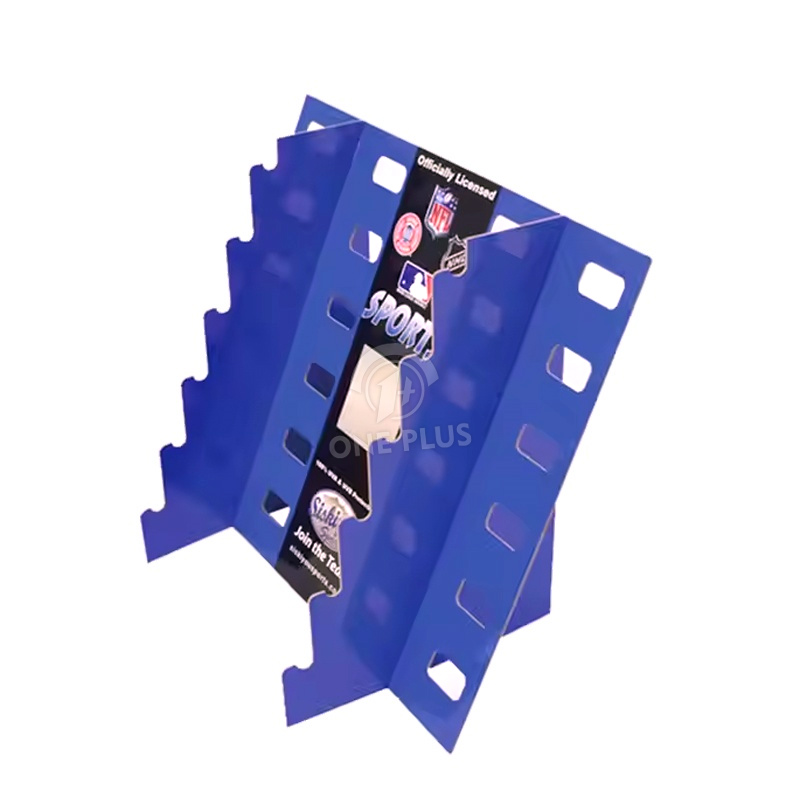
The core challenge of an eyewear CDU is holding frames securely without scratching lenses or temples. We approach this with a modular slot system. Each slot is a die-cut channel sized to accept a range of frame widths—typically from narrow reading glasses to wider sport wraps. The slot depth and angle are adjustable during design: a slight backward tilt (5–15 degrees) keeps frames from tipping forward while allowing easy removal.
Structural integrity comes from a combination of material thickness and internal bracing. High-density corrugated board is die-cut and folded into a self-locking base that distributes weight across the counter surface. For heavier loads or premium acrylic versions, we add a secondary support layer or a hidden MDF spine. The goal is a unit that feels solid when a customer pulls a pair from the top row, yet remains lightweight enough for a store associate to reposition.
Another engineering consideration is lens protection. Slots can be lined with soft-touch flocking or EVA foam inserts to prevent abrasion. For acrylic displays, we polish edges and use rounded corners to avoid sharp contact points. If your assortment includes both metal and acetate frames, we can design separate slot profiles to accommodate different temple thicknesses.
Modular Slot Configurations
- Single-row vertical: five to eight slots, ideal for a focused brand presentation.
- Two-tier stepped: back row elevated for visibility, front row for impulse picks.
- Rotating carousel: for higher SKU counts, though less common in cardboard due to complexity.
- Mixed slot sizes: wider channels for sport wraps, narrower for reading glasses.
Materials and Finishing Options
We manufacture eyewear CDUs in three primary material families, each with distinct advantages. The choice depends on your retail environment, budget, and desired lifespan.
Corrugated Cardboard Grades
For temporary or seasonal programs, high-density corrugated board (B-flute or E-flute) offers an excellent strength-to-weight ratio. E-flute provides a smoother printing surface for high-resolution graphics, while B-flute delivers greater rigidity for taller units. We can specify double-wall corrugated for added durability in high-traffic stores. Finishes include matte or gloss lamination, spot UV, and soft-touch coating. Recycled content is available upon request.
Elevata Capacità di Stock
When you need a longer-lasting display that still ships flat, PVC foam board is a strong contender. It is moisture-resistant, easy to clean, and holds fine detail well. Typical thicknesses range from 3 mm to 10 mm. We can print directly onto the board or apply a vinyl wrap. PVC foam is often chosen for beauty and eyewear counters where spills or humidity are concerns.
Acrylic
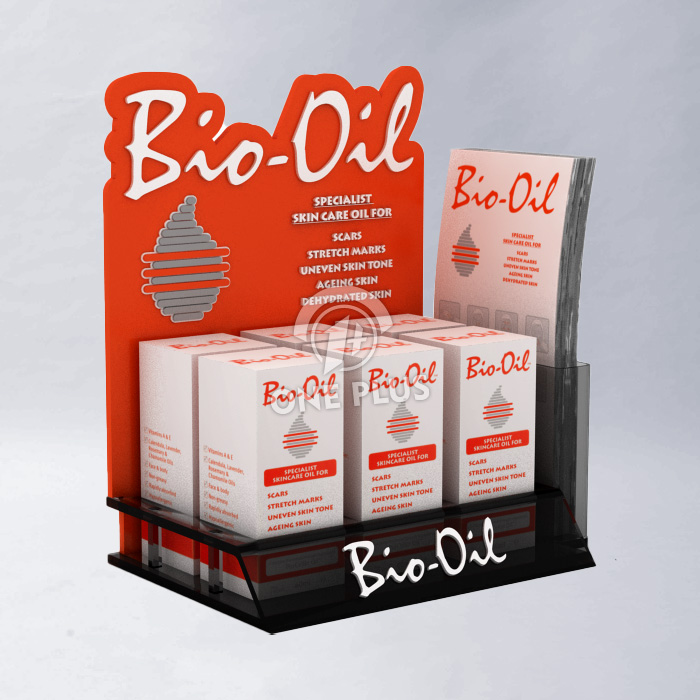
For a premium, glass-like appearance, acrylic (PMMA) is the material of choice. It can be clear, frosted, or colored, and we can bend it into curved profiles for a modern look. Acrylic units are heavier and more expensive than cardboard, but they convey durability and luxury. Edge polishing and flame treatment are standard. For a related example, see our custom acrylic countertop display stand for Bio-Oil.
Across all materials, we offer customizable ranges for dimensions, slot count, and branding area. Typical countertop footprints range from 20 cm x 15 cm to 40 cm x 30 cm, with heights from 20 cm to 45 cm. We do not publish fixed load ratings; instead, we engineer each unit to your specific weight and usage requirements through prototyping.
Merchandising and Retail Placement
Where you place the CDU determines its effectiveness. In an optical store, the best spot is adjacent to the fitting mirror or at the checkout counter, where customers pause. In a department store, position it on a cosmetics counter or near the accessory department entrance. For airport kiosks, a compact unit near the register captures last-minute purchases.
The display’s branding should guide the eye. A central header panel—typically 10–15 cm tall—can carry your logo and a short tagline. We recommend keeping the header uncluttered; one strong brand mark and a product benefit line are enough. Slot labels or small shelf talkers can indicate price or lens features.
Lighting is optional but impactful. Battery-operated LED strips can be integrated into the header or base to illuminate the frames. For cardboard units, we can add a die-cut channel for a light bar. Acrylic units can accommodate edge-lit panels.
Planogram Tips
- Place best-selling or highest-margin frames at eye level (top row).
- Group by style or color family to simplify browsing.
- Leave one empty slot as a visual breather—it signals that product is moving.
- Rotate seasonal frames to the front during peak periods.
Customization and Production Workflow
Every eyewear CDU we produce starts with a conversation about your assortment. We need to know frame dimensions (width, height, temple thickness), the number of SKUs, and your branding assets. From there, our design team creates a 3D structural concept and a flat die-line. You receive a digital proof and, if needed, a physical prototype for fit testing.
Once approved, production begins. Corrugated units are printed on offset or digital presses, then die-cut and glued. PVC foam and acrylic units are CNC-routed or laser-cut, then finished and assembled. Typical lead times range from 10 to 25 days depending on material and complexity. We ship flat where possible to reduce freight costs.
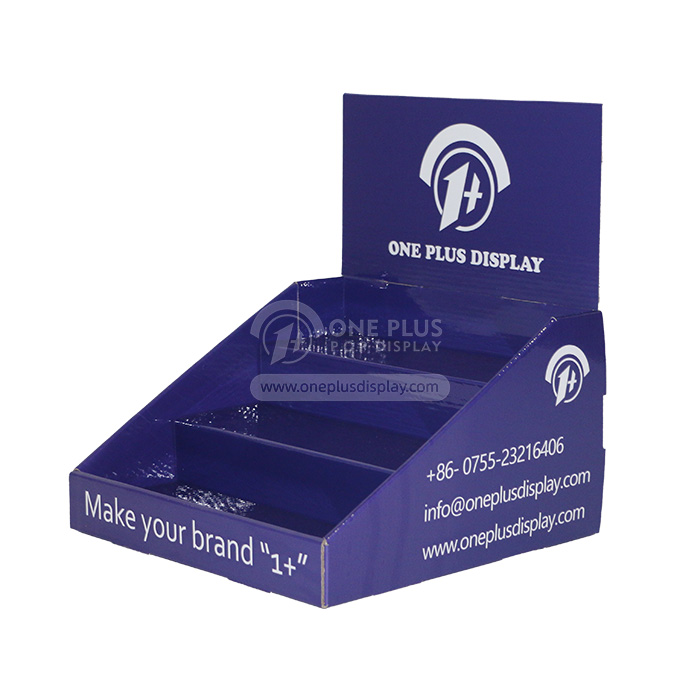
For smaller promotional runs, consider our custom corrugated cardboard countertop display stand, which shares the same engineering approach in a compact format.
Three Concrete Use-Case Scenarios
Scenario 1: Independent Optical Boutique
A boutique with a curated selection of 12 designer frames needs a countertop unit that fits on a 60 cm wide counter. We design a two-tier CDU with six slots per tier, a mirrored back panel, and a small shelf for cleaning cloths. The unit is made from E-flute corrugated with a matte laminate to resist fingerprints. The boutique’s logo is printed on the header in metallic foil.
Scenario 2: Sunglass Brand Pop-Up at a Music Festival
A sunglass brand wants a lightweight, shippable display for a three-day event. We produce a flat-packed corrugated CDU with eight slots and a bold, high-contrast graphic wrap. The unit assembles without tools and can be recycled after the event. The compact footprint fits on a folding table, and the header includes a QR code linking to the brand’s online store.
Scenario 3: Department Store Reading Glasses Program
A department store chain needs a durable, long-term display for a reading glasses line across 50 locations. We manufacture the CDU from 5 mm PVC foam board with a printed vinyl wrap. The unit holds 10 pairs in two rows, with a clear acrylic divider between rows. The base is weighted for stability, and the header space allows for the store’s private label branding.
Assembly, Packing and Logistics
Most of our countertop displays are designed for flat shipping. Corrugated and PVC foam units arrive as die-cut sheets or partially assembled components. Assembly typically involves folding, tab-and-slot locking, and sometimes a few screws for acrylic parts. We provide illustrated assembly instructions and, for larger orders, a video link.
Packing is tailored to protect printed surfaces. Corrugated units are stacked with interleaving paper and shrink-wrapped. Acrylic units are wrapped in foam and packed in double-wall cartons. We can ship to a single warehouse or direct to individual stores. For international orders, we optimize carton dimensions to minimize dimensional weight charges.
If you are managing a multi-store rollout, we can label each carton with store numbers and include a packing list. Our goal is to make receiving and assembly as smooth as possible for your store teams.
Frequently Asked Questions
Can the display accommodate different frame sizes?
Yes. We design slots based on your specific frame dimensions. During prototyping, we test with actual frames to ensure a secure fit without scratching. Adjustable inserts or modular slot dividers can accommodate a range of sizes within one unit.
What is the minimum order quantity?
Minimum order quantities vary by material and customization. Corrugated displays generally have lower minimums than acrylic. Contact us with your project details for a specific quote.
How do I clean and maintain the display?
Corrugated units should be wiped with a dry or slightly damp cloth. PVC foam and acrylic can be cleaned with mild soap and water or a non-abrasive plastic cleaner. Avoid solvents that may damage printed graphics.
Can you integrate security features?
For high-value sunglasses, we can design slots with hidden cable channels for security tethers or add a locking acrylic cover. These options are evaluated case by case during the design phase.
Ready to Build Your Eyewear Countertop Display?
Whether you need a single prototype or a multi-store rollout, our team can engineer a countertop display unit that fits your frames, your brand, and your retail environment. Share your assortment details and branding assets, and we will provide a structural concept and quote. Let’s turn your counter space into a high-performing sales tool.