When a Movie Premiere Needs More Than a Poster
A cinema lobby fills with the low hum of conversation, the scent of popcorn, and the glow of a digital ticker board. Near the entrance, a lifesize cutout of the film’s antihero looms—one arm extended, jacket billowing. Within minutes, a queue forms. Phones come out. The standee becomes a backdrop for social posts, a silent ambassador for the film’s brand. This is the moment when a flat poster would have gone unnoticed. A die-cut floor standee turns a passive wall into an interactive photo opportunity.
For toy and game launches tied to movie releases, the same principle applies inside retail. A standee that mirrors the film’s silhouette—whether it’s a masked hero, a spacecraft wing, or a game controller’s curve—signals that the merchandise on the shelf belongs to the same universe. Retail buyers and brand managers need a display that arrives flat, assembles in under two minutes, and survives weeks of foot traffic without sagging.
This page details a free-standing cardboard standee engineered specifically for cinema and media promotions. It combines CNC die-cutting, high-fidelity litho or UV printing, and a rear easel strut that locks into place. The result is a sturdy, lightweight, recyclable floor display that can be customized to any film genre or game IP.
Why a Standee/Totem Wins for Toy and Game Promotions
Toy aisles are crowded. Licensed merchandise competes for attention against generic products, and shelf space is finite. A floor standee breaks the horizontal plane—it rises above the shelf line and uses vertical space that would otherwise be empty. For movie-based toys, the standee can replicate the film’s key art in three dimensions, creating a direct visual link between the screen and the product.
Unlike a standard poster, a standee invites physical interaction. Shoppers stand next to it, compare their height to the character, or pose for photos. That interaction increases dwell time, which correlates with higher conversion in retail environments. For game launches, a standee shaped like a console or a controller silhouette can guide shoppers to a demo station or a dedicated endcap.
From a logistics standpoint, standees are flat-packed and lightweight compared to rigid fixtures. They ship in compact cartons, store flat in stockrooms, and can be deployed across multiple locations without special installation crews. That flexibility makes them ideal for time-sensitive movie releases, where displays must appear in theaters, toy stores, and electronics retailers within a narrow window.
Structural and Engineering Decisions
The core challenge of a lifesize standee is balance. A tall, narrow cutout with elaborate side extensions can become top-heavy. To counter this, the rear easel strut is engineered with a wide footprint and an interlocking tab system that prevents the panel from tipping forward. The strut is die-cut from the same fluted board as the main panel, then folded back and locked into pre-scored slots. No glue or screws are needed.
Another critical decision is the die-cut path. Complex silhouettes—such as dragon wings, robotic arms, or the curved edge of a game controller—require clean, tear-resistant edges. A digital CNC routing system follows a vector path derived from the client’s artwork, cutting through the fluted board without crushing the flutes. This preserves structural integrity and allows for intricate details that would be impossible with manual cutting.
For larger standees, a double-wall fluted board (such as EB-flute) provides additional rigidity. The board’s thickness and flute direction are specified based on the standee’s height and the weight of any surface treatments. In some cases, a lightweight KT board (foam core) is used for smaller countertop versions, but for lifesize floor displays, corrugated cardboard remains the standard for its strength-to-weight ratio and recyclability.

Materials and Finishing Options
Material selection depends on the display’s environment and lifespan. For a short-term movie premiere, a single-wall B-flute corrugated board offers a good balance of printability and cost. For longer retail campaigns or high-traffic areas, EB-double wall flute provides greater puncture resistance and load-bearing capacity. Both are 100% recyclable and biodegradable.
When a more premium, rigid feel is required—such as for a collector’s edition game launch—PVC foam board or acrylic can be used. PVC foam board is lightweight, moisture-resistant, and can be die-cut with similar contours. Acrylic offers a glossy, glass-like finish and exceptional durability, but it is heavier and more expensive. These materials are typically reserved for permanent or semi-permanent displays.
Surface treatments further tailor the standee’s performance. Anti-glare matte film lamination reduces reflections under spotlights, making it ideal for cinema lobbies where overhead lighting is intense. Ultra-gloss protective coating enhances color vibrancy and provides a wipe-clean surface for high-touch areas. Both options protect the printed graphics from scuffing during transport and assembly.
Printing methods include offset lithography for large runs, which delivers consistent color and fine detail, and UV digital printing for shorter runs or variable data. Both can reproduce the deep blacks and saturated colors typical of movie key art. Custom sizes range from approximately 1.2 meters to 2.2 meters in height, with widths varying according to the die-cut silhouette. Load ratings are not fixed; they depend on board grade, strut design, and environmental conditions, and are validated through prototype testing.
Merchandising and Retail Placement
In a toy store, the standee often serves as a category beacon. Placed at the end of an aisle or near a dedicated movie merchandise section, it draws shoppers toward the licensed products. The die-cut silhouette can incorporate a shelf or a small tray for impulse items—though this must be engineered to maintain balance. For game launches, a standee near the electronics department can direct traffic to a demo kiosk.
Cinema lobbies present a different set of considerations. Floor space is limited, and displays must not block fire exits or sightlines. A standee with a narrow footprint and a rear easel strut can be positioned against a wall or column, using vertical space without obstructing flow. The interlocking strut allows staff to reposition the standee quickly if needed.
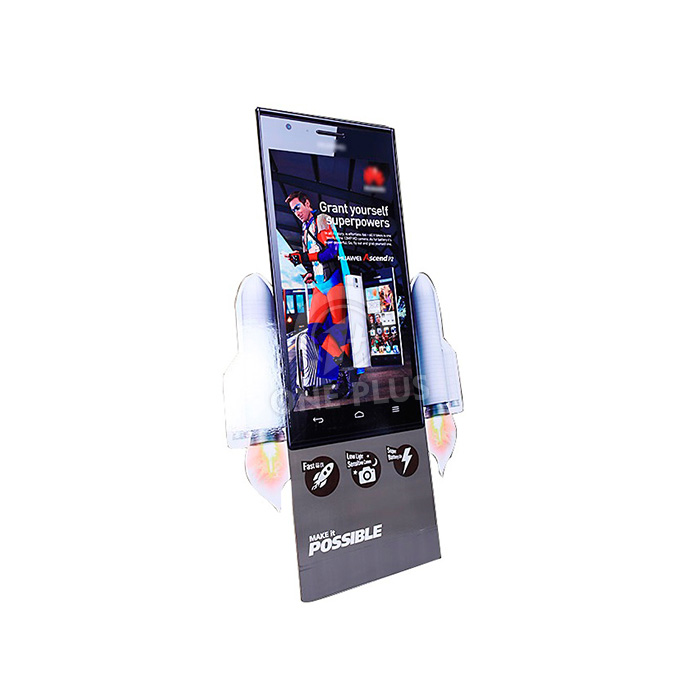
Trade show entrances are another high-impact location. A lifesize standee with custom die-cut extensions—such as flanking booster rockets or abstract shapes—can signal a booth’s theme from a distance. Because it assembles without tools, it can be set up by booth staff in minutes and packed flat for return shipping. For a more column-like presence, consider a custom cardboard display totem with a square column design, which offers a different structural approach for brand storytelling.
Customization and Production Workflow
Every standee begins with the client’s artwork or a creative brief. The design team converts the artwork into a die-cut vector path, ensuring that the silhouette is structurally sound and that any thin elements are reinforced. A digital proof shows the contour, print layout, and assembly instructions. Once approved, production moves to printing and CNC routing.
Printing is followed by lamination or coating, then the board is cut to the custom contour. Pre-scoring and creasing are applied for the easel strut and any fold lines. The flat standee is then packed with a simple assembly guide. For complex projects, a physical prototype can be produced for fit and stability testing before mass production.
One Plus Display handles each step in-house, from prepress to die-cutting to packing. This vertical integration reduces lead times and ensures that the final product matches the approved proof. Typical production lead times vary by order volume and material availability, but flat-packed standees can often be produced and shipped within a few weeks.
Three Concrete Use-Case Scenarios
Scenario 1: Animated Film Premiere in a Cinema Chain
A major animation studio releases a sequel featuring a dragon character. The standee’s die-cut silhouette includes the dragon’s wings extending outward, printed with a UV digital press to capture the character’s iridescent scales. The anti-glare matte lamination prevents reflections from lobby spotlights. The standee is placed near the ticket counter, where families stop for photos. The rear easel strut locks into place, and the standee remains stable despite constant foot traffic.
Scenario 2: Toy Launch for a Superhero Movie
A toy manufacturer launches a line of action figures tied to a summer blockbuster. The standee replicates the hero’s iconic pose, with a die-cut cape that sweeps to one side. It is positioned at the end of a toy aisle, directly above the action figure shelf. The vibrant litho print matches the packaging colors, reinforcing brand recognition. Store staff assemble it in under two minutes during a morning restock.
Scenario 3: Video Game Launch at a Trade Show
A game publisher attends a gaming convention and needs a display that stands out in a crowded hall. The standee features the game’s protagonist holding a weapon, with die-cut energy effects around the edges. The ultra-gloss coating makes the colors pop under convention lighting. The standee is set up at the booth entrance, and attendees pose with it, sharing photos on social media. After the event, it folds flat and ships back in its original carton.
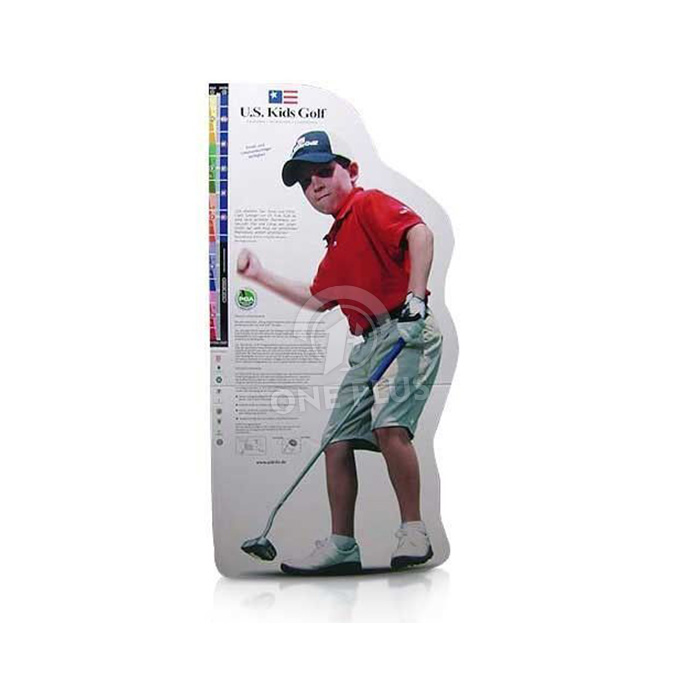
For sports-themed retail merchandising, a similar approach can be applied to lifesize cardboard character cutouts for golf clubs, demonstrating the versatility of die-cut standees across industries.
Assembly, Packing and Logistics
Standees are shipped flat in corrugated cartons. Each carton contains the main panel, the pre-attached rear easel strut, and a printed assembly guide. The assembly process requires no tools: unfold the main panel, pull out the strut, and lock the tabs into the pre-scored slots. The entire process takes under two minutes and can be performed by a single person.
Flat-packing minimizes shipping volume and reduces freight costs, especially for international campaigns. The cartons are designed to withstand normal handling and can be stacked on pallets. For high-volume orders, custom carton printing can include handling instructions and branding. Because the standee is lightweight, it can be shipped via standard parcel carriers or consolidated with other retail fixtures.
At the end of the campaign, the standee can be recycled with other paperboard. If the graphics are still relevant, it can be stored flat for future use. The interlocking strut design allows for repeated assembly and disassembly without loss of stability.
Frequently Asked Questions
Can the die-cut silhouette match any movie genre?
Yes. The die-cut path is created from your artwork or a creative brief. Whether you need fantasy wings, sci-fi mechanical elements, or a character’s exact outline, the CNC routing system follows the vector path precisely. Our design team can also suggest structural reinforcements for thin or delicate areas.
How stable is the standee in a busy cinema lobby?
Stability depends on the board grade, strut design, and placement. The interlocking rear easel strut is engineered to provide a wide base and secure locking. For high-traffic areas, we recommend EB-double wall flute and a wider strut footprint. Prototype testing can validate stability before production.
What materials are available for the standee?
Standard options include B-flute and EB-double wall corrugated cardboard, as well as lightweight KT board for smaller versions. For premium applications, PVC foam board and acrylic are available. Each material has different printability, durability, and cost characteristics, and we can advise on the best fit for your campaign.
Can the standee be customized with my own artwork and dimensions?
Absolutely. We produce fully custom standees. You provide the artwork and desired height (within a practical range), and we create a die-cut path that matches your silhouette. Surface treatments such as matte lamination or gloss coating are also customizable. Contact us to discuss your project.
Ready to Bring Your Movie or Game Promotion to Life?
One Plus Display manufactures custom standee and totem displays for brands, retailers, and event marketers. From die-cut silhouettes to high-definition printing, we handle design, prototyping, and production under one roof. Share your artwork and campaign goals, and we’ll provide a quote and timeline. For more standee and totem options, visit our standee/totem display page.