Custom Beverage Display Stand for Walmart Promotion: What 15 Years in a Dongguan Factory Taught Us About 80kg Loads
Fifteen years in this business, and I still get nervous about one type of inquiry. A customer sends a render and says: “Just make it like this — a beverage stand, needs to be strong.”
Here is the thing. A beverage display is not a snack display. Load one shelf with 12oz aluminum cans and you are looking at 20kg per shelf. Stack four tiers and it is 80kg plus, pushing straight down through corrugated board. Pick one grade too thin, or run the flutes the wrong direction, and the unit collapses before it even reaches the Walmart sales floor. Not a figure of speech. It happens.
Let me walk through a batch of 5,500+ units we ran for a Walmart summer drink program last year. The details that actually decide whether a beverage display survives are not the ones in the sales deck.
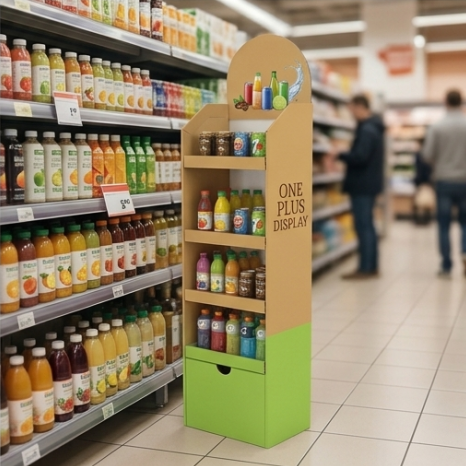
Custom Beverage Display Stand for Walmart Promotion
1. Get the board grade to pass the exam first — then talk structure
Walmart has a hard floor on corrugated specs. Supplier documentation is explicit: pallet displays must use corrugated board rated at a minimum 200# Mullen. A lot of small factories quote cheap because this is exactly where they cut — you specify 200#, they run 150#, and the outside looks identical. Load it with drinks, roll it into a cold aisle overnight, and the bottom tiers go soft as a wet newspaper.
For that beverage run, every load-bearing tier used double-wall B/E flute, paired with hidden paper support columns. This is not jargon for the sake of sounding professional. A case of 24 twelve-ounce cans weighs close to 10kg. Rating each shelf at 20kg gives real margin, not a number that only works on paper.
One detail that matters more than most buyers realize: the flute direction on the cross-beams has to run perpendicular to the load path. That gets locked in at the 3D structural design stage — in the file, not left to the workshop to “figure out on the floor.”
2. 48×40 pallet is not a “close enough” spec
Walmart DC automation reads exactly one footprint: the 48″ × 40″ GMA pallet, four-way entry, no overhang. We sized the outer carton from day one to sit inside that frame. Fully packed, the load stays square — no overhang, no floating edges.
Then comes drop testing. Walmart’s supply chain packaging requirements point suppliers toward ISTA-series standards. ISTA 3A is written for single-parcel shipping, but the testing logic — vibration, drop, stacking compression — maps directly onto how a palletized display travels. Before any bulk run leaves our floor, we do our own round: load the unit with product, drop it from forklift height onto a corner, and check whether the board structure crushes. If it fails, we do not call the customer for inspection. We go back to the die line.
3. From 3D file to flat-pack shipment — one line, one owner
Plenty of trading companies can show you a beautiful render. The real question is: who drew the render, who cut the tooling, and who ran the die-cut press? If those three things happen in three different places, good luck finding someone accountable when something goes wrong.
Our process keeps it in one facility in Dongguan:
- Structural engineers produce the 3D wireframe and die-cut layout in-house.
- The sample room builds the white sample from the same board stock allocated to bulk, on the same die-cutting press.
- After sign-off, printing, lamination, die-cutting and gluing all run inside the same park.
- Final step is K/D flat-pack: the unit ships flat and assembles tool-free — fold, slot, lock. Three minutes on the store floor.
Walmart floor associates are not going to study a manual. If it does not stand up fast, it goes to the back room and stays there.
Carton sizing gets calculated too, not guessed. We work backward from the 40×48 pallet module — how many units per carton, how to stack the layers — so container and pallet space are used efficiently. Get this wrong and your ocean freight is paying for empty air.
If you have a beverage promotion coming up — 12oz cans, 500ml bottles, whatever the format — send me the per-shelf weight and the number of facings. Our engineering team will map the load path and come back with a board grade recommendation. Some problems get solved at the drawing stage. No need to find out after the bulk run.
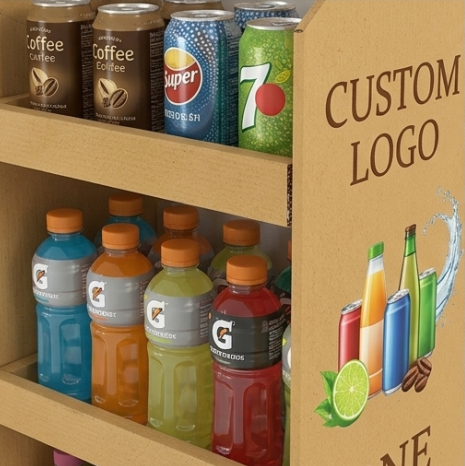
Custom Beverage Display Stand for Walmart Promotion
Similar structures we have built
- 4-Tier High-Load Corrugated Beverage Display (bottles & cans) — closest to the Walmart build, double-wall with internal support columns.
- 6-Compartment Beverage Floor Display (mixed can SKUs) — the dividers double as load-bearing members, good for multi-flavor sets.
- Premium 3-Tier Bottled Drink Display — for glass bottles or higher-end positioning, with a larger header for branding.
Industry standards & shipping test references (check these yourself)
- ISTA 3A Transport Packaging Performance Test (ANSI) — ISTA is the authority on transport packaging testing. 3A covers single parcels, but its vibration and drop logic is a direct reference for judging how a display survives shipping.
- Walmart Corrugated Board Specifications (Fibre Box Association) — states the 200# Mullen minimum for pallet displays. Quote it directly when confirming specs with a customer.
- Walmart WFS Inbound Pallet Standards (40×48, 72″ height, 2,100 lbs) — the official page. Pallet compliance starts here.
Contact: inquiry@oneplusdisplay.com