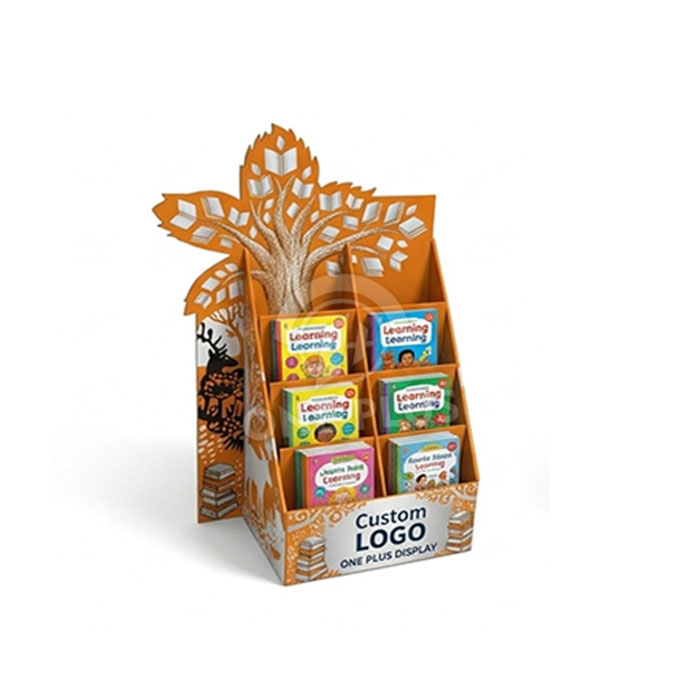
A bookseller straightens a leaning stack of board books for the third time that morning. Parents browse with toddlers in tow, and every time a book is pulled from the pile, the display collapses a little more. The problem isn’t the books—it’s the fixture. Flat stacks and wire racks don’t invite browsing, and they don’t keep titles organized by age or series. A countertop PDQ built specifically for children’s media solves this with tiered pockets that hold books upright and a shape that stops traffic. One Plus Display manufactures a tree-shaped, three-tier countertop display that turns a cramped 30 cm of counter space into a miniature bookstore.
This article explains how the design works, what it’s made of, and how to customize it for your brand. You’ll find technical guidance on materials, printing, and logistics—plus real-world scenarios for bookstores, educational publishers, and museum shops. If you’re sourcing retail displays for children’s books or educational media, this page gives you the specifications and questions to ask before you order.
Why a Tiered Tree Display Wins for Children’s Books
Children’s books are a tactile category. Parents and kids pick them up, flip through pages, and compare covers. A flat stack hides most covers except the top one. A tiered pocket display presents multiple covers at once, angled toward the shopper. The tree shape adds a visual cue: it signals “children” and “learning” before a single word is read. That matters in a retail environment where you have less than three seconds to capture attention.
The 3-tier, 6-pocket layout (dual pockets per tier) lets you group titles by reading level, series, or theme. Board books on the bottom for toddlers, early readers in the middle, and chapter books up top—or any arrangement that matches your merchandising plan. Because each pocket is separate, books stay upright and organized even after repeated handling. The compact countertop footprint means you can place it at the point of sale, on a shelf end, or on a dedicated children’s table without sacrificing floor space.
Compared to a standard countertop PDQ display, the tree-shaped header does double duty: it’s a branding billboard and a thematic signpost. You can die-cut the backboard into a tree, an animal, a mascot, or a logo silhouette. That flexibility makes this format work for publishers with a strong series identity, museums with a signature character, and retailers running seasonal promotions.
Structural and Engineering Decisions
Every countertop display is a balance between weight, stability, and visual impact. For children’s books—especially board books, which can weigh significantly more than paperbacks—the structure must resist sagging and tipping. Here’s how we approach the engineering:
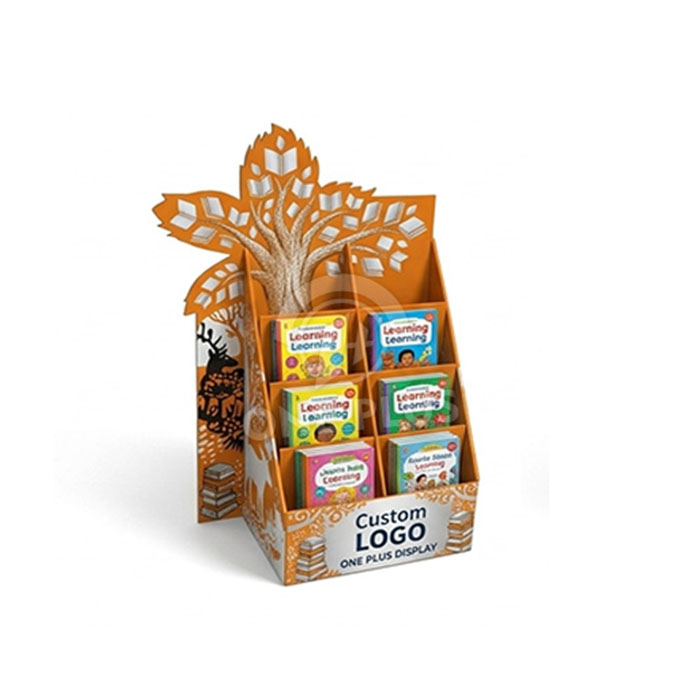
- Tier geometry: Each tier uses a horizontal shelf with a front lip to keep books from sliding forward. The pockets are open at the top for easy access but deep enough to hold books upright. Pocket depth is customizable; a typical configuration holds 3–5 standard board books per pocket.
- Backboard support: The die-cut tree header is not just decorative. It acts as a vertical stiffener, tying the tiers together and preventing side-to-side wobble. We add internal fluting or a secondary layer of corrugated board behind the header for extra rigidity.
- Base stability: The footprint is sized to prevent tipping when a child pulls a book from the top tier. We can add a weighted base or a wider bottom tier if your product mix is top-heavy.
- Assembly: The unit ships flat and assembles without tools. Interlocking tabs and slots create a secure structure that can be disassembled for storage or transport.
These decisions are driven by the product, not by a generic template. If you’re displaying heavy board books, we might specify a thicker corrugated grade or add a double-wall panel at the shelf level. If your books are light paperbacks, we can reduce material without compromising durability.
Materials and Finishing Options
The standard material for this display is E-flute corrugated board—a thin, high-density paperboard that balances printability with structural strength. It’s 100% recyclable, which aligns with the sustainability expectations of many book buyers and retailers. E-flute takes crisp, high-resolution printing, so illustrations and logos reproduce cleanly.
Depending on your budget and reuse goals, we offer several material paths:
| Material | Best for | Key characteristics |
|---|---|---|
| E-flute corrugated | Short-term promotions, seasonal displays | Lightweight, recyclable, excellent print surface |
| B-flute or double-wall corrugated | Heavier books, longer retail cycles | Greater stiffness and load capacity |
| PVC foam board | Premium look, repeated use | Rigid, moisture-resistant, smooth finish |
| Acrylic | High-end retail, permanent fixtures | Transparent or opaque, durable, easy to clean |
Printing options include edge-to-edge CMYK digital printing with a matte or gloss aqueous coating. We can also add spot UV, embossing, or metallic inks for special effects—though for children’s books, bright, clear CMYK is usually the priority. The entire unit can be wrapped in your artwork, including the tree header, tiers, and even the inside of the pockets.
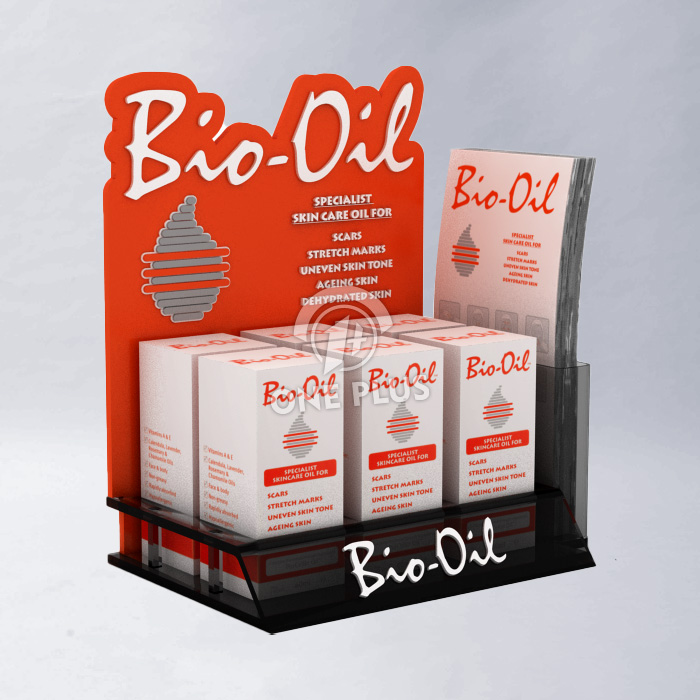
If you’re considering a more permanent fixture, an acrylic countertop display stand offers a premium alternative that resists wear and can be wiped clean—useful in high-traffic children’s sections.
Merchandising and Retail Placement
Where you place this display determines its success. The tree shape and tiered structure are designed for countertops, but they also work on shelf ends, display tables, and checkout lanes. Here are placement strategies that book retailers and publishers use:
- Point-of-sale counter: Catch impulse buyers while they wait. Place the unit next to the register, facing the queue. The tree header acts as a beacon.
- Children’s section table: Create a dedicated browsing station. Use multiple units to build a small forest of books—one for board books, one for picture books, one for activity kits.
- Cross-merchandising: Pair with plush toys, educational games, or greeting cards. The tiered pockets can hold a mix of media, reinforcing a theme like “bedtime” or “learning.”
- Seasonal promotions: Change the header graphic for holidays or events. Because the header is a separate die-cut piece, you can order seasonal backboards and swap them without replacing the entire unit.
For brands with a strong character or mascot, the die-cut header becomes a recognizable symbol. A publisher of a popular early-reader series might use the main character’s silhouette; a museum shop might use a dinosaur or rocket shape. The goal is to make the display feel like part of the story.
Customization and Production Workflow
Customization starts with your artwork and specifications. You provide the book dimensions, the number of tiers and pockets, and any branding requirements. Our design team creates a structural dieline and a print-ready layout. You approve a digital proof and, if needed, a physical sample. Once approved, production begins.
Key customization options:
- Header shape: Any die-cut contour—tree, animal, logo, letter, or abstract shape.
- Tier count: 2, 3, 4, or more tiers, depending on your product range and counter space.
- Pocket configuration: Dual side-by-side pockets, single wide pockets, or a mix.
- Print coverage: Full-surface CMYK plus optional coatings and special finishes.
- Material grade: E-flute, B-flute, double-wall, PVC foam, or acrylic.
- Assembly: Tool-free interlocking tabs, or a fixed glued structure for heavier loads.
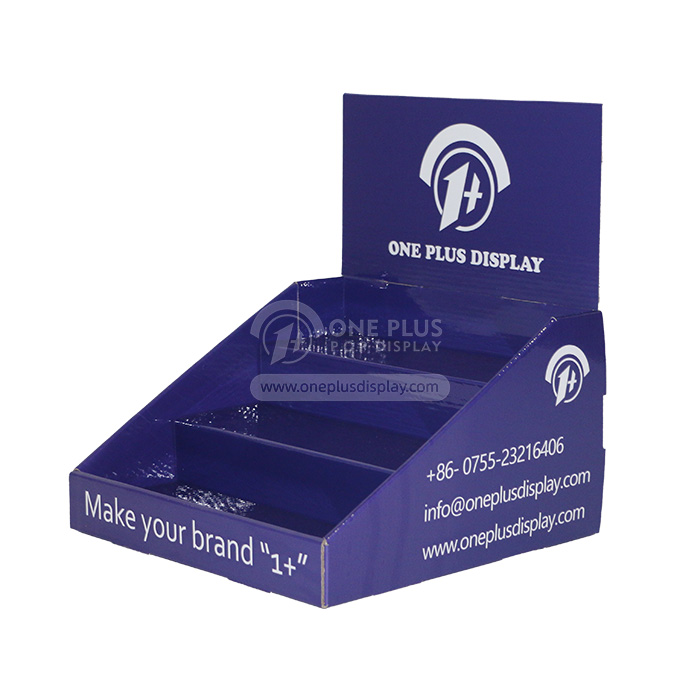
Typical lead time for a custom countertop display is a few weeks after proof approval, depending on complexity and order quantity. We ship flat to reduce freight costs and carbon footprint. For smaller promotional runs, a custom corrugated cardboard countertop display stand like our 12x13x26 cm model offers a compact, budget-friendly option that still allows full customization.
Three Use-Case Scenarios
1. Independent bookstore children’s corner. A neighborhood bookstore wants to increase browse time and sales in its children’s section. They order two tree displays: one for board books and one for early readers. The units sit on a low table at child height. Parents can easily see covers, and kids can reach the bottom tier. The bookseller reports that books stay neater and the section feels more inviting.
2. Educational publisher series launch. A publisher is launching a new leveled reading series with six titles. They need a display that groups the series together and communicates the reading levels. The 3-tier, 6-pocket layout holds one copy of each title, with the tree header printed with the series logo. The display ships to 200 retail partners, who assemble it in minutes and place it on their counters. The publisher sees higher attach rates because the series is merchandised as a set.
3. Museum shop educational toy and book combo. A natural history museum shop sells dinosaur-themed books alongside plush toys and activity kits. They order a custom tree display with a die-cut T-Rex header. The pockets hold books and small toys, creating a themed merchandising zone near the checkout. The display reinforces the museum’s brand and encourages add-on purchases.
Assembly, Packing, and Logistics
The display ships flat in a corrugated carton. Assembly takes less than five minutes and requires no tools. Each component is labeled and keyed for correct orientation. We include a simple instruction sheet with diagrams. For retail partners, you can also order a QR code that links to an assembly video.
Packing is designed for protection during transit. We use corner boards, shrink wrap, and double-walled cartons to prevent crushing. If you’re shipping to multiple locations, we can pack units individually or in master cartons with a specific number of units per box. For international orders, we optimize carton dimensions to minimize dimensional weight charges.
Storage is straightforward: flat-packed units stack vertically and take up minimal space. If you plan to reuse the display for multiple promotions, store it in a dry area away from direct sunlight to prevent warping.
Frequently Asked Questions
Bisakah bentuk pohon diubah menjadi karakter atau logo yang berbeda?
Yes. The backboard is die-cut to order. We can produce any silhouette—your mascot, a logo, a seasonal icon, or an abstract shape. You provide the vector artwork, and we create the cutting die. There is no additional charge for shape changes beyond the one-time die cost, which depends on complexity.
Berapa banyak buku papan yang dapat ditampung oleh setiap kantong?
Pocket depth is customizable. For standard board books, a typical pocket holds 3–5 books. If you need to hold more, we can increase the depth or add a support shelf. The limiting factor is usually the weight of the books and the stability of the countertop unit, not the pocket itself.
Is the corrugated board strong enough for heavy board books?
E-flute corrugated is surprisingly strong when engineered correctly. For heavier loads, we recommend B-flute or double-wall corrugated, or we can add a reinforcing layer at the shelf level. If you’re unsure, send us a sample book, and we’ll test the structure.
What is the minimum order quantity?
Minimum order quantities vary by material and complexity. For corrugated displays, we can accommodate small runs for promotional testing. For acrylic or PVC foam, the minimum is higher due to material costs. Contact us with your project details for a specific quote.
Ready to Build Your Tree Display?
If you’re looking for a countertop display that organizes children’s books, reinforces your brand, and fits in a small footprint, the tree-shaped 3-tier PDQ is a proven format. One Plus Display can customize every element—shape, size, material, and print—to match your product line. Send us your book dimensions and branding assets, and we’ll return a structural proposal and quote. Let’s turn a stack of books into a browsing experience.