A Cosmetics Aisle Where the Display Does the Selling
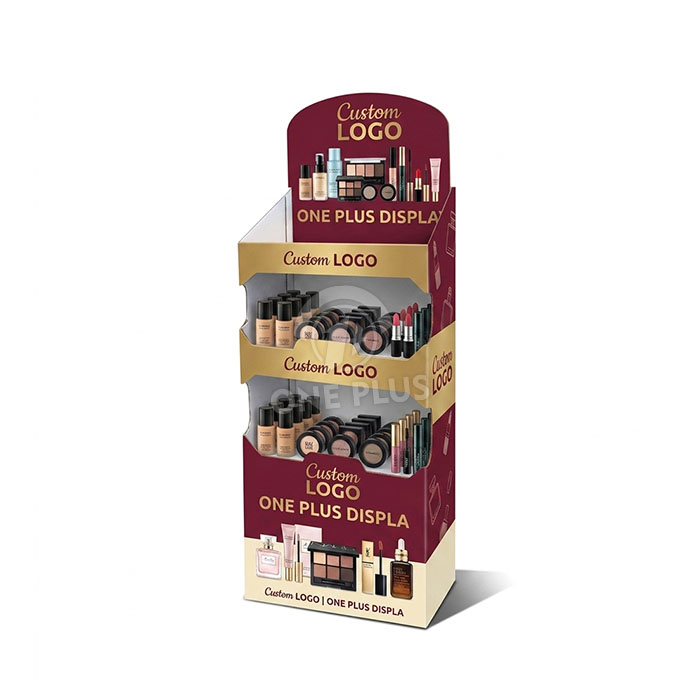
A shopper pauses in the beauty aisle, eyes moving from a wall of similar bottles and compacts to a freestanding unit that frames the products in burgundy and gold. The arched header carries the brand mark; the shelves step back in tiers so every SKU reads at a glance; the front retaining lips keep glass foundation bottles from sliding forward when a customer lifts the neighboring item. That single fixture can carry a full launch story — primer, foundation, lipstick, palette — without a sales associate saying a word.
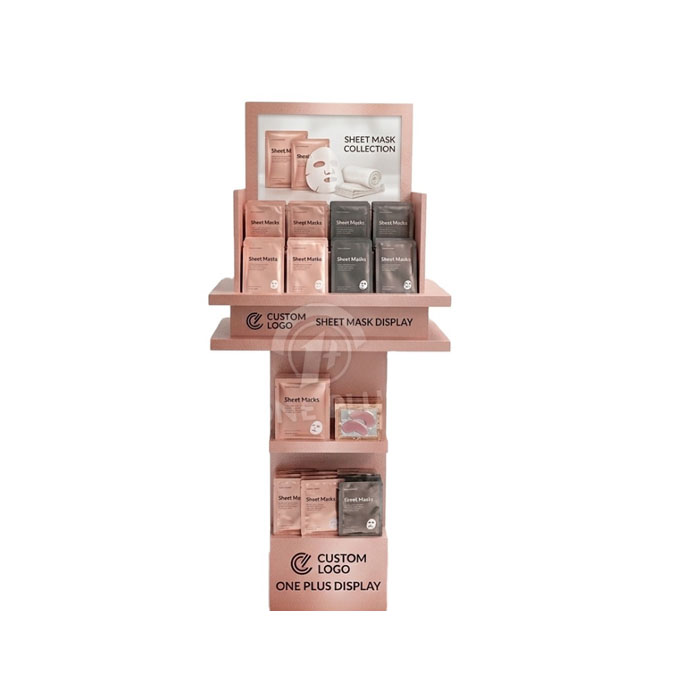
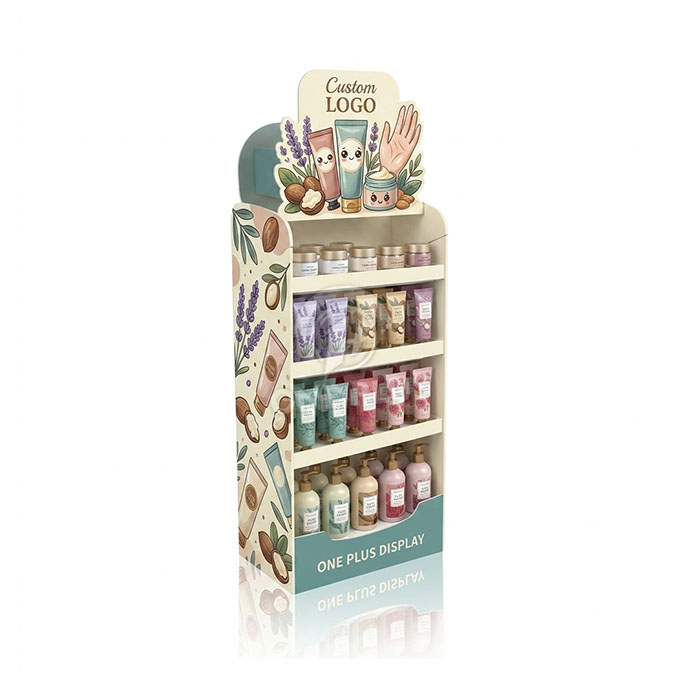
This page covers a floor-standing display unit built specifically for that moment. It is a multi-tier open-shelf merchandiser fabricated from recyclable corrugated cardboard, engineered for the weight and geometry of cosmetic packaging, and finished in a burgundy and gold palette with high-resolution graphics and an arched die-cut header. The working product ID is SKU-202608280709348-COSMETIC-FSDU-DISPLAY, though every dimension, shelf count, and finish below is customizable to your retail planogram.
Cosmetics retail is a crowded, high-velocity environment. Products are small, margins are high, and the difference between a sale and a missed sale is often whether the unit made the product easy to see, easy to reach, and easy to trust. A floor display designed around those three requirements earns its place on the sales floor.
Why a Floor Display Wins in Cosmetics Retail
Cosmetics are an impulse category with a discovery problem
Beauty shoppers rarely arrive with a single item in mind. They browse, compare shades, test textures, and frequently add a second or third product they did not plan to buy. Countertop trays and shelf-edge strips can hold a handful of SKUs, but they cannot present a coordinated range. A floor display creates a destination: a vertical block of color and brand identity that interrupts the aisle and gives shoppers a reason to stop, turn, and explore.
Small packages need vertical real estate
Lipsticks, serums, and compact powders occupy very little shelf depth. Their packaging is short, so a flat shelf wastes vertical space. Multi-tier open shelving solves this by stacking product families in a stepped arrangement — taller serum bottles on a lower or deeper tier, small lipsticks on a shallower upper tier — so the unit presents many facings per square foot of floor space. That density is what makes a free-standing unit economical for a retailer who is giving up aisle real estate.
Brand protection in a self-service environment
Cosmetics are heavily self-served. Shoppers pick up, open, and compare. Retaining lips at the front of each shelf keep product from drifting forward or falling when a neighboring item is removed, which reduces damage and keeps the display looking intentional even after a busy weekend. The structural design matters as much as the graphic design here — a beautiful unit that sags under glass foundation bottles loses the brand equity it was built to create.
Structural and Engineering Decisions
Load path and shelf reinforcement
Cosmetic products are dense for their size. A row of glass foundation bottles or a cluster of serum jars can concentrate significant weight on a relatively narrow shelf. The unit uses a reinforced shelf structure in which each horizontal tier is supported by internal corrugated beams or double-wall shelf panels, transferring load to the side walls and then to the base. Rather than quoting a single static load figure, we size the shelf construction to your actual product mix: tell us the heaviest SKU and the number of facings per shelf, and the engineering follows.
Shelf geometry and retaining lips
Shelf depth, tier spacing, and lip height are all variables. A shallow lip works for lipstick tubes and compacts; a taller lip is appropriate for round bottles that roll. We typically design the lip as an integrated die-cut fold rather than a separate glued strip, because a continuous fold distributes force across the shelf edge and resists delamination. Tier spacing is set so that the tallest product on a given shelf can be removed without knocking the shelf above.
Header and stability
The arched die-cut header carries the brand name and campaign message at eye level. Because a tall header raises the center of gravity, the base is designed with a wider footprint and, where needed, internal ballast pockets or a double-layer base panel. The goal is a unit that stays upright when a shopper leans on it or when a pallet jack passes nearby.
Materials and Finishing Options
Corrugated grades
The primary material is premium recyclable corrugated cardboard. For a cosmetics floor unit we generally specify a grade with a printed outer liner and a structural flute that balances stiffness against weight. Options include single-wall for lighter shelf configurations and double-wall or combined board for heavier products and taller headers. Flute direction is oriented so that vertical compression strength is maximized in the side panels and shelf supports.
Surface finishing
The burgundy and gold aesthetic can be achieved through lithographic printing, direct digital print, or a combination of print and specialty coating. High-resolution graphics reproduce product photography and fine text; a matte or soft-touch varnish reduces glare under store lighting, which matters for cosmetics because shoppers need to read shade names and ingredient callouts. Gold effects can be simulated with metallic inks or foil-look coatings, and spot UV can highlight a logo or a product silhouette.
Alternative and complementary materials
For some cosmetics programs, PVC foam board is worth considering for the header or for a reusable shelf insert, because it resists moisture and holds a crisp edge over a longer campaign. Acrylic can be used for small product trays, dividers, or a clear lipstick rail where visibility is the priority. These are not replacements for the corrugated structure — they are accents that extend the life of high-touch areas. Material mixes are quoted based on the specific component and its role.
| Variable | Customizable Range | Consideration |
|---|---|---|
| Overall height | Low counter-height through tall free-standing | Header visibility vs. base stability |
| Number of shelves | Two to six or more tiers | Product count and facing density |
| Shelf depth | Shallow for compacts to deep for gift sets | Product footprint and reach |
| Retaining lip height | Low profile to tall containment | Product shape and roll risk |
| Print finish | Litho, digital, matte, soft-touch, metallic | Brand palette and lighting conditions |
| Header style | Arched, rectangular, die-cut silhouette | Campaign message and brand mark |
Merchandising and Retail Placement
Where the unit performs best
This format suits the main cosmetics aisle, an endcap, a front-of-store promotional zone, or a dedicated brand bay. In a grocery or mass retailer, it works as a seasonal gift-set merchandiser; in a pharmacy, it can anchor a skincare or dermocosmetics section. The arched header is sized to be legible from the aisle entrance, while the shelf faces are arranged by product family so a shopper can move from primer to foundation to finishing powder in a natural sequence.
Planogram and cross-merchandising
Shelf assignments matter. Place the highest-turn SKUs at hand height, the newest launch at eye level, and heavier glass bottles on lower tiers where the load path is shortest. Retaining lips should be positioned so that product faces forward without hiding the label. If the campaign includes a trial or sampling component, an acrylic or PVC foam insert can be added to one tier for testers, keeping the corrugated shelves clean.
For retailers running multiple categories, the same structural approach can be adapted to other floor programs. Our présentoirs de sol en carton share the same engineering logic — reinforced shelves, stable bases, and print-ready surfaces — so a brand can keep visual consistency across departments.
Customization and Production Workflow
From brief to approved sample
Projects begin with a brief: product dimensions and weights, number of SKUs, desired shelf count, retail placement, and brand guidelines. From there, our team produces a structural concept and a graphic layout. A physical or digital white sample validates fit and proportion before printing. Once the print-ready artwork is approved, production moves to die-cutting, printing, laminating, and gluing. The key checkpoint is the pre-production sample: it is the moment to confirm that a foundation bottle clears the shelf above and that the retaining lip holds without obscuring the label.
What to prepare
- Product list with approximate dimensions and weights for the heaviest items
- Number of facings per SKU and total SKU count
- Retailer planogram constraints, if any
- Brand assets: logo files, color references, product imagery
- Campaign timing and delivery destinations
Because every unit is built to order, there is no fixed catalog size. Shelf count, header shape, print finish, and even the base footprint are adjusted to the retailer’s floor plan.
Three Concrete Use-Case Scenarios
1. Mass retailer foundation launch
A color cosmetics brand launches a foundation range with 12 shades. The floor unit carries four tiers: primer and setting products on the top tier, the 12 foundation shades across two middle tiers at eye and hand height, and value-size or bundled sets on the bottom tier. The arched header announces the launch, and the burgundy and gold palette matches the campaign’s packaging. Retaining lips keep the glass bottles upright through heavy weekend traffic.
2. Pharmacy skincare and serum program
A skincare line with tall serum bottles and small eye creams uses a unit with deeper lower shelves and shallower upper shelves. Because serums are heavier than they look, the lower tiers use double-wall shelf reinforcement. A matte finish reduces glare under pharmacy fluorescent lighting, and a PVC foam header insert keeps the brand mark crisp over a longer in-store life.
3. Department store gift-set endcap
During the holiday period, a beauty brand converts an endcap into a gift destination. The floor display holds boxed sets on wide, shallow shelves and single lipsticks in a small acrylic rail on the top tier. The unit is designed for a shorter campaign window, so the emphasis is on high-impact print and quick assembly rather than extended durability. The same structure can be re-skinned with new graphics for a spring launch.
Assembly, Packing and Logistics
Assemblage
Corrugated floor displays are engineered for flat-pack shipping and tool-free assembly. The unit arrives with pre-glued sections, die-cut slots, and clear instructions. Typical assembly involves unfolding the base, inserting shelf supports, and locking the header into place. No special tools are required, and a single store associate can usually set up the unit in a few minutes. For larger programs, we can provide a setup guide or a short video reference.
Emballage
Units are packed flat in corrugated shippers sized for standard pallets or parcel networks. Shelf components and headers are separated and protected to prevent edge damage and print scuffing. If the program includes acrylic or PVC foam inserts, those are packed separately with protective film.
Logistics considerations
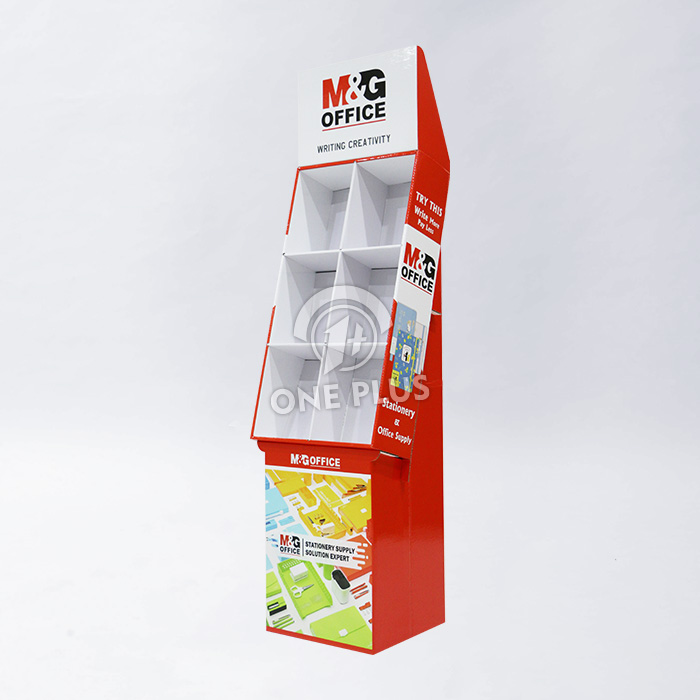
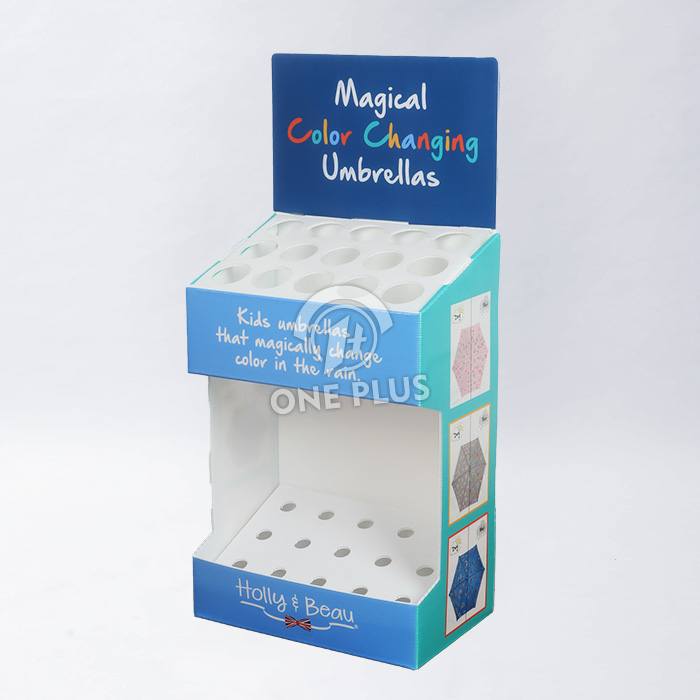
Because the display ships flat, freight cost per unit is minimized compared with pre-assembled fixtures. For multi-store rollouts, we can sequence production and delivery to match a retailer’s installation calendar. If you are also running displays in adjacent categories, the same logistics model applies to our cardboard floor display rack for stationery and office supplies, and to heavier-duty programs such as a PVC pegboard floor rack for umbrellas and parasols, where different structural rules apply.
Frequently Asked Questions
Can the display be built for a specific number of shelves and SKUs?
Yes. Shelf count, tier spacing, shelf depth, and retaining lip height are all customized. The starting point is your product list and the number of facings you need per SKU. There is no fixed configuration.
Is corrugated cardboard strong enough for glass foundation bottles?
With the right shelf reinforcement, yes. We size the corrugated grade and shelf construction to the heaviest product in the mix. Double-wall or combined board and internal support beams are used where concentrated loads require them. We do not publish a universal load rating because capacity depends on shelf span, product distribution, and base design.
Can you match a specific burgundy and gold brand palette?
We work from your brand color references and can match them through lithographic or digital printing, with metallic inks or foil-look coatings for gold effects. A printed proof or sample confirms the match before production.
What is the typical production lead time?
Lead time depends on structural complexity, print finishing, and order quantity. A standard multi-tier unit with custom graphics generally moves through concept, sample approval, and production in a defined schedule that we confirm at the quotation stage. For time-sensitive launches, tell us your in-store date and we will build the timeline backward from it.
Start Your Cosmetics Floor Display Project
If you are planning a cosmetics launch, a seasonal promotion, or a permanent brand bay, send us your product list, shelf requirements, and brand assets. One Plus Display will return a structural concept, a material recommendation, and a production timeline. Every unit is built to order, so the design starts with your products — not a catalog template.
Contact our team to request a quote for your custom cosmetics floor display.