
When a Sock Display Has to Sell From a Checkout Counter
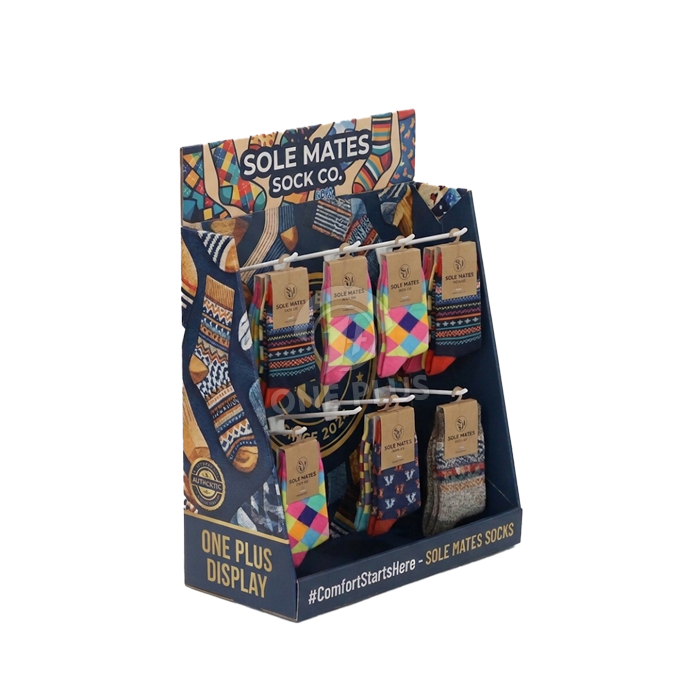
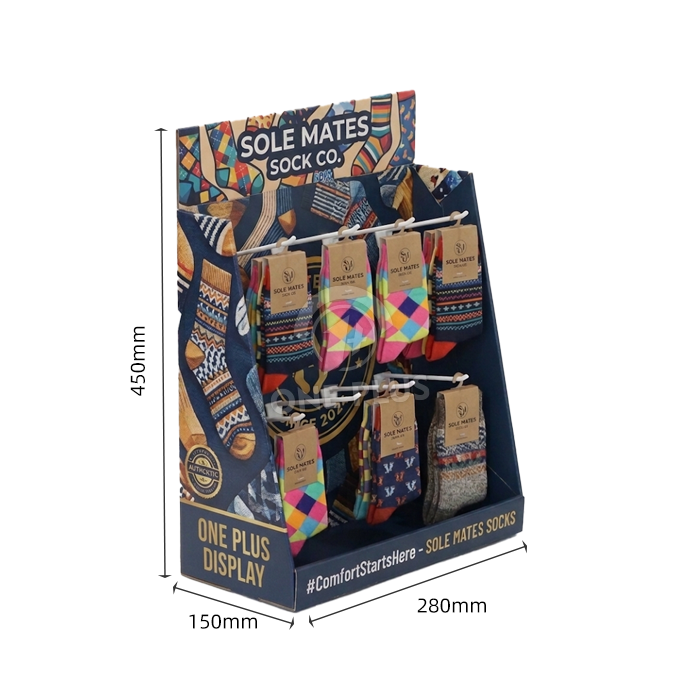
Picture a pharmacy checkout lane on a Monday morning. The counter is already crowded with a card terminal, a receipt printer, a hand-sanitizer pump, and a wire rack of gift cards. A shopper waiting to pay glances sideways and sees a tidy row of carded socks hanging from a compact cardboard tray. She picks a pair, adds it to the basket, and the transaction grows by a few dollars without a single salesperson saying a word. That small moment is the entire job of a countertop hook PDQ tray — and it is the format we build most often for sock, glove, and hat brands that need to work in tight retail space.
Counter space is the most expensive real estate in any store. It is also the most underused. A well-designed counter display does not compete with the register; it fits around it, using a footprint no larger than a shoebox while presenting twenty or thirty hanging SKUs at eye level. For accessories like socks, gloves, beanies, lanyards, and hair goods, that combination of small footprint and high SKU count is exactly what drives impulse purchases.
This article walks through how a hook-based countertop PDQ tray is engineered, what material and finishing choices are available, how to plan the merchandising, and how the production workflow runs from artwork to flat-packed cartons. If you are sourcing for a brand, a chain, or a distributor, the technical detail here should help you brief a supplier with confidence.
Why a Hook Tray Beats a Shelf or a Floor Stand for Accessories
Hanging merchandise has three structural advantages over stacked or shelved product. First, it keeps every unit front-facing: gravity pulls the next package forward as the previous one is removed, so the display never looks picked-over. Second, it exposes the full card face, which matters when the packaging carries sizing, colour, or brand messaging. Third, it allows dense vertical packing in a very small horizontal area — the reason hook trays can hold more SKUs per square metre than almost any other counter format.
For socks and gloves specifically, the packaging is usually a carded header with a euro-slot or a punched hole. That means the display does not need shelves, dividers, or trays — it needs a rigid row of hooks mounted on a back panel that will not flex under load. A countertop PDQ tray delivers exactly that, and because it sits at hand height on the counter, it captures attention in the final seconds before payment.
Compared with a floor spinner, a counter unit also avoids the logistics problem of a tall, heavy base. It ships flat, assembles in seconds, and can be replaced seasonally without a planogram reset. That is why this format appears so often in fashion accessories, where assortments change every few months.
Structural and Engineering Decisions Behind the Tray
A hook tray looks simple, but three engineering questions determine whether it survives a busy retail week.
1. How the hook row is anchored
Hooks are the load-bearing element. In our counter displays, hooks are mounted through a reinforced back panel, with the panel laminated to the tray base so that the pulling force is transferred into the floor of the unit rather than into a single sheet of board. Plastic hooks are common for lighter carded goods; metal hooks are specified when the retailer wants a more premium feel or when the carded pack is heavier, such as multi-pair sock bundles. The number and spacing of hooks are fully customizable — we adjust the panel width and punch positions to match your packaging pitch.
2. Whether the unit needs a raised front lip
A raised lip along the front edge serves two purposes: it stiffens the tray so it does not bow, and it creates a printable band that faces the shopper directly. On a counter, that band is often the first thing seen, so it is a good place for a category callout such as “New Arrivals” or a size guide.
3. How the header carries the brand
The back header is the billboard. It sits above the hook row and can be die-cut to a custom silhouette — a rounded arch, a stepped profile, or a shape that echoes the brand logo. Because the header is a flat panel, it is also the easiest surface to print with rich colour and fine type.
All three decisions are driven by your product dimensions and the retail environment. We do not publish fixed load ratings because they depend on board grade, hook type, and pack weight, but we will confirm a working configuration against your sample pack before production.
Materials and Finishing Options
The default construction for a countertop hook tray is a corrugated board body. For this format we typically work with E-flute corrugated laminated to 350gsm coated clay-coated newsback (CCNB), which gives a smooth printable surface on the outside and a rigid, lightweight structure. E-flute is chosen for counter units because it is thin enough to die-cut cleanly and strong enough to hold a loaded hook row when the panel is properly laminated.
Where more rigidity is needed — for example, a wider tray with a long hook row — we can step up to a heavier corrugated grade or add an internal reinforcement panel. The board grade, flute direction, and lamination are matched to the finished size and expected pack weight rather than fixed by catalogue.
For brands that want a different look or a longer service life, two alternative substrates are available:
- PVC foam board — a rigid, moisture-resistant sheet that can be printed and cut to the same tray geometry. It suits washable categories and environments where humidity is a concern.
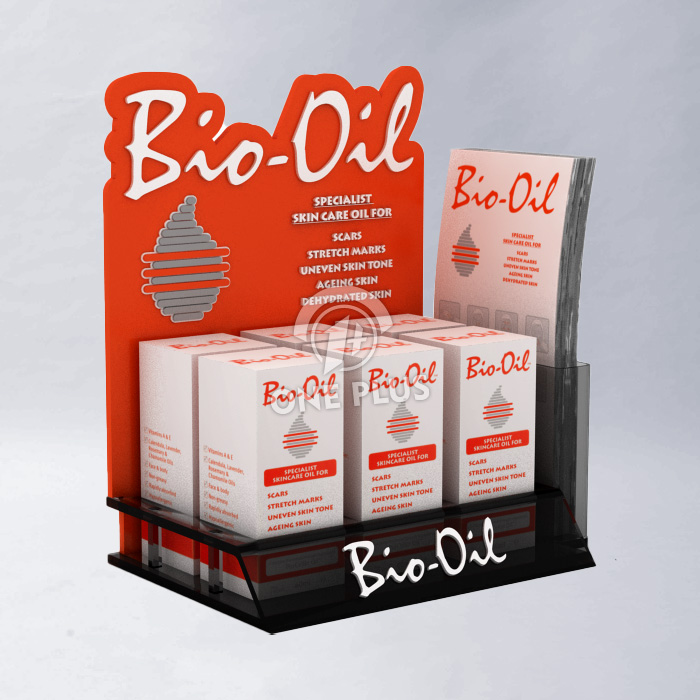
- Acrylic — a premium, transparent or coloured material that gives a high-end counter presence. Acrylic is often chosen for cosmetics, electronics accessories, and premium gifting, and it can be combined with the same hook hardware. You can see a comparable acrylic execution in this premium retail POP display rack for Bio-Oil.
Printing is CMYK offset, which reproduces photographic imagery and brand colours accurately across a long run. Finishing options include gloss lamination for punchy colour and matte lamination for a softer, more tactile feel; spot UV and embossing are available on request. Hooks can be supplied in plastic or metal, in natural, black, or custom colours.
Merchandising and Retail Placement
Hook trays are usually placed in one of three positions: beside the register, on a dedicated accessory table, or on a wall-mounted shelf where counter space is unavailable. Each position changes the optimal header height and hook count.
At the register, the unit should be compact enough to leave the payment area clear, with the header angled slightly toward the queue. On a display table, the tray can be wider, with more hooks and a larger header, because it is not competing with a terminal. On a shelf, the unit is often used without the base, with the hook panel hung or rested against the back.
From a merchandising perspective, the hook pitch should match your carded pack width plus a small finger gap. Too tight, and shoppers cannot remove a pack; too loose, and the display looks sparse. We recommend sending a physical sample of your packaged product so the hook spacing can be validated before tooling.
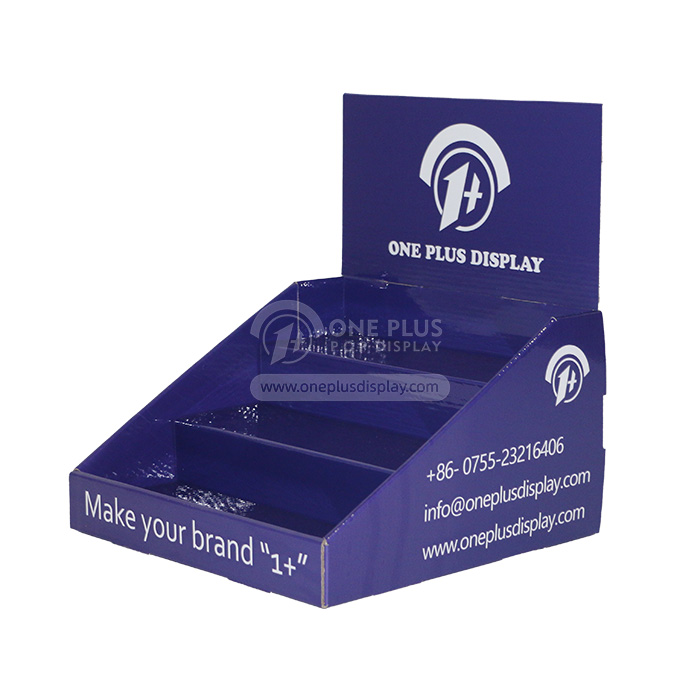
For seasonal assortments, the same tray structure can be reprinted with new graphics while reusing the hook hardware, which lowers the cost of a refresh. Brands that need a smaller promotional unit for a single SKU often use a compact countertop stand such as this custom corrugated countertop display stand for small product promotions as a companion piece to the larger hook tray.
Customization and Production Workflow
Every unit we make is built to a specification rather than pulled from a catalogue. The workflow follows a predictable sequence:
- Brief and dieline. You share product dimensions, pack weight, hook count, and branding requirements. We return a proposed dieline showing the tray footprint, hook positions, and header profile.
- Artwork adaptation. Our pre-press team adapts your artwork to the dieline and supplies a digital proof. We check bleed, safe areas, and colour build before printing.
- Sample. A physical sample is produced for fit and finish approval. This is the stage where hook spacing and header height are confirmed.
- Production. Offset printing, lamination, die-cutting, and hook insertion are completed in-house. Quality checks cover print registration, board integrity, and hook retention.
- Packing. Units are flat-packed with assembly instructions, then master-cartoned for shipment.
Because the process is handled under one roof, changes at the sample stage do not trigger a lengthy re-quote. Minimum order quantity for this format starts at 200 pieces, and custom sizes, hook counts, and print finishes are all available within that run.
For buyers who need a broad counter program, we also produce a full range of countertop PDQ displays that share the same engineering logic and can be specified together for a consistent retail look.
Three Concrete Use-Case Scenarios
Scenario 1: A sock brand launching a seasonal colour range
A sock brand wants a counter unit for a spring palette. The packaging is a standard carded header. We specify a tray with a row of plastic hooks at the brand’s card pitch, a low front lip printed with the season name, and a die-cut header in the brand’s signature arch shape. The unit holds a curated selection of six colours and ships flat to the brand’s retail partners, who assemble it at the till.
Scenario 2: A pharmacy chain adding gloves and beanies to the checkout
A pharmacy chain wants a single counter fixture that can carry gloves in winter and lightweight beanies in autumn. We build a slightly wider tray with metal hooks and a neutral header that can be re-skinned with a printed insert. The structure stays the same; only the graphics change between seasons, which keeps reorder costs predictable.
Scenario 3: A gift shop using acrylic for a premium accessory line
A gift shop sells hand-dyed socks and small accessories at a higher price point. Cardboard would undersell the product, so we specify a clear acrylic tray with polished edges and metal hooks, plus a printed back panel that slides into the acrylic frame. The unit reads as a permanent fixture rather than a temporary promotion, and it can be wiped clean between seasons.
Assembly, Packing, and Logistics
Counter hook trays are designed to ship flat. The base, back panel, and header fold and lock together without tools, and the hooks are either pre-installed or supplied in a small accessory bag depending on the design. We include simple assembly instructions in every master carton, so retail staff can set up the unit in seconds.
Flat-packing is the single biggest lever on freight cost. A fully assembled tray occupies many times its own volume, so shipping it built would multiply the cost per unit. Flat-packed units stack efficiently in master cartons, typically 20 to 50 units per carton depending on size and configuration. This also reduces storage space at the retailer’s distribution centre.
For international orders, we can palletise and label cartons to your warehouse requirements. Lead times depend on artwork readiness and order volume; once a sample is approved, production is scheduled and confirmed in writing.
Frequently Asked Questions
Oui. En tant que fabricant sur mesure, nous pouvons percer des trous et installer des crochets exactement où vous en avez besoin pour correspondre à la taille et à la quantité de vos produits suspendus.
Yes. As a direct factory, we adjust the width of the counter display and punch custom holes to accommodate any number of hooks required for your specific packaging. We recommend sending a sample pack so the hook pitch can be confirmed.
Are you a trading company or a manufacturer?
We are a cardboard display stand manufacturer. Working directly with us means factory-direct pricing, faster lead times, and direct communication on every custom cardboard display project.
How are these shipped to save freight?
All our PDQ trays are designed to ship flat-packed. We include simple assembly instructions, allowing retail partners to pop them up in seconds.
Can the header be die-cut to a custom shape?
Yes. The back header is a flat panel, so it can be die-cut to a silhouette, rounded, stepped, or shaped to echo your logo. We will confirm the shape on the dieline and sample before production.
Start Your Counter Display Project
If you are planning a sock, glove, or hat program for counter placement, the fastest way to get an accurate quote is to send us your product dimensions, pack weight, and hook count. We will return a proposed dieline, material recommendation, and pricing at your target quantity. One Plus Display handles printing, die-cutting, and hook assembly in-house, so your specification is controlled from first proof to final carton. Contact our team to request a sample or discuss your next retail launch.