We got the inquiry in late March 2025. A skincare brand, launching a 12-SKU line across roughly 400 doors, needed 800 cardboard dump bins in stores by the third week of May. The brand book was 60 pages. The retailer’s fixture guide was 40 more.
The part that almost killed the project wasn’t the printing. It was a number on the drawing: 100 cm.
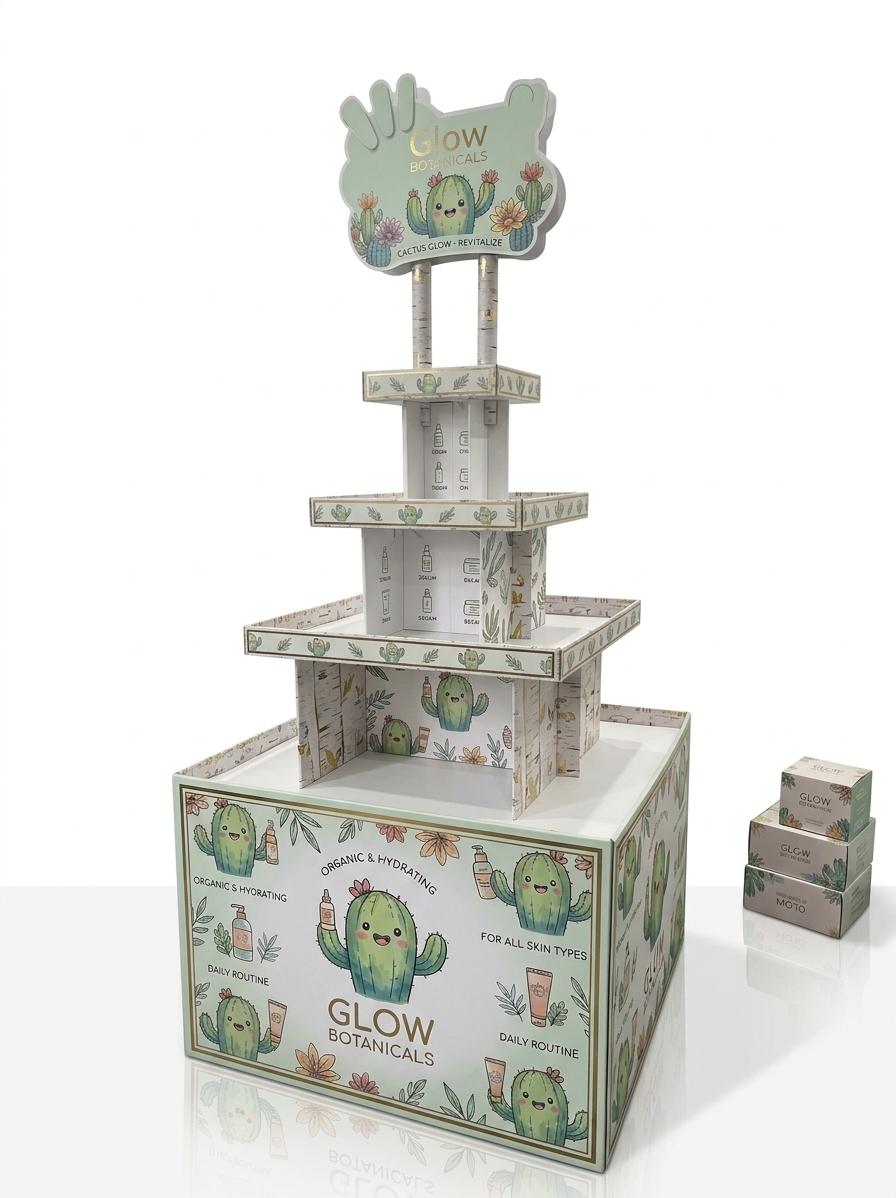
They asked for 100 × 100 cm. We came back with 80 × 80.
100 × 100 × 170 cm is a standard beauty floor display footprint, and on a spec sheet it looks reasonable. But the retailer had sent us aisle clearances, and 100 cm on each side leaves less than a shopping cart’s width of passing room in the smaller-format doors. Store managers in that chain have pulled fixtures for less.
We proposed 80 × 80 × 170 cm. Same height, same four tiers, same shelf depth for the jars. Twenty centimeters off each side.
The brand manager’s reply, roughly translated from the email: “If it holds the full load, I don’t care about the extra 20 cm. If it sags by week two, I’ll hear about it from 400 store managers.”
Fair enough. We built the prototype, loaded all four tiers with the heaviest configuration in the range—glass serum bottles on the bottom, cream jars on top—and left it standing in the workshop for 48 hours. Then we sent photos of the shelf deflection, or lack of it. The footprint was approved that week.
That prototype check is the same one we describe in what gets verified during display prototyping. The load test is usually the part clients want to skip. It’s also the part that decides whether the display survives the campaign.
What actually breaks a beauty floor display
Not the printing. Not the brand colors. The base.
Beauty store floors get mopped, often twice a day, and the cleaning carts are not careful. Standard corrugated feet absorb that moisture, soften at the flute, and once the bottom layer gives, the whole unit leans. We’ve seen displays fail in week three of a twelve-week campaign for exactly this reason.
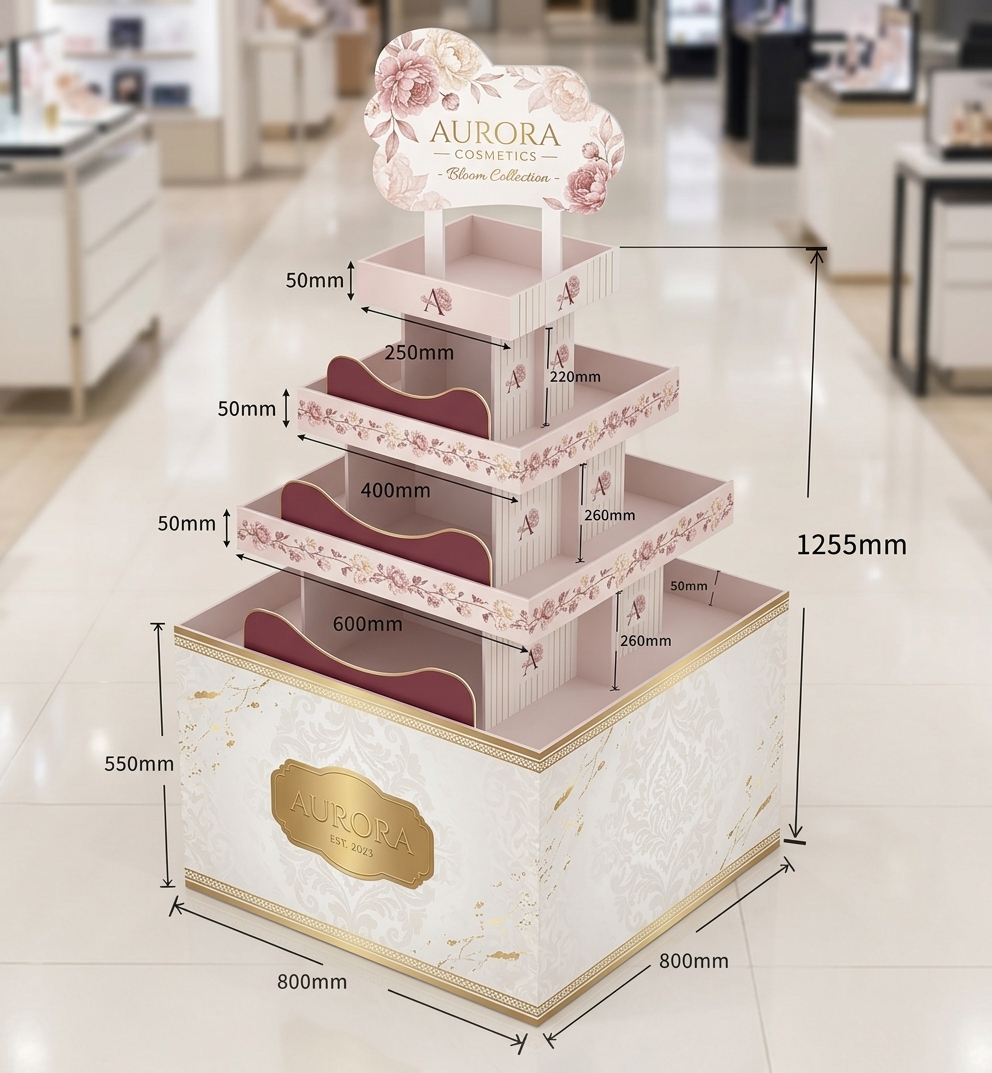
Three changes on this build:
- Elevated base tray. Keeps the bottom flute off the wet floor. Costs a little more per unit, saves the campaign.
- Corner guards. Front corners take the hits from carts and restocking. We reinforced those two zones instead of thickening the whole panel, which kept the flat-pack carton within the freight class the client had budgeted for.
- Paper tube supports in the tiers. Four tiers of glass creates real downward load. Tubes carry it to the base. We ran flat-crush checks against the board spec before production—same method as the TAPPI standard, no surprises at the load test.
- Assembled load test, all four tiers, at the weight the client signed off on.
- Pantone match under store lighting, not workshop lighting. This one catches more problems than people expect.
- Flat-pack fit check. Each unit in its own master carton, corners protected, nothing shifting in the box.
- TAPPI—flat crush and corrugated board test methods.
- ISTA—packaged-product performance testing for parcel and flat-pack distribution.
- Shop! Association (formerly POPAI)—in-store display and shopper marketing benchmarks.
If you’re building something similar for a beauty program, the 4-tier and multi-sided formats on our cosmetics merchandising display page use the same structural logic.
The production part nobody writes about
800 units, five weeks from PO to ship date. That timeline is tight but doable if the golden sample is locked early and nobody changes the Pantone halfway through.
Three checks per batch:
Flat-pack is our default for this format. Freight cost drops, and store staff can assemble without tools. On this run it also meant no transit dents across all 800 units, which is not something we get to say on every project.
For load ranges and assembly on the dump bin format itself, see our cylindrical dump bin product page. Different shape, same structural approach.
Where the 37.5% comes from
To be precise about the number in the title: the client ordered 800 units, then placed a second order for 300 units a few weeks after rollout. 300 divided by 800 is 37.5%. That’s the reorder, not a sales lift, and we’re not going to dress it up as one.
What we can say: the 800 units shipped on time, the brand hit its launch date, and no store requested a replacement unit during the campaign. The reorder came after the brand’s own retail team reviewed sell-through in the first wave of doors. We didn’t see that data. They did, and they ordered more.
In this business, a reorder before the campaign ends is the review that matters. Everything else is a brochure.
We’ve been manufacturing custom cardboard displays since 2013, and the projects that turn into repeat orders usually have one thing in common: the structural questions got answered before the print files were approved. If you have a footprint you’re not sure about, or a load spec that worries you, send the dimensions and SKU weights through the main site. We’ll tell you what we’d change and why, before anyone quotes anything.
Industry references
For the standards behind the load and transit checks mentioned above: