A Matte Black Floor Display That Earns Its Space in the Snack Aisle
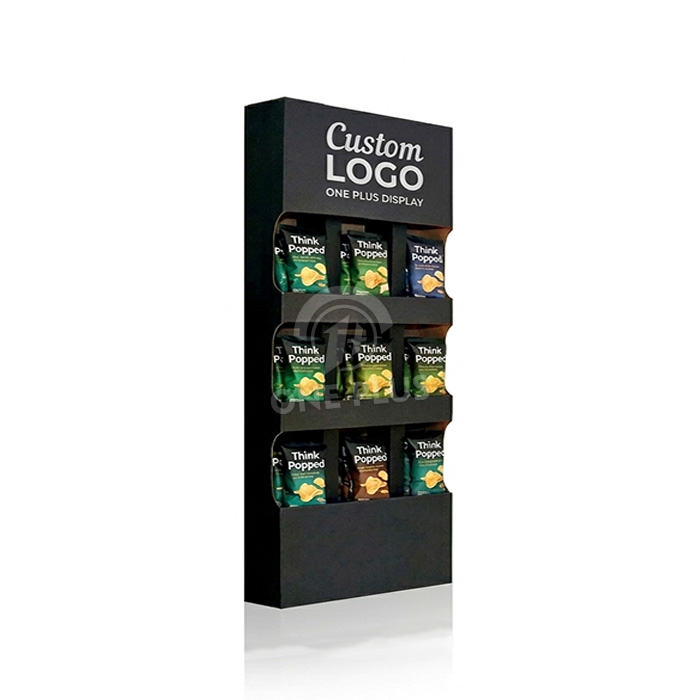
Walk into any grocery, convenience store, or specialty market and look at the snack aisle. Bags of potato chips, puffed snacks, and popcorn compete for a shopper’s glance in a matter of seconds. In that environment, a standard wire rack or a generic white cardboard stand rarely commands attention. The matte black 3-tier floor display changes that dynamic. Its dark, non-reflective finish absorbs overhead lighting rather than bouncing it back, creating a visual pause that draws the eye toward the product rather than the fixture itself. For premium, organic, or gourmet snack lines, that pause is where sales begin.
This particular floor display format—a fully enclosed box-frame structure with three deep-well trays and an integrated header—is designed to hold lightweight bagged snacks securely while keeping brand graphics front and center. It is not a one-size-fits-all solution. Every dimension, from the tray depth to the header height, can be customized to match your retail footprint and your packaging profile.
One Plus Display manufactures this unit from heavy-duty corrugated cardboard, with options for PVC foam board and acrylic components where the application demands extra rigidity or a different surface finish. The result is a retail-ready fixture that balances structural integrity with the lightweight, shippable nature of corrugated POP displays.
Why the Sidekick and Powerwing Floor Format Wins for Snack Merchandising
Snack bags are notoriously difficult to merchandise. They are lightweight, irregularly shaped, and prone to slumping or sliding when placed on shallow shelves. A standard flat shelf forces retailers to constantly face and re-face the product. A floor display with deep-well trays solves that problem by giving each bag a defined resting pocket. The raised front lip acts as a physical stop, keeping bags upright even when customers pull from the middle of the stack.
The sidekick and powerwing format—a vertical, narrow-footprint floor unit that can sit at the end of an aisle or beside a checkout lane—is particularly effective for impulse-driven categories. Unlike a full pallet display that requires significant floor space, a sidekick occupies a small footprint while offering three distinct merchandising levels. That verticality matters: shoppers scan from top to bottom, and a well-designed header at eye level can trigger recognition before they even register the individual bags.
For brands launching a new flavor, running a seasonal promotion, or testing a new retail channel, this format offers a low-risk entry point. It ships flat, assembles without tools, and can be positioned in multiple locations within a single store. If you are exploring the broader category of sidekick and powerwing displays, this 3-tier configuration represents one of the most versatile configurations for bagged snacks.
Structural and Engineering Decisions Behind the Box-Frame Design
Not all cardboard floor displays are built the same way. An open-sided stand—one with just a back panel and shelves—can wobble under load and often looks unfinished from the side. This unit uses a fully enclosed box-frame structure. The side panels are continuous from the base to the header, creating a closed rectangular column that distributes weight more evenly and resists lateral movement. In practical terms, that means fewer sagging shelves, less sway when a customer brushes past, and a cleaner visual profile from every angle.
Each of the three tiers incorporates a deep front lip. The depth is customizable based on your bag dimensions—typically ranging from a shallow retaining edge to a deeper well that cradles the base of the bag. The goal is to allow full visibility of the product branding while preventing the bags from tipping forward. For brands with taller or wider bags, the tray depth and shelf spacing can be adjusted during the design phase.
The integrated header is more than a branding billboard. It also acts as a structural cap, tying the two side panels together at the top and adding rigidity to the entire unit. The header height and angle can be customized to suit your logo proportions and the viewing distance typical in your target retail environment. If you need to merchandise heavier items—such as glass jars of salsa or plastic tubs of dip—internal support inserts or a reinforced base can be added without changing the external footprint.
Materials and Finishing Options for Custom Cardboard Displays
The base material for this floor display is heavy-duty corrugated cardboard. Corrugated board is available in a range of flute profiles and wall thicknesses, and the choice affects both load-bearing capacity and print quality. For a 3-tier snack display, a double-wall or heavy single-wall corrugated grade is typically specified to handle the cumulative weight of bagged snacks without bowing. The exact grade is selected after reviewing your product weight and the number of units per tray.
While corrugated is the standard, some brands opt for PVC foam board for the header or side panels when they want a smoother, more rigid surface that resists denting during repeated store setups. Acrylic can be used for tray dividers or small product retainers where clarity and durability are priorities. These are not all-or-nothing choices; a hybrid construction that uses corrugated for the main body and PVC foam for the header is common in premium programs.
Finishing is where the matte black aesthetic comes to life. A matte black coating or laminated liner is applied to the corrugated substrate, followed by custom screen or digital printing for logos, product imagery, and promotional messaging. A protective matte varnish is then applied over the print to resist scuffing and fingerprints—a critical detail in retail environments where the display is handled daily. The varnish also maintains the non-reflective quality that gives the display its premium look.
| Component | Standard Material | Optional Upgrade |
|---|---|---|
| Main body panels | Heavy-duty corrugated cardboard | PVC foam board for added rigidity |
| Tray lips and dividers | Corrugated with folded edges | Acrylic or PVC foam retainers |
| Header | Corrugated with matte print | PVC foam with direct digital print |
| التشطيب | Matte black coating with varnish | Custom color matching or spot UV |
Merchandising and Retail Placement Strategy
Where a floor display is placed often matters as much as how it looks. This 3-tier unit is designed for flexibility. In a grocery store, it can sit at the end of a snack aisle, angled slightly toward oncoming foot traffic. In a convenience store, it works beside a checkout counter or in a dedicated snack zone near the beverage cooler. In a specialty organic market, it can be positioned near the entrance to catch shoppers before they settle into a browsing pattern.
The integrated header should carry your primary brand mark and, if space allows, a short benefit statement or flavor callout. Because the trays are deep, you can merchandise multiple flavors or product variants across the three tiers—for example, a top tier for a new flavor launch, a middle tier for core SKUs, and a bottom tier for value packs or multipacks. The matte black background creates strong contrast for colorful snack packaging, making each bag pop without competing with the display itself.
For retailers, the enclosed box-frame design also reduces the visual clutter that open-sided racks can create. There are no visible cross-braces or exposed corrugated edges from the side. The unit reads as a single, intentional piece of retail furniture rather than a temporary cardboard stand.
Customization and Production Workflow
Every element of this floor display can be customized, but the process follows a structured workflow to avoid costly errors. It begins with a discovery phase where we collect your product dimensions, target unit count per tray, retail footprint constraints, and brand artwork. From there, our structural design team creates a die-line and a 3D rendering for your approval. This step is critical for snack brands because bag dimensions vary widely—a puffed snack bag may be taller and narrower than a potato chip bag, and the tray geometry needs to accommodate that difference.
Once the structure is approved, we move to print production. Screen printing is often used for large, solid areas of color and bold logos, while digital printing is better suited for photographic imagery or short runs with multiple version changes. The matte black coating is applied as a base layer, and the custom graphics are printed over it. A protective varnish is the final step before die-cutting and creasing.
If your program includes co-packing or pre-filled display requirements, we can coordinate that as well. This is particularly relevant for brands that want to ship displays already loaded with product to retail distribution centers. Our experience with pre-filled sidekick displays and co-packing services translates directly to snack and chip programs where speed-to-shelf is a priority.
Three Concrete Use-Case Scenarios
1. Organic Potato Chip Brand Entering Natural Grocers
A regional organic chip brand wants to test a new sea salt and vinegar flavor in a chain of natural grocery stores. They need a display that feels consistent with the store’s earthy, premium aesthetic. The matte black finish and enclosed box frame fit that environment better than a glossy white stand. The three tiers allow them to merchandise the new flavor alongside two core SKUs, creating a cross-selling opportunity. The header carries the brand’s logo and a simple “New Flavor” callout.
2. Popcorn Company Running a Seasonal Holiday Promotion
A gourmet popcorn company plans a holiday gift-giving promotion in a department store’s food hall. They need a display that can hold festive-themed bags and withstand heavy foot traffic. The deep-well trays keep the bags upright even when shoppers pull from the middle. The matte black background makes the red and green packaging stand out. Because the display ships flat and assembles without tools, the store’s visual merchandising team can set it up quickly during a busy seasonal reset.
3. Puffed Snack Brand Testing Convenience Store Channel
A puffed snack brand is expanding from grocery into convenience stores. Space is at a premium, and the retailer wants a narrow footprint that can sit near the checkout. The sidekick configuration of this floor display fits that requirement. The brand uses the top tier for a single-serve impulse size, the middle tier for a sharing size, and the bottom tier for a multipack. The integrated header ensures brand recognition even in a crowded checkout zone.
Assembly, Packing, and Logistics
One of the practical advantages of corrugated floor displays is their shipping efficiency. This unit is designed to ship flat, with all panels creased and die-cut for straightforward assembly. Most retail teams can set up the display in a matter of minutes without tools or specialized labor. The assembly sequence typically involves folding the side panels, locking the base, inserting the tray shelves, and attaching the header. Clear assembly instructions are included with every production run.
For packing, the flat components are bundled and protected with edge guards to prevent crushing during transit. If the display is part of a pre-filled program, the assembled unit is loaded with product and shrink-wrapped or palletized according to the retailer’s receiving requirements. We work with your logistics team to determine the most efficient pack-out, whether that means shipping to a distribution center or directly to individual store locations.
Because the unit is made from corrugated cardboard, it is also fully recyclable at end of life, which aligns with the sustainability goals of many retail partners. The matte varnish and printing inks are selected to be compatible with standard recycling streams wherever possible.
Frequently Asked Questions
هل اللمسة النهائية السوداء مقاومة للتآكل والتمزق في البيع بالتجزئة؟
Yes. The matte black coating is sealed with a protective varnish that resists scuffs, fingerprints, and light abrasion. This is particularly important for floor displays that are handled by store staff and brushed against by shoppers. The varnish also helps maintain the non-reflective finish that gives the display its premium appearance over time.
هل يمكن لهذه الوحدة أن تدعم الوجبات الخفيفة المعلبة الثقيلة أيضًا؟
While the standard configuration is optimized for bagged chips and lightweight snacks, we can add internal support inserts or a reinforced base to accommodate heavier glass or plastic jars. The external footprint and visual design remain the same. If you plan to merchandise jars, we recommend sharing the jar weight and dimensions during the design phase so we can specify the appropriate corrugated grade and support structure.
What are the customization options for dimensions and tray depth?
Dimensions are fully customizable to fit your retail footprint and product profile. Tray depth, shelf spacing, header height, and overall unit height can all be adjusted. We do not publish fixed dimensions because every program is built around the specific product and store environment. Provide us with your bag or package dimensions, and we will engineer the tray geometry accordingly.
Do you offer co-packing or pre-filled display services?
Yes. We can coordinate co-packing and pre-filled display programs for brands that want to ship retail-ready units directly to stores or distribution centers. This service is common for snack and chip brands that need to reduce handling time at the retail end.
Ready to Build a Display That Sells Your Snacks?
If you are planning a retail launch, a seasonal promotion, or a channel expansion for potato chips, popcorn, or puffed snacks, the 3-tier matte black floor display is a proven format. It combines structural stability, premium aesthetics, and flexible merchandising in a single unit. To get started, send us your product dimensions, target retail environment, and brand artwork. Our team will return a structural design, a die-line, and a production quote. Let’s build a display that earns its space in the aisle.